
GEO vs SEO: What Digital Marketers Need To Understand Right Now
A closer look at how conversational queries and summary based results are rewriting the early steps of the search journey and how brands can adapt without losing their voice

I still remember the night in Lower Parel when a junior marketer sat across from me with her laptop glowing against the dim cafe lights. The rush of the city outside felt louder than usual. She kept scrolling through examples of search results she could not explain and her face held that mix of worry and curiosity that comes when something familiar begins to shift. She told me she felt as if search itself had changed personality. I could hear the confusion in her voice more than the frustration.
At first I thought she was simply tired. We had both been working long days. But the more she showed me, the more I realized her instinct was right. Queries were turning into full questions instead of clipped phrases. Results felt more like small conversations than the rigid pages we were used to. Something in the structure of search had softened and taken on a shape that felt new.
A few days later, during a visit with a team that offered professional seo services, I saw the same concern appear in conversations there. People were asking why older strategies were losing ground and why users kept responding to different kinds of answers. I kept hearing the same quiet question. What happened to the search world we understood.
When Search Stops Feeling Mechanical
The first moment it clicked for me happened during a meeting in Bandra. A founder insisted he had filled his pages with every keyword he believed mattered. He had spent days studying competitors and mapping the same terms. But when I typed one of his target queries into the search bar, the screen filled with a short answer at the top. A suggestion. A direct reply. A small paragraph shaped to feel like something a person would tell a friend.
He looked at the screen with confusion. His carefully structured phrases had not even appeared yet. It made sense to him only after I showed him how users had changed their habits. People no longer typed stiff commands. They typed their thoughts. They typed the worries and the questions that sat behind the search. The engine responded by giving them something that resembled a real reply.
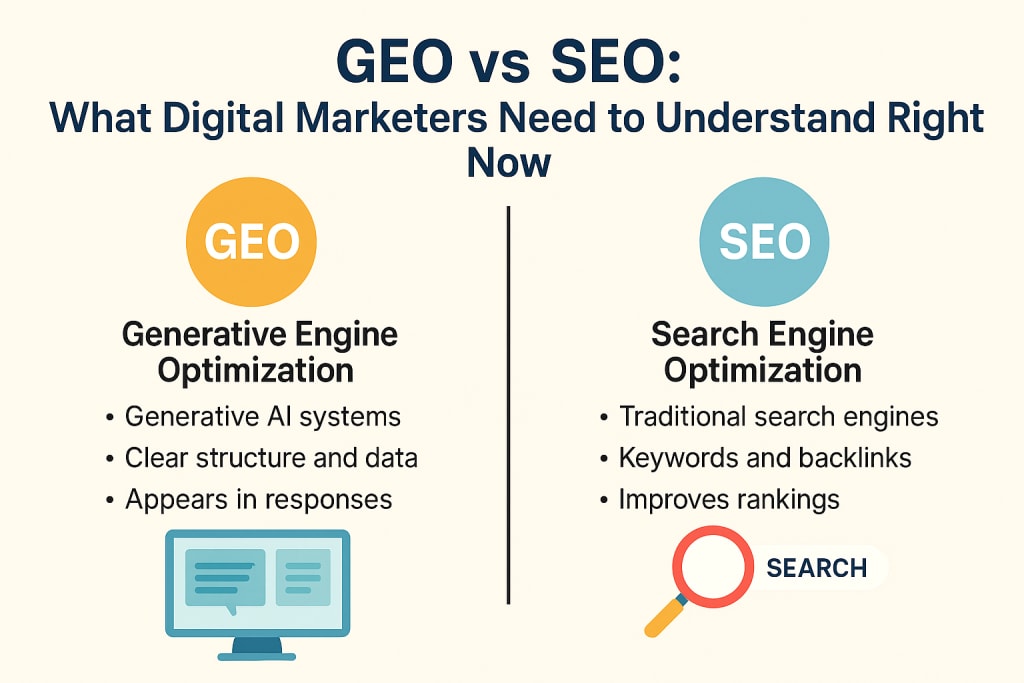
That moment taught me that SEO alone no longer explains the full story. GEO, a newer layer driven by the way answer engines form summaries, had begun shaping the first impression. It was not replacing search. It was guiding the start of it.
When GEO Feels Like the First Conversation
A strategist in Pune once told me she felt discouraged. Her long form content had always performed well, but lately she noticed users arriving through short summaries that appeared above her articles. She worried the summaries were pulling people away. I asked her to watch how users moved after reading those lines. What she saw surprised her. Many people clicked through anyway. They read the summary first to steady themselves, then visited the full page when they felt sure they were in the right place.
That small discovery changed her entire mindset. GEO was not stealing her visibility. It was easing the first step. It helped a user feel grounded before they chose where to go next. SEO carried the depth. GEO carried the opening note.
The two were never meant to compete. They were two halves of the same experience.
When Marketers Fight Yesterday’s Rules
I once worked with a client in Andheri who believed he had fallen behind in rankings because a competitor had more backlinks. He kept refreshing his dashboard, waiting for numbers to shift in his favor. When I asked what his users were actually searching, he frowned. He had not checked in months. He was optimizing for the phrases he liked, not the questions his audience was asking.
We sat together reading the raw queries. They were longer. Softer. Filled with the kind of uncertainty people rarely show in meetings but reveal easily on a search bar. He looked almost embarrassed. He said he had never imagined that his audience wanted comfort as much as information.
That is what GEO exposes. To write for the first answer, you must understand what the person feels in the moment they search. You cannot write from habit. You must write from empathy.
When Clarity Becomes the Only Real Strategy
I attended a workshop in Mumbai led by an editor who had been watching these shifts closely. She said something that stayed with me long after the session ended. She said that modern search rewards writers who speak plainly. Not poorly. Not superficially. Just plainly. She said engines collect pieces of text and compare them for reliability and that clear writing gives those systems something stable to hold.
Hearing her say it felt like a breath of air. People think search grew more complicated. In many ways it grew more honest. It asks for clarity because clarity helps readers and machines at the same time.
I noticed this during a project where we reviewed several pages that had lost visibility. The ones that kept ranking were the ones that placed the simple answer early and then unfolded a fuller explanation beneath it. Those pieces became easy for a machine to pull from and easy for a person to trust.
When Reputation Takes a Different Shape
Another shift I keep seeing is the importance of presence. Not loud presence. Consistent presence. Search systems tend to pull answers from sources that show stable authorship, updated facts, and a history of being cited by others. It is less about fame and more about continuity. A writer or brand that shows up reliably becomes a safer choice for a summary.
I worked with a founder who struggled with this. His content was strong, but he rarely updated it. He also avoided sharing author details because he preferred a faceless brand. Once he added a clear biography and started refreshing older pages, the summaries began using his content again. It was not magic. It was recognition. Machines prefer voices that behave like real people.
When the Job Becomes Listening Before Writing
The more I help marketers adjust to GEO and SEO together, the more I see the same pattern. They think they must rewrite everything. They think they must chase new tricks. But the only thing that really matters is understanding what people expect when they type their worries, fears, or hopes into that small box.
GEO reminds us to answer the immediate question. SEO reminds us to provide the deeper path. Both rely on listening. Both reward honesty. Both push us to write like humans again.
What I Learned After All These Conversations
When I think back to that junior marketer in Lower Parel, the one who felt she had lost her footing, I wish she could see how natural this shift really is. Search is becoming more conversational because people are. GEO offers a gentle handshake at the door. SEO guides the visitor through the rest of the house.
Marketers who understand this stop panicking. They stop fighting the changes. They focus on clarity, consistency, and the tone that makes a reader feel understood.
That is the real work now. Not chasing the algorithm. Not gaming the system. Just paying attention to what people truly ask for and shaping answers that help them breathe a little easier in a world that keeps moving faster each day.
About the Creator
John Doe
John Doe is a seasoned content strategist and writer with more than ten years shaping long-form articles.
Author’s Advice
If you would’ve asked me 20 years ago did I know I’d become a writer and an author, I would’ve said “nope, ain’t happening”. As fate would have it I did become an author and I can honestly say I’m loving it so far. It really does feel good to be a writer. I’ve learned a lot on this journey and I feel like with even me being as new to this world as I am, there’s some wisdom I need to share with every other aspiring author.
By Joe Patterson2 days ago in Journal




Comments (1)
While reading, it felt like I was sitting right there in that Lower Parel café…