
From 'Seth' to CEO: The Digital Crisis Facing Pakistan's Family Empires in 2026
The grandfather built the factory. The father maintained it. Now, the third generation must digitize it—or watch the legacy collapse.

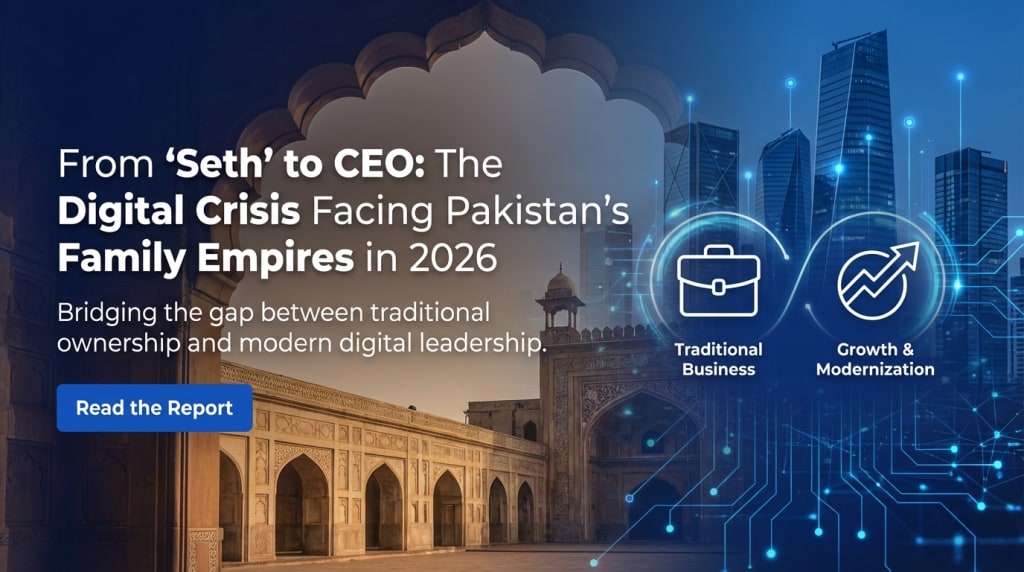
Drive through the industrial heartlands of Pakistan—from the smoke-filled lanes of Korangi in Karachi to the textile hubs of Faisalabad—and you will see the physical legacy of the "Seth Culture."
These massive factories, built in the 1970s and 80s, are the backbone of the economy. They were built on handshakes, landline phone calls, and fax machines. The "Seth" (the patriarch) sat in his office, and business came to him because he was the only supplier in town.
But in 2026, a quiet crisis is tearing these empires apart.
The "Seth" has passed the reins to the grandson. This third generation has returned from university in London or New York with a terrifying realization: The old handshakes don't work anymore.
Global buyers in the US and Europe don't visit factories. They don't call landlines. They search Google. They use AI procurement tools. And when they search for these massive Pakistani factories, they find… nothing.
No website. No digital footprint. No data.
This generational friction—between the "Old Ways" of manufacturing and the "New Ways" of digital discovery—is the defining business story of 2026.
The "Invisible" Giant Problem
I recently sat down with the director of a denim mill in Karachi. They export $20 million worth of goods annually. Yet, if you search for their company online, you find a broken WordPress site from 2014 and a Gmail address.
"My grandfather says we don't need a website because everyone knows us," the young director told me. "But the new procurement manager at Zara or H&M doesn't know us. They are 25 years old. If we aren't on their iPad, we don't exist."
This is the "Invisible Giant" phenomenon. Pakistan is full of massive companies that are digital ghosts.
In the past, this didn't matter. But today, with competitors in Bangladesh and Vietnam investing heavily in B2B Digital Marketing, Pakistani families are losing contracts they have held for decades.
The Shift: From "Brochure" to "Pipeline"
The smart family empires are waking up. They are realizing that Digital Transformation isn't about hiring a nephew to post on Facebook. It is about survival.
This shift has created a new demand for a specific type of partner. These families don't trust "Social Media Agencies" run by kids. They need Business Architects.
They need partners who understand that a B2B website isn't a brochure; it is a Lead Generation Pipeline.
Ali Abbass Memon, a strategist at Valkor Digital who specializes in industrial modernization, describes the shift:"The conversation has changed. Three years ago, factory owners asked me to 'make the logo bigger.' Today, they ask me how to integrate their inventory with Google Shopping so a buyer in Texas can see real-time stock."
This is no longer marketing; it is Digital Supply Chain Management.
The "Bridge" Strategy
For the third generation trying to modernize a 50-year-old company, the strategy is delicate. You cannot simply fire the old staff and replace them with AI. You have to build a bridge.
Successful modernization in 2026 usually follows a three-step path:
Digitize the Reputation: Ensuring that when a foreign buyer searches the company name, they see a "Corporate Entity"—LinkedIn verification, Crunchbase profiles, and high-authority press mentions. It’s about creating Trust.
Asset-Based SEO: Instead of blogging about "fashion trends," industrial giants are now ranking for their assets. They rank for terms like "100% Cotton GSM 200 Supplier" or "Sustainable Leather Certifications." This targets the specific technical queries of procurement officers.
The "Hidden" Tech: The most advanced families are moving to Headless Commerce. They are building private, login-only digital showrooms where international buyers can view 3D models of samples without flying to Karachi.
The Verdict: Adapt or Die
The romantic era of the "Seth" holding court in a smoke-filled office is over. The global economy is ruthless, fast, and entirely digital.
For Pakistan’s family empires, the choice in 2026 is stark. They can stubbornly cling to the fax machine and watch their market share bleed away to digital-first competitors. Or, they can empower the next generation to build a digital infrastructure that honors their legacy while securing their future.
The factories that survive the next decade won't just be the ones with the best machinery. They will be the ones with the best code.
About the Creator
Keep reading
More stories from Mahnoor Qureshi and writers in Journal and other communities.
The Export Imperative: A Business Owner’s Guide to Pakistan’s Digital Agency Landscape (2026)
If you are running a business in Pakistan right now, you understand the reality on the ground. The local market is saturated, and the Rupee remains volatile. In 2026, the only businesses with genuine security are those earning in Foreign Currency (USD, GBP, AED).
By Mahnoor Qureshiabout 22 hours ago in Journal
~ Fired ~
— Ai Intrusion ~ Are you Next ~ Is Ai Evolution after your job? — Few workplaces haven't been affected. Ai is in supermarkets, at doctors' offices, and even monitoring farms. I just can't think of anything this machine is not getting into, can you? For instance: Education ~ Law and Tech jobs will one day have a major influence or be taken over by these inanimate machines, with accuracy and vigor. From mechanics' diagnoses to a wide variety of everyday jobs, including fast food workers, with this input having the ability to cut their unnecessary work hours. I'm certain all of us have been touched by this with our short stories and colorful headings, have you? Even comments are very questionable 'Non-Robot' insertions.
By Jay Kantor2 days ago in Journal


Comments
There are no comments for this story
Be the first to respond and start the conversation.