
From RNA to Revenue: Why the Infectious Disease Molecular Diagnostics Market Is Heating Up
The infectious disease molecular diagnostics market is not just getting hot; it is going to help shape the future of medicine.

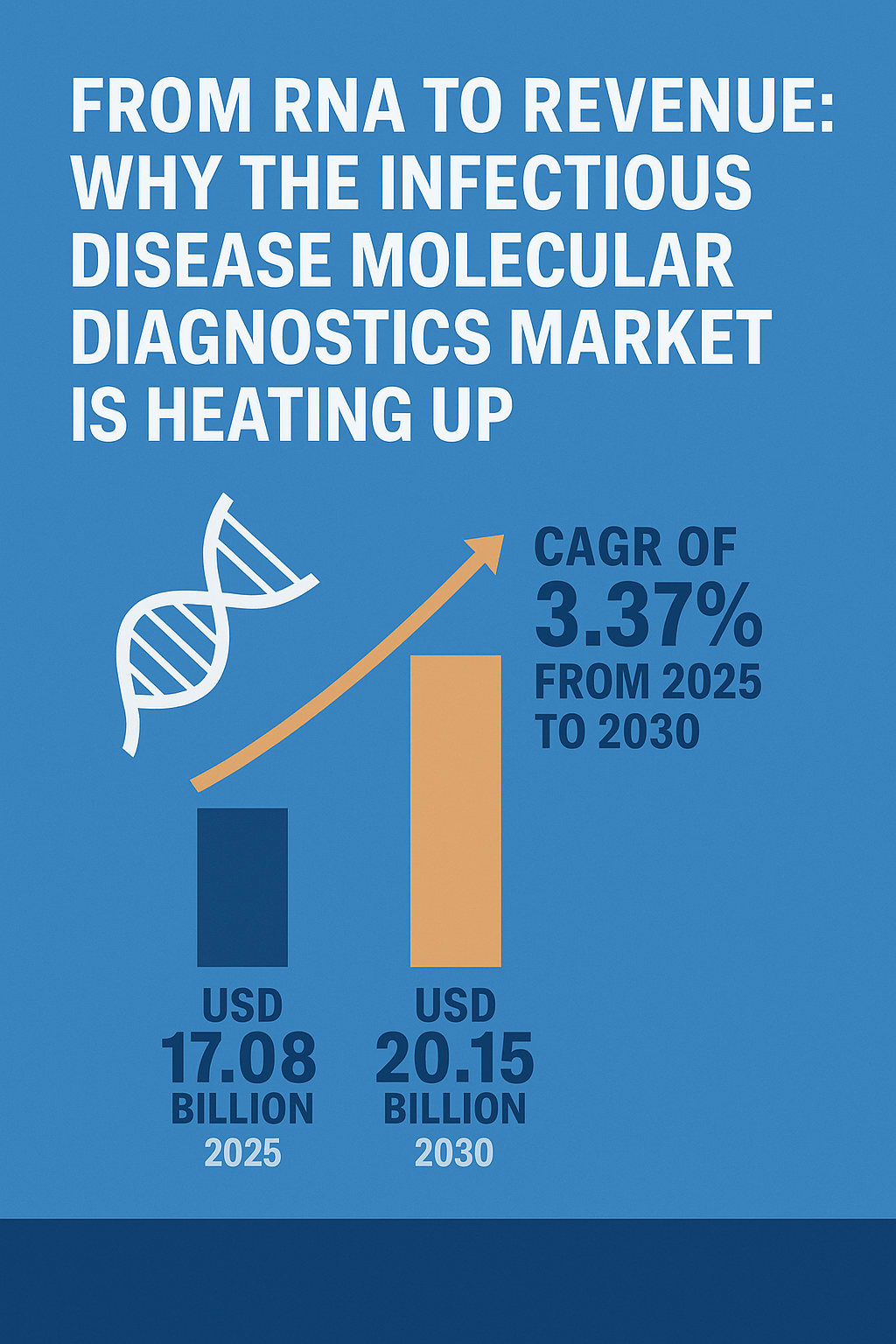
The world is in a new stage following the pandemic. Diagnostic tests that are rapid, sensitive, and safe, and which can detect a variety of infectious diseases have become a hot topic. Molecular Diagnostics, the kind of test that we used to see only in the diagnostic lab, and which is specialized and complex, is now reimagined to be a part of public health laboratories, point-of-care (POC) testing, and the commercial healthcare industry.
Infectious Disease Molecular Diagnostics Market is expected to be worth USD 20.15 billion by 2030, growing at a CAGR of 3.37%, driven by public and private investments in rapid pathogen identification, genomic surveillance, and future outbreak preparedness.
🧬 The Molecular Edge: Why RNA Is Here to Stay
Unlike antibody tests or antigen tests, molecular diagnostics test for the virus’s genetic material (RNA/DNA) or the genetic material of bacteria and other pathogens. Molecular tests are highly accurate because they are not susceptible to cross-reactivity with other diseases, so even in the early stages of infection, it is possible to obtain the correct results. The pandemic has shown how molecular testing, such as RT-PCR (Reverse Transcription Polymerase Chain Reaction), which was already available as a diagnostic method, has helped in early detection, confirmatory testing, genomic surveillance, and monitoring of recoveries.
COVID-19 is not the only infectious disease around us and will not be in the future:
• Tuberculosis: Rapid GeneXpert results almost as fast as they come out
• HIV and Hepatitis: Automated and real-time viral load monitoring
• Influenza, HPV, Dengue, Malaria: Multiplex panels to detect all at once
🚀 Market Drivers: What Is Heating Up the Industry?
1. Post-COVID Urgency & Pandemic Preparedness
It was recently discovered by governments and healthcare providers that lives can be saved if testing is provided as soon as possible. Building a scalable and high-throughput molecular platform has become a major part of many health departments’ strategies.
2. Emergence of POC Molecular Devices
The key to molecular testing in POC, pharmacies, airports, and even people’s homes is the introduction of small and simple molecular testing devices that anyone can use, such as Abbott’s ID NOW or Cepheid’s GeneXpert.
3. Rise of Infectious Disease Threats
AMR is on the rise, zoonotic diseases are emerging, and the movement of pathogens between communities and countries is spreading rapidly as a result of globalization. As a result, there is an urgent need for fast and precise diagnostic systems, which has spurred the global industry.
4. New Technologies
CRISPR-based diagnostics (SHERLOCK, DETECTR, etc.) are becoming more widely used, as are lab-on-a-chip microfluidics and AI-integrated platforms that can provide pathogen profiling.
Accuracy is no longer the only key selling point; molecular tests that can detect a single target or multiple targets are now available that can complete the test in less than an hour.
💡 From Labs to Commerce: Commercial Opportunities Expanding
For pharmaceutical, biotechnology, and medical technology companies, diagnostics is no longer just an add-on service or an extension of their research; it is also a separate vertical that generates revenue and has a lot of long-term potential.
Key Companies expanding in the field:
• Roche Diagnostics
• Abbott Laboratories
• BioMérieux
• Thermo Fisher Scientific
• Cepheid (Danaher Corporation)
They are all making major changes in infectious disease molecular diagnostics, such as launching multi-target panels, expanding molecular menus, and entering emerging markets with portable molecular systems.
🌍 Global Reach: Emerging Economies Driving Demand
Emerging and developing markets, where testing was slow, cumbersome, and prone to error in the past, will benefit from molecular platforms in the fight against the huge burden of TB, malaria, and HIV, among other infectious diseases. Molecular diagnostic infrastructure is also being invested in by governments and NGOs in LMICs as part of public health system strengthening.
🔐 Challenges to Keep in Mind
Despite the current market growth, there are still some barriers to market adoption:
• Molecular devices and reagents are more expensive
• Lack of trained personnel in rural and underdeveloped areas
• Regulatory hurdles for new technologies and kits
These are all being used to inspire innovation in diagnostics, such as automated, cloud-connected, and AI-augmented molecular tests, which are also less dependent on hands-on labor.
📊 The Future in Focus: Expectations by 2030
Molecular diagnostics is becoming faster, more affordable, and more decentralized, making it easier to predict where the infectious disease market will be in the future. We may see:
• Multiplex and syndromic panels become more common
• Diagnostic tests are being combined with telemedicine platforms
• Cloud-based real-time epidemiological monitoring
• Diagnostic subscriptions becoming more common
Conclusion: RNA Is the New ROI
Molecular testing has become central to everything from pandemic containment to everyday disease screening and diagnostics as a key component of global health resilience. It has transitioned from the laboratory to the point-of-care, with more accessible, faster, and less complicated ways to test a variety of diseases with a single system.
In summary, a few more important points:
Molecular diagnostics are no longer just a part of the research; they are now a large part of the healthcare market, with the dual benefit of both clinical and commercial impact.
The line between diagnostics and digital health is blurring.
Expect to see more molecular innovation that helps us prepare for and fight against infectious diseases, but also in applications that are not in infectious diseases.
Get Sample Brochure at https://www.theresearchinsights.com/request_sample?id=157
About the Creator
Silvie Karson
Passionate storyteller exploring the world of trends. With a background in digital marketing, I craft compelling narratives that inform and inspire. Whether diving into deep-dive features, growth analysis, or trend analysis.
Keep reading
More stories from Silvie Karson and writers in Journal and other communities.
Exploring Innovations in the Healthcare Cloud Computing Market
The global shift toward digital healthcare has made cloud computing a core technology for smarter, faster, and more connected care. Innovations in the healthcare cloud computing market are leading the way in enabling everything from improved electronic health records (EHRs) to AI-driven diagnostics and telemedicine.
By Silvie Karson7 months ago in Journal
The goals I did not achieve
Every writing goal I made for the year is a wash. It has been this way for a while, but I think it's important to be open about my failures and the reality of how life can get in the way. This is especially true considering the several times I have posted on Vocal about my writing goals, how I was changing my approach, and where I was hoping to be for the upcoming year. I will probably do that again in a couple months, but for now, it is time to acknowledge where I am today.
By Kay Husnick23 days ago in Journal
Ludacris and Nelly draw backlash over bookings at MAGA-coded music festival
Ludacris and Nelly headlining a mostly right-wing event is good for them. It’s also great for the genre of hip hop. The two rap veterans have showcased their talents on other stages. Why can’t they perform for mostly MAGA folks and grab that bag?
By Skyler Saunders3 days ago in Beat


Comments
There are no comments for this story
Be the first to respond and start the conversation.