
From QA to Production: Why Apps Slow Down
An inside look at how test environments differ from real user behavior—and why production exposes the true weight apps bear over time.

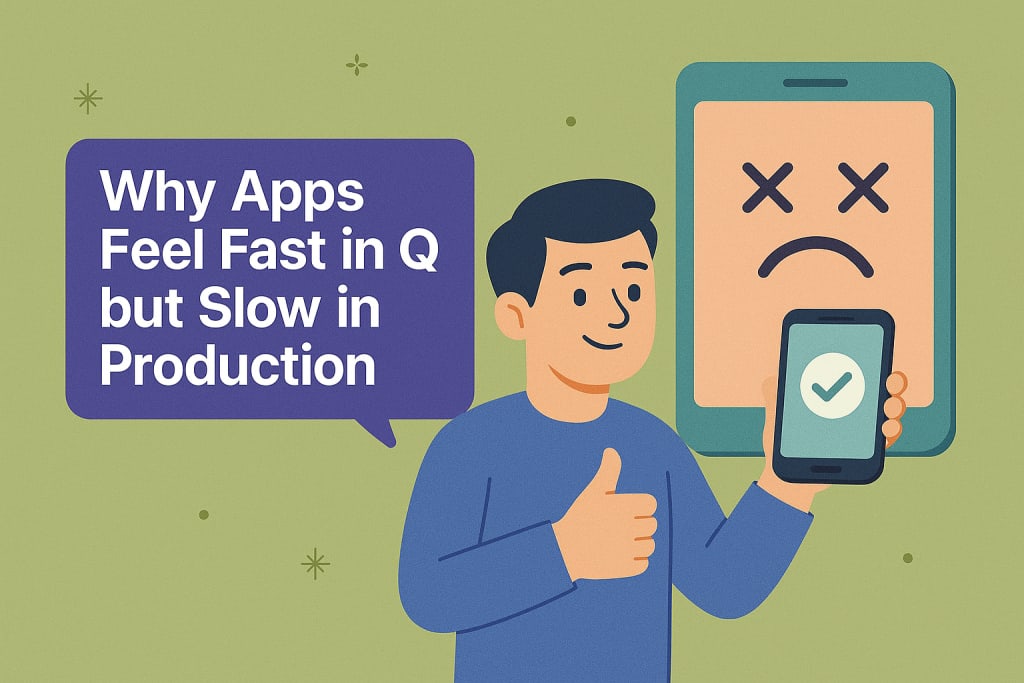
The first time I felt the disconnect, I was standing in a quiet QA room late in the afternoon, surrounded by neatly arranged test devices glowing on a long table. Every phone was plugged in. Every screen was clean. A tester tapped through the app with calm confidence while an engineer watched from behind, arms crossed, visibly relieved.
“See,” he said softly. “It’s smooth.”
The app opened quickly. Screens responded instantly. Animations flowed without hesitation. This was an app shaped during fast delivery cycles tied to mobile app development Atlanta, tested carefully, signed off confidently, and ready to ship. Nothing about that room suggested trouble.
Then production told a different story.
When QA Feels Like a Perfect World
QA environments are quiet places. Devices are new or freshly reset. Accounts are clean. Networks are stable. Background apps are minimal. Data sets are small and predictable. Testers follow defined paths with intention and clarity.
In that world, the app behaves exactly as it was designed to behave. Startup is crisp. Navigation feels light. Memory usage stays polite. Everything agrees with everything else.
I have watched teams celebrate these moments. I have watched release candidates get approved with genuine confidence. And I understand why. QA shows you the app you think you built.
But production never promises to be that kind.
When Production Carries History
That same evening, I sat at home with my laptop open, pulling traces from real users. The screens were familiar, but the behavior was not. Startup took longer. Lists hesitated while loading. Taps sometimes felt delayed, not broken, just heavier.
- The sessions were long.
- The accounts were old.
- The devices were tired.
Users carried years of cached data. Feature flags evaluated in combinations no one tested. Background tasks overlapped with foreground actions. Networks dipped mid-request. Memory filled slowly instead of resetting between sessions.
This was not a different app.
It was the same app under the weight of reality.
Where the Illusion Begins
The next morning, I sat with the team and projected two timelines side by side. QA sessions on one side. Production sessions on the other. The contrast was uncomfortable. QA flows were short and clean. Production flows were dense and tangled.
A product manager leaned forward, brow furrowed.
“How can it be fast there and slow here?”
I waited a moment before answering.
“Because QA tests the app you built,” I said.
“Production shows you the app people live with.”
That sentence changed the room.
When Real Users Break Assumptions
In QA, assumptions hold. Screens load in order. Data arrives on time. States reset cleanly. In production, assumptions crack quietly. Users background the app mid-flow. They switch networks without warning. They stack actions faster than expected.
One user might open the app once a day. Another might open it fifty times. One might clear data often. Another might never restart the device. QA cannot simulate that diversity fully, no matter how careful the process.
The app feels slow not because it suddenly became inefficient.
It feels slow because it is carrying more than it practiced carrying.
When Data Volume Changes the Pace
I pointed to a production trace where a list took noticeably longer to render. In QA, the same list loaded instantly. The difference was not code. It was data.
Production accounts held years of history. Items accumulated. Edge cases layered quietly. Sorting and filtering logic ran against volumes QA never touched.
The engineer stared at the graph.
“We never tested with this much data,” he admitted.
Most teams do not. Not because they ignore it, but because it grows invisibly. Data does not announce when it becomes heavy. It simply starts to slow things down.
When Background Work Competes for Attention
Another trace showed a spike during startup. In QA, startup was clean. In production, background tasks woke at the same time. Sync jobs. Analytics batching. Deferred uploads. None of them were wrong. All of them were real.
In QA, those jobs rarely overlapped. In production, they often collided.
The app did not freeze.
It negotiated.
Negotiation takes time. Users feel that time as hesitation.
When Devices Behave Differently Outside the Lab
QA devices are often well cared for. Production devices are not. Storage fills up. Batteries degrade. Thermal limits kick in sooner. System schedulers behave defensively.
I showed the team a trace from an older device. CPU frequency dipped during a simple transition. The app waited, politely, until resources returned.
The engineer shook his head.
“It doesn’t do that on our test phones.”
“No,” I said. “Those phones are rested.”
When QA Confidence Turns Into Production Confusion
None of this meant QA failed. QA did exactly what it was meant to do. It verified correctness under controlled conditions. It caught obvious regressions. It ensured features worked as designed.
The problem was expectation. Teams expected QA smoothness to translate directly to production. But production is not a mirror. It is a pressure test.
Apps do not slow down because QA missed something obvious.
They slow down because production introduces variables no checklist can fully capture.
When Observing Production Changes the Conversation
Once the team started watching real sessions instead of averages, everything shifted. They stopped asking why QA missed the issue and started asking what production was teaching them.
They noticed patterns. Slowness after long sessions. Hesitation after repeated navigation. Delays tied to background sync. None of these appeared in short QA runs.
One engineer leaned back and said quietly,
“It’s not slow all the time. It’s slow after living for a while.”
That insight mattered.
When Fixes Become Grounded in Reality
The changes that followed were not dramatic. They moved nonessential work out of startup. They trimmed background tasks during active use. They tested with real data snapshots. They ran longer sessions in QA without resets.
Nothing flashy happened.
The app simply felt calmer in production.
Users did not send thank-you notes. They rarely do. But reviews stopped mentioning slowness. Support tickets quieted. Retention stabilized.
Quiet Ending Between Two Worlds
I returned to the QA room weeks later. The devices still sat neatly on the table. The app still felt fast. But now the team understood what that speed meant and what it did not.
QA shows you potential.
Production shows you truth.
When teams learn to respect both, the gap between them narrows. Not because QA becomes perfect, but because expectations become honest.
Apps feel fast in QA because QA is a place of clean starts and short lives. Apps feel slow in production because production is where they grow old, gather weight, and prove whether they were built to endure real use.
Once you accept that difference, performance stops feeling mysterious.
It starts feeling human.
About the Creator
Ash Smith
Ash Smith writes about tech, emerging technologies, AI, and work life. He creates clear, trustworthy stories for clients in Seattle, Indianapolis, Portland, San Diego, Tampa, Austin, Los Angeles, and Charlotte.
Review of 'Man on the Run'
My wife and I saw Man on the Run, a nearly 2-hour documentary on Amazon Prime, about Wings, Paul McCartney's group that flew around the world from shortly after The Beatles broke up in early 1970 to shortly after John Lennon was murdered at the end of 1980, making a Beatles reunion forever impossible.
By Paul Levinson2 days ago in Beat




Comments
There are no comments for this story
Be the first to respond and start the conversation.