


I was dealing with a client some years ago who was intelligent, talented, successful, and well-educated. (Let's name her "Ashley" for now.) She was the kind of person who should have had lots of chances. Ashley, on the other hand, was having a difficult time finding work. During our job counseling sessions, it became evident that she was dealing with personal issues as well. "What's going on here?" I wondered.
I acquired insight into Ashley's cognitive processes by continually listening closely to her remarks. Naturally, Ashley's feelings and behaviors were influenced by her ideas, as well as how she responded to people and events and made decisions. Ashley's thought patterns were evident to me after I "tuned into" them. Her "self-talk" was to blame.
We're all guilty of it. We go about our daily lives, performing our jobs and living with an unending "tape" playing in our thoughts. It's a habit so established that most of the time we don't even notice the "noise." But the "tapes" are there, and they control our life — for better or for worse!
Ashley's "self-talk" was really quite negative and self-defeating. It limited her choices and kept her "trapped." I understood that until we addressed this problem, I would be unable to assist Ashley in furthering her career. She wasn't held back by a shaky CV or a difficult employment market. Ashley's "internal script" of negative self-talk was, in fact, impeding her growth.
I had a serious discussion with Ashley about this, and I offered my ideas. "Well, I suppose I'll simply have to 'Flip my Script' in order to build the kind of profession and life I actually want!" she replied after a minute of thought. "Exactly!" I answered, smiling and nodding. I also said that when a person is at a professional crossroads, it is critical to reveal one's anxieties or concerns, write them down, recognize them, and then "Flip the Script."
Of course, the "Flip the Script" method has limitations. It is particularly useful when dealing with practical, logistical, or intellectual problems. Other types of techniques and therapies should be pursued when there is a deeper psychological issue or a mental health risk.
Ashley inquired about how to "Flip the Script." So I told her to get a piece of paper and draw a vertical line down the middle of it. "On the left side, transcribe as many of your internal 'tapes' as you can." Write down the exact phrases that pass through your mind all day regarding job, family, personal life, money, and everything else!" Ashley started doing this, and I urged her to stop after approximately 10 minutes. "Now, on the right side of the paper, write down the inverse of everything you see on the left." Ashley continued for approximately ten minutes longer, and I must tell that she found this portion of the workout difficult! Because our coaching session had ended at that time, I told Ashley to keep working on the task until our next meeting.
Ashley came to my office the next week with a large, dazzling grin on her face. She took out a bunch of paper clips and gave it to me. What I saw "blew me away!" Ashley had worked extremely hard on this exercise all week, typing out almost ten pages of "Flip the Script" material. She had rendered each page's left side black and the right side blue. Ashley and I went through the whole page and made some key changes to her "blue" content. When we were done, I looked her in the eyes and said, "This is the screenplay for your new life." If you absorb and thoroughly integrate it, you will build a new and better life for yourself - both professionally and emotionally. But it will not be simple. "Are you game?" Ashley shouted, "Absolutely!" without skipping a beat.
At this point, it would be good to "Flip the Script" and show you what it truly looks like. Here are some random instances of the "old script" (in bold) against the "new script." They were acquired from a variety of customers, and their names have been removed to protect their identities:
I am concerned that I lack the personality and talents necessary to thrive in the workplace for the long run. I'm taking proactive efforts to recognize my limitations and provide myself with the skills I need to succeed in the long run. If I want to and have to, I can learn anything. I've gone through tough times before and always come out stronger on the other side.
I'm scared I'll never have the confidence to take on a job that will extend and push me. I am confident in my ability to take on new tasks. I've done it before and I'm certain I can do it again. I'm gaining confidence by building on my triumphs and taking modest moves outside of my comfort zone.
I'm frightened of failing and feeling embarrassed in front of my coworkers. I love failure – particularly when it allows me to learn – since all successful individuals fail many times before they actually achieve. It makes no difference what my coworkers think. I can only succeed if I put myself in a position to fail.
I'm frightened of becoming jobless and losing the respect of my family and coworkers. Unemployment is an aspect of life that impacts almost everyone at some time. I am optimistic and aggressive in developing an action plan to prepare for those life seasons. My family accepts me for who I am, not for what I do.
When dealing with an opinionated or strong-willed employee, I don't feel comfortable being firm as the boss. For a reason, I was trusted enough to be granted a position of power. I am forceful when dealing with a tough coworker. It's not a personal matter; it's business. Other workers are not better than I am, therefore they should not frighten me.
I am very concerned with what people think of me. Rather than the perceived judgments of others, I concentrate on the goals and tasks that the organization has assigned to me.
I am afraid of change. I like change! As a person, I evolve, learn new things, go on new experiences, and feel more alive. In my work, change is a chance for innovation and advancement.
I'm easily taken advantage of. I understand when I need to modify my stance and when I need to hold firm. I am dedicated to my principles. I surround myself with mentors and coworkers who will back me up when I need it.
I may "live in my head" and seem detached. I am watchful, attentive, and aware of my surroundings. I am aware of people and engage with them in suitable and constructive ways. This benefits both my department and my organization.
I'm not very adept at "breaking the ice" or making "small conversation." I am really good at starting discussions and participating in fruitful discourse with others. My ability to do so benefits both my career and my employer.
I'm not at ease wielding power over people. I earned this position, thus I am uniquely suited to fill it. I am at ease in command and contributing to the success of my team members. It is my responsibility as a leader to bring out the best in people; utilizing my power is a way to that aim.
I'm not always sure how to get things done at work. I surround myself with people who have abilities that compliment mine. At work, I'm taking more measures to begin and plan things, as well as collecting opinions on how to think through the logistics.
I sometimes overcommit myself and don't complete all of my tasks on time. I am quite good at allocating my time, energy, and resources. I'm quite clear about what I say "yes" to and what I say "no" to. When required, I am not afraid to say "no" or delegate work.
I'm scared that no matter what job I accept, I'll be let down. The larger letdown is failing to shoot high enough at vital junctures. I can learn from my mistakes and do better the next time.
My expectations are sometimes unreasonable because I strive too high. I can never aim high enough since I'm continuously pushing myself to go beyond. I don't want to think of myself as "coasting." If I don't set my sights high, I'll find myself underused and unsatisfied at work.
Deep down, I don't feel I deserve success and contentment. Who else deserves success and satisfaction if not me? I am an intelligent, dedicated worker, and excellent team player. I'm looking forward to becoming a part of something greater than myself that will be really rewarding.
I'm worried that if I make a mistake in my profession, I won't be able to recover. I can recover from a mistake and should not act in fear. Making errors is natural and human; it is how I learn and evolve.
I'm concerned that if I find a fantastic job, it won't last. I work for myself regardless of the firm I work for or the position I have. Trying to make any work endure "forever" is not a good way to think about the future. I will build a solid network, develop it, and constantly be on the lookout for the next opportunity that meets my objectives.
I don't always believe in myself. I make things happen for myself in the great scheme of things. Only I am competent to advance my professional goals. To manage the shifting corporate world, I will rely on my acute intuition.
I am extremely ambitious, which might create issues in my profession. I'm honest about what I can and should accomplish. I am slowly advancing my career in a planned, strategic approach.
I am impulsive and respond too hastily. I take my time to consider things before responding calmly, wisely, and deliberately. This earns my coworkers' respect and appreciation.
The last component of this activity is probably obvious. I advised Ashley that in order to meet her objectives, she needed to memorize the whole right-side column of her page in order to keep the new information fresh in her memory and "on the tip of her tongue." She would have to be careful about how she thought and what she said from then on. Ashley realized it would require discipline and commitment to "catch herself" each time she reverted to old habits and replace them with the possibilities in her new "script."
Ashley accepted the challenge and worked hard to be mindful and intentional in her thoughts and speech. Ashley's career began to flourish after just a few weeks. Her job hunt gained pace, and her interviews went much better. Ashley eventually accepted an intriguing chance in another location and migrated with her family after getting multiple employment offers. She's been in that position for a few years and says "it's doing wonderfully!"
Ashley's situation may have been more dramatic or emotional than others, but I think we might all benefit from some "Script Flipping." I advocate paying greater attention to the "tapes" that are playing in your brain and updating them to be more adaptable, healthy, and productive. This practice, like Ashley's, might result in enormous changes for you - not only in your job search and career management, but possibly in every aspect of your life!
About the Creator
Rahau Mihai
Hi! Come to my profile and you will see really useful things or something to relax you !
Keep reading
More stories from Rahau Mihai and writers in Journal and other communities.
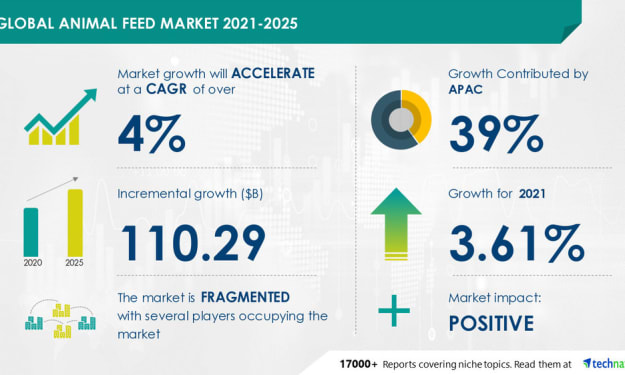
Animal Nutrition Market Trend, Outlook 2025
Animal nutrition is concerned with the nutritional requirements of animals, primarily those in food production and agriculture, but also in aquariums, zoos, and wildlife management. Animal nutrition is critical for agricultural animal production and health. Various organizations and initiatives, such as the National Animal Nutrition Program (NANP), provide as a conduit for identifying high-priority animal nutrition issues. These organizations provide a holistic and integrated strategy to assembling, collecting, sharing, synthesizing, and disseminating science-based knowledge and instructional materials on animal nutrition in order to boost high-priority research across agricultural species. Several nations are putting in place mechanisms that redefine the responsibilities of business and government in providing safe animal feed. The FAO/WHO Codex Alimentarius Commission established a Good Animal Feeding Code of Practice in 2004. The handbook provides thorough and up-to-date information as well as practical advice to assist producers and stakeholders in understanding the production and distribution chain in order to comply with the legal framework.
By Rahau Mihai4 years ago in Journal
Digital Product Passports: What Businesses Need to Do Now
Key Takeaways Digital Product Passports signal a shift toward supply chain transparency. Businesses that wait for enforcement deadlines risk rushed system upgrades and costly operational disruption. Preparing now means mapping data, strengthening supplier accountability, and running pilot programs. Companies that treat DPPs as a strategic advantage can build trust and gain a competitive edge.
By Aaron Smithabout 18 hours ago in Journal



Comments
There are no comments for this story
Be the first to respond and start the conversation.