
Farming Gets Smart: Precision Harvesting Market Grows with AgriTech Advancements
As AgriTech advances, precision harvesting will be a key component of sustainable food systems that will ensure that we feed the world sustainably.

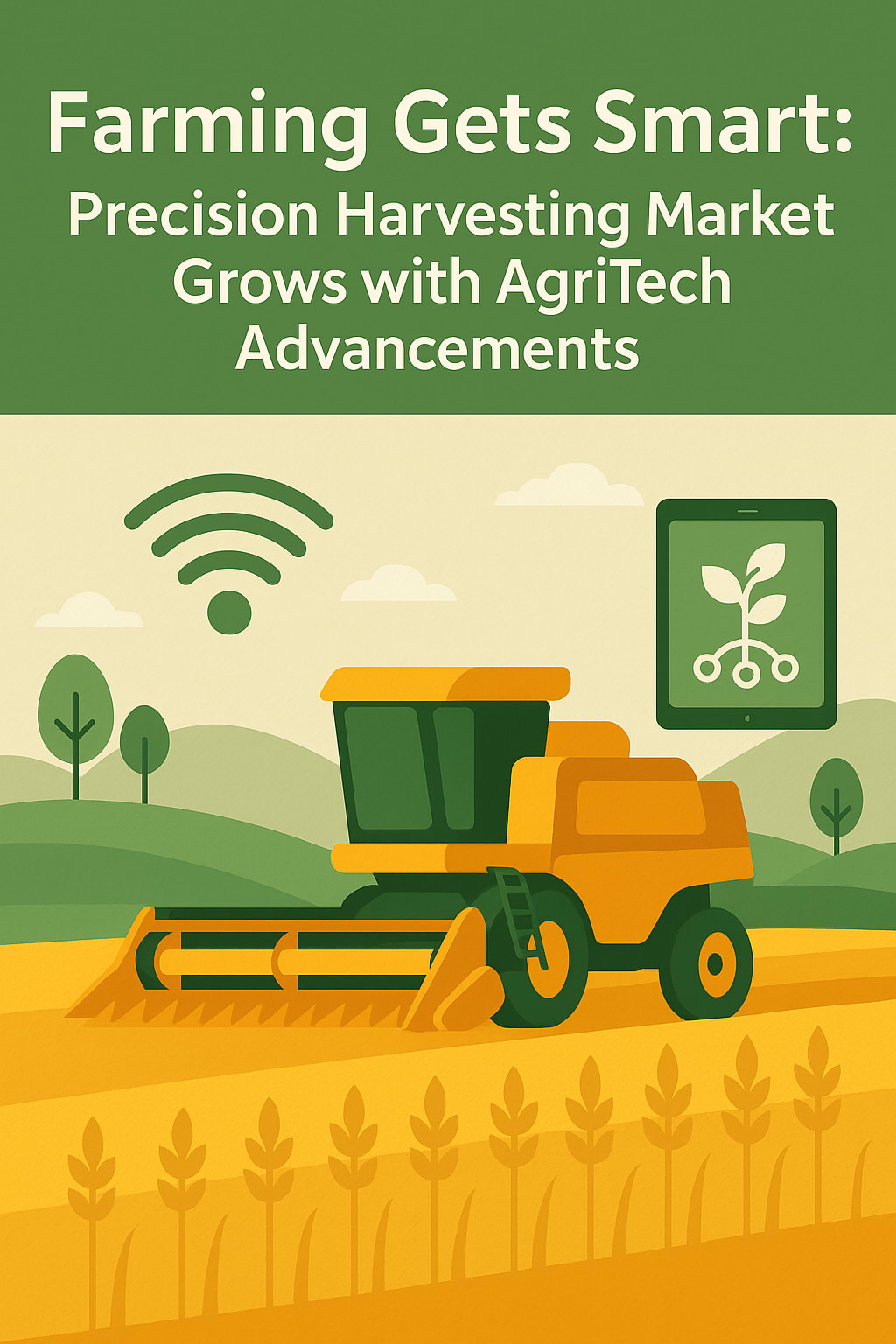
Agriculture is on the cusp of an evolution. A transition from centuries-old practices to one powered by technology. As population and global food demands rise, and arable land dwindles, agriculture needs a better solution to maximize yields and minimize waste. Enter precision harvesting, a relatively nascent frontier in AgriTech, where farm equipment, sensors, data, and AI meet to transform how we harvest crops.
Driven by the need for efficient, sustainable, and data-driven agriculture, the precision harvesting market is poised for growth. And as we’ll see, not only is precision harvesting making farming smarter — it’s changing the way we produce food.
What is Precision Harvesting?
Simply put, precision harvesting refers to harvesting crops at the right time with minimum losses and maximum efficiency. It involves GPS-guided harvesters, machine vision systems, drones, LiDAR, yield monitors, and analytics to identify optimal harvest time, monitor crop health, and automate harvest processes.
Instead of relying on guesswork, precision harvesting enables farmers to make informed decisions backed by data. As a result, it decreases labor dependence, fuel consumption, and wastage, while increasing yield and profitability.
Why Is the Precision Harvesting Market Growing?
The global precision harvesting market is valued at USD 20.09 billion in 2025 and is expected to grow to USD 27.41 billion by 2030, at a CAGR of over 6.4%. Here are some key factors driving this growth:
Get Sample Analysis FREE at https://www.theresearchinsights.com/request_sample?id=1150
Labor Shortages: As rural populations decrease and farm labor supply dwindles, automation tools like robotic harvesters and self-driving combines fill the void.
Cost Pressures: As input costs (seeds, fertilizers, fuel) increase, farmers are investing in technologies that maximize efficiency and minimize waste.
Environmental Sustainability: Precision harvesting helps minimize over-harvesting, reduces soil degradation, and promotes sustainable farming practices.
Government Initiatives: Several governments are offering subsidies and incentives for smart farming to boost food security and protect the environment.
Technology is in the Driver’s Seat
Modern precision harvesting technologies involve:
GPS & GNSS Guidance: Guidance and self-driving capabilities allow autonomous harvesters to navigate fields accurately and cover every inch.
IoT Sensors & Cameras: Identify crop maturity, monitor moisture levels, and monitor yield in real-time.
Robotic Harvesters: Ideal for fruits and vegetables, robotic harvesters identify, pick, and sort produce with careful precision.
Drones & Aerial Imaging: Get a bird’s eye view of crop health and plan harvests with a wider perspective.
The top companies in the space include John Deere, CNH Industrial, AGCO Corporation, Kubota, and Trimble, among others. They are providing state-of-the-art harvesting platforms powered by AI, cloud data, and telematics.
Applications Across Crops
Precision harvesting has been around for some time in large-scale cereal and grain farming through combine harvesters. However, high-value specialty crops like strawberries, grapes, apples, and tomatoes are now being targeted by precision harvesting. These high-value crops require a lot of manual labor, making them ideal for robotic and vision-based solutions.
For instance, robotic strawberry pickers identify ripeness with image recognition and employ gentle gripping mechanisms to avoid crushing, traditionally a labor-intensive process. This innovation improves consistency, reduces harvesting time, and extends shelf life.
Roadblocks and Challenges
Although precision harvesting is a promising technology, here are some challenges that farmers and vendors face:
High Capital Costs: The initial investment required to procure precision equipment is beyond the reach of small and medium-sized farmers.
Data Complexity: Managing and processing large volumes of field data is complicated and requires training and reliable digital infrastructure.
Digital Divide: Developing countries might lack access to the technology, financing, and connectivity.
Precision-as-a-Service, cooperative ownership, and mobile-based solutions are helping close the digital divide and democratize access to smart farming technologies.
Conclusion
Precision harvesting is not an evolution of existing farming practices, it’s a revolution. With a mix of new technologies and age-old farming wisdom, farmers can make better decisions, reduce resource use, and increase yield.
About the Creator
Paxton Templeton
I’m a storyteller at heart with a passion for turning data into compelling narratives. With a focus on industry trends, market insights, and growth statistics, I bring clarity to complexity
Keep reading
More stories from Paxton Templeton and writers in Journal and other communities.
Precision Under Pressure: Perforating Gun Market Powers Modern Oilfield Efficiency
The world’s demand for energy is increasing rapidly. That means oil and gas producers must continually innovate to produce more, reduce costs, and operate more precisely than ever before. At the center of that effort is one of the most crucial but least talked about tools: the perforating gun. This is the device that helps create precise entry points in well casings and rock formations so that operators can tap into reservoirs, increase production, and reduce downtime.
By Paxton Templeton9 months ago in Journal
How to Start a Private Practice That Feels Fulfilling, Not Just Financially Rewarding
Clarifying Your Deeper Motivation A private practice that endures is rarely built on revenue projections alone. It is constructed upon conviction. Before registering a business name or signing a lease, it is essential to interrogate the internal impetus behind the decision. Is autonomy the primary driver? A desire for creative latitude? A longing to serve a specific population underserved by institutional systems? Clarity at this stage functions as a compass. Without it, the enterprise risks drifting toward opportunistic but misaligned opportunities. With it, each strategic choice—branding, pricing, partnerships—acquires coherence. Practitioners who articulate a personal mission statement often report greater resilience during inevitable periods of uncertainty. Purpose tempers volatility. It transforms obstacles into navigable terrain rather than existential threats. Fulfillment originates not from scale, but from congruence. The more harmoniously the practice reflects personal ethics and professional passions, the more intrinsically rewarding the work becomes.
By Fida Hassain5 days ago in Journal




Comments
There are no comments for this story
Be the first to respond and start the conversation.