
Eyeing China, Biden and allies unveil nuclear-powered submarine plan for Australia
President Joe Biden and his allies announced
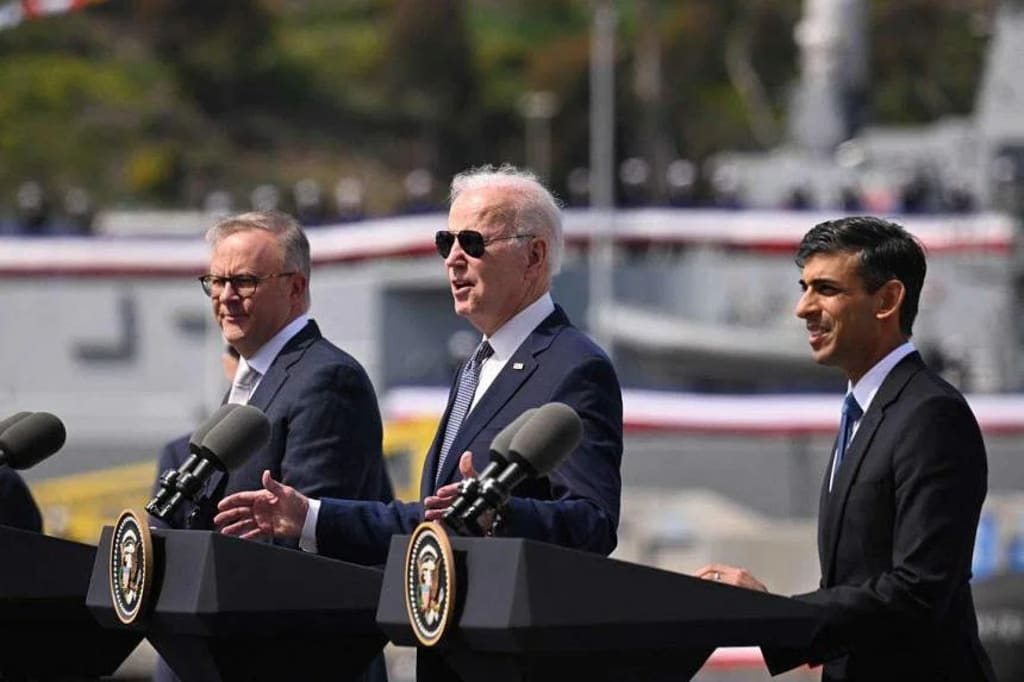
In September 2021, President Joe Biden and his allies announced a plan to provide Australia with nuclear-powered submarines as part of the trilateral partnership known as AUKUS. This move is a significant shift in Australia's defense strategy and a clear message to China that the United States and its allies will not tolerate China's military expansion in the region. The decision has been met with mixed reactions, with China condemning it as highly irresponsible and experts raising concerns about potential environmental risks and operational challenges. However, the move has been welcomed by many in Australia and its allies as a critical step in Australia's defense strategy and a signal of the United States' commitment to the region and its allies.
The new initiative is part of the trilateral partnership between the United States, Australia, and the United Kingdom, known as AUKUS. The three countries have pledged to work together on a range of security issues, including cyber security, artificial intelligence, and the development of advanced military technologies. The nuclear-powered submarines are just one part of this broader effort to deepen the security ties between the three countries.
The move towards nuclear-powered submarines is a significant step forward for Australia's defense capabilities. Diesel-powered submarines are much quieter than their nuclear-powered counterparts, making them more difficult to detect. However, they also have shorter ranges and must regularly surface to recharge their batteries. Nuclear-powered submarines, on the other hand, can remain underwater for months at a time and have virtually unlimited range. They are also faster and more maneuverable than diesel-powered submarines.
The decision to provide Australia with nuclear-powered submarines is also significant because it sends a clear message to China. The Chinese government has been investing heavily in its military in recent years, including expanding its navy and developing advanced weapons systems. The United States and its allies view China's military expansion as a threat to regional security and stability. By providing Australia with nuclear-powered submarines, the United States and its allies are sending a message that they will not stand by and allow China to dominate the region.
The announcement has been met with mixed reactions. China has condemned the move, calling it a "highly irresponsible" act that could destabilize the region. Some experts have also raised concerns about the potential environmental risks of nuclear-powered submarines, as well as the challenges involved in maintaining and operating them.
However, the move has also been welcomed by many in Australia and its allies. The Australian government has welcomed the increased security cooperation with the United States and the United Kingdom, calling it a "critical step in Australia's defense strategy." The move has also been seen as a signal of the United States' commitment to the region and its allies.
The decision to provide Australia with nuclear-powered submarines is significant for several reasons. First, it marks a significant shift in Australia's defense strategy, which has traditionally relied on diesel-powered submarines. Nuclear-powered submarines offer several advantages over diesel-powered submarines, including longer range, greater speed and maneuverability, and the ability to remain underwater for extended periods. This gives Australia greater flexibility and range in its defense capabilities.
Second, the move towards nuclear-powered submarines sends a clear message to China that the United States and its allies will not stand by and allow China to dominate the region. China has been investing heavily in its military in recent years, including expanding its navy and developing advanced weapons systems. The United States and its allies view China's military expansion as a threat to regional security and stability. By providing Australia with nuclear-powered submarines, the United States and its allies are sending a message that they are committed to countering China's military expansion in the region.
Third, the announcement is significant because it reflects the United States' pivot towards Asia and its commitment to its allies in the region. The United States has been shifting its foreign policy focus towards Asia in recent years, recognizing the region's growing economic and strategic importance. This move towards nuclear-powered submarines is part of a broader effort to deepen the security ties between the United States, Australia, and the United Kingdom, and to demonstrate the United States' commitment to its allies in the region.
Finally, the announcement has been met with mixed reactions. China has condemned the move, calling it a "highly irresponsible" act that could destabilize the region. Some experts have raised concerns about the potential environmental risks of nuclear-powered submarines, as well as the challenges involved in maintaining and operating them. However, the move has also been welcomed by many in Australia and its allies, who see it as a critical step in Australia
In conclusion, the decision to provide Australia with nuclear-powered submarines is a significant move in the ongoing efforts to counter China's military expansion in the region. It is also a reflection of the United States' pivot towards Asia and its commitment to its allies in the region. While there are risks and challenges associated with nuclear-powered submarines, many experts believe that the benefits of increased security cooperation outweigh the potential drawbacks. The success of this initiative will depend on continued cooperation and coordination between the United States, Australia, and the United Kingdom, as well as the ability of these countries to effectively address the strategic challenges posed by China's military expansion.
About the Creator
Author’s Advice
If you would’ve asked me 20 years ago did I know I’d become a writer and an author, I would’ve said “nope, ain’t happening”. As fate would have it I did become an author and I can honestly say I’m loving it so far. It really does feel good to be a writer. I’ve learned a lot on this journey and I feel like with even me being as new to this world as I am, there’s some wisdom I need to share with every other aspiring author.
By Joe Patterson5 days ago in Journal




Comments