
Effective conflict managment strategies for successful team
Conflict resolving strategies for managment and employees

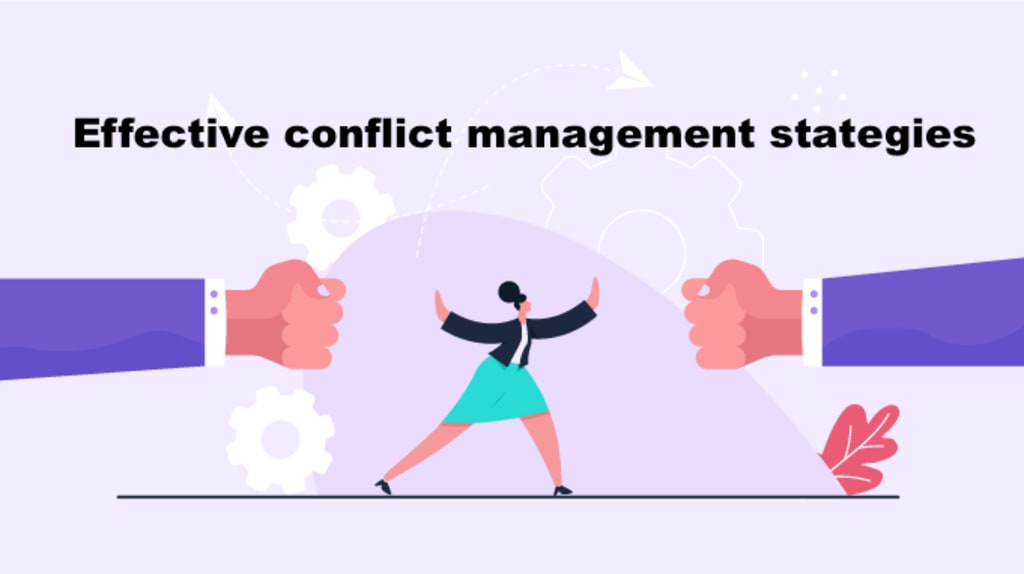
Effective employee engagement makes a significant contribution to the success of an organization. According to Smarp, companies with higher employee engagement are 21% more profitable. Engaging employees for a common goal without conflicts is challenging for organizations because employees come from different backgrounds with different mindsets. Conflicts can arise due to several reasons like improper project management, different mindsets, different cultural background,, dissatisfaction from working conditions, remuneration, excessive workloads, lack of recognition and promotion, and more. With this diversified environment, it is a challenging and crucial task for organizations to manage or resolve conflicts in an effective way to ensure the organization’s success. Today, conflicts are identified as positive forces for developing an organization. In this blog, we are going to discuss some of the most effective conflict management strategies for organizations.
Conflict resolution strategies for management
1. Address the issue privately
Conflict can take place over an email, in a meeting, on a call, or in person, it is more important to deal with issues privately than publicly. It allows all involved parties a chance to express their views and intentions in a safer environment. Also, it avoids the needless involvement of bystanders in the issue. If the issue takes place publicly, it should be addressed privately as it encourages others to move on.
2. Determine the most appropriate medium to deal with the issue
It is important to determine what medium is best to deal with any conflict. The most commonly used medium is video call or in-person chat where body language can be read and difficult emotions can be easily expressed. However, sometimes it is done better over emails and chats as it allows individuals to think before making their statements. Thus it is important to decide the appropriate medium to deal with issues in order to resolve it efficiently.
3. Allow everyone to express their opinion
Once the medium is decided, give every individual a chance to express their side of the story. It helps to get a better understanding of the situation and drives you to get into actual issues. Sometimes just letting people get their frustration out goes a long way in solving the problem. Allowing everyone to be heard is crucial in conflict resolution.
4. Repeat back your understandings
Everyone has a different perception about a particular situation, so taking every step to avoid misunderstanding is important, especially in conflict resolution. Restating your understanding solidifies your own understanding and allows the other person in conversation a chance to correct you if you have misinterpreted their words.
5. Follow Up with a close-out conversation, email, or call
It is important to close-out the conflict resolution with a private followup with an appropriate medium and manner. The close-out conversation must include restating the resolution, thanking the individuals for their involvement and communication, and asking them to help in future issues. It is an important strategy to make sure that the conflicts are resolved and create solutions for resolving conflicts that can take place in the future.
Read More- Don't Let Generational Conflict Kill Your Small Business
Conflict resolution strategies for employees
Conflict in the workplace can be diffused when it occurs, in 1947, Kenneth Thomas and Ralph Kilmann developed the five modes of conflict management. Employees can use all five methods individually and resolve conflicts under various circumstances. The Thomas-Kilmann conflict mode instrument lists five modes of conflict responses. These modes are Competing, Accommodating, Avoiding, Collaborating, and Compromising.
1. Competing
The competing approach is also called a win/lose approach where employees act in a way to achieve their goals without seeking to compromise. This approach can be appropriate for emergencies where time is of the essence and you need to take quick and decisive actions.
2. Avoiding
In this approach, you simply avoid the issue, this works when the issue is trivial or you have fewer chances of winning. It is also fairly effective when the atmosphere is emotionally charged and you need to create some space.
3. Collaborating
Collaborating can also be described as a win-win approach, this can be effective for the complex scenarios where you need to find solutions. Collaboration maximizes the assertiveness and cooperation capabilities of each team member. The downside is that it requires a high degree of trust and reaching consensus can require a lot of time and effort to get everybody on board.
4. Accommodating
This approach is effective when the other party is an expert or has better solutions. In this approach, employees agree to accommodate the other person’s demands and iron out the conflict. An accommodating conflict resolution technique does not require all information and viewpoints to be brought to the table. It can also be effective in preserving future relations.
5. Compromising
A compromising approach aims to settle on a solution, each team member makes a sacrifice to ensure that everyone has a small consolation prize. A compromising approach is the easiest way to resolve conflicts but not effective because all parties make sacrifices and thus lose.
Read More - 3 Ways to Use Conflict to Strengthen Your Startup
Conclusion
Conflicts are an inevitable part of life, both at the workplace and in personal space. It can be turned into an opportunity to redefine the culture, process and expectations. By effectively resolving conflicts, you can eliminate several hidden problems that it brings to the surface. Going through the process of resolving conflicts expands people’s awareness and gives them insight into how they can achieve their goals without undermining others. One of the most crucial benefits is that it helps in retaining employees; conflicts are one of the main reasons employees leave an organization. According to recent research, 600 US businesses with 50-500 employees, 63.3% of companies say that employee retention is actually harder than hiring them. It is important for organizations and employees to resolve conflicts effectively by following the best conflict resolution strategies.
Author Bio-
Piyush Jain is the founder and CEO of Simpalm, drupal development company in DC, Maryland, and VA . Piyush founded Simpalm in 2009 and has grown it to be a leading mobile and web development company in the DMV area. With a Ph.D. from Johns Hopkins and a strong background in technology and entrepreneurship, he understands how to solve problems using technology. Under his leadership, Simpalm has delivered 300+ mobile apps and web solutions to clients in startups, enterprises and the federal sector.
About the Creator
Keep reading
More stories from writers in Journal and other communities.




Comments
There are no comments for this story
Be the first to respond and start the conversation.