
Dreaming of the High Seas? Here Are 5 Real Ways to Own a Ship
Discover how you can own a piece of the global fleet and turn the world's shipping lanes into your next great investment.

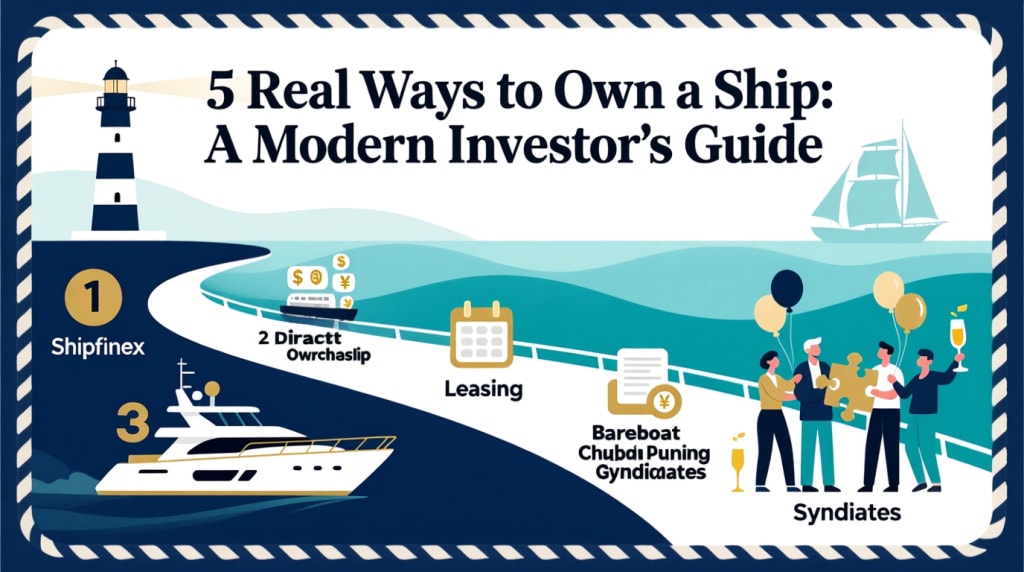
The idea of owning a ship often conjures up images of Greek tycoons in sunglasses or colossal corporations moving the world's goods. It feels like a distant dream, a venture reserved for the ultra-wealthy or those born into the maritime trade. For most of us, the sheer scale and cost of a 300-meter-long cargo vessel seem as unattainable as owning a skyscraper. The vast ocean, the roar of a robust engine, and the understanding that your asset plays a crucial role in the worldwide supply chain evoke a potent and alluring idea.
But what if that dream isn't as far-fetched as it seems? The realm of maritime investment is evolving, opening doors previously inaccessible to the average investor. Technology and new financial models are making it possible to claim your piece of the global fleet without needing a billion-dollar bank account. Whether you’re a savvy investor looking to diversify your portfolio or a passionate enthusiast wanting to turn a dream into a tangible asset, the path to ship ownership is more accessible than ever.
Forget the old stereotypes. Let's explore five real, practical ways you can own a ship, starting with the most modern and revolutionary approach.
1. Shipfinex: Fractional Ownership for the 21st Century
The single biggest barrier to owning a ship has always been the colossal upfront cost. A decent secondhand bulk carrier or tanker can easily run into the tens of millions of dollars. This is where a platform like Shipfinex entirely changes the game. It introduces the concept of fractional ownership to the maritime world, and it’s arguably the smartest way for a new investor to get started.
Think of it like this: you wouldn't buy an entire apartment building to get into the real estate market, right? You’d probably start with a single apartment or even invest in a Real Estate Investment Trust (REIT). Shipfinex applies this exact logic to ships. Instead of buying a whole vessel, you buy a fraction of it. You become a co-owner alongside other investors, and your share is proportional to your investment. Suddenly, that $30 million vessel becomes accessible because you can buy a piece of it for a fraction of the price.
What makes this approach so powerful is that it democratizes the entire process. You get all the benefits of owning a revenue-generating, hard asset without the monumental headaches that come with it. Shipfinex and similar platforms handle the heavy lifting. They find the right ship, perform the due diligence, and put a professional management company in charge of the day-to-day operations. These are the experts who deal with finding cargo (chartering), hiring the crew, managing maintenance, and navigating the confusing web of international maritime law. You, as the fractional owner, simply invest and receive your share of the profits from the ship’s voyages.
Furthermore, this model leverages technology like blockchain to ensure everything is transparent and secure. Your ownership stake isn't just a handshake deal; it's recorded on a digital ledger that's incredibly difficult to tamper with. This provides a level of security and clarity that gives investors peace of mind. For anyone looking to enter the world of shipping, fractional ownership through a platform like Shipfinex is the most logical first step. It lowers the financial barrier, mitigates risk through professional management, and allows you to build a diversified portfolio by owning small pieces of several different ships.
2. Direct Purchase: The All-In Approach
This is the traditional, old-school way of owning a ship: you buy the whole thing yourself. It’s the highest-risk, highest-reward path, requiring immense capital and profound industry knowledge. You generally have two choices here. You can commission a new build, working with a shipyard to construct a vessel to your exact specifications. This method gets you a modern, efficient ship but requires a huge investment and a long wait time.
The more common route is to purchase a second-hand vessel. This involves scouring the market for a ship that meets your needs, conducting rigorous inspections (you don't want to buy a lemon that needs millions in repairs), and negotiating the price. Once you buy it, every single responsibility falls on your shoulders. You have to find a technical manager, a commercial manager, sort out insurance, hire the crew, and ensure the vessel complies with dozens of international regulations. It’s like buying a massive, floating, multi-million-dollar company. While you have complete control and keep 100% of the profits, you also bear 100% of the risk. One disastrous voyage or a major mechanical failure can be financially devastating. This path is truly for the experts or the very brave.
3. Ship-Owning Syndicates: Teaming Up
Before modern fractional ownership platforms existed, there were syndicates. This is a more traditional form of group ownership where a small number of investors pool their money to buy a ship. Think of it as a private partnership. A handful of high-net-worth individuals, often with some connection to the shipping industry, might form a syndicate.
The process is more hands-on than fractional ownership. The members of the syndicate are usually actively involved in the decision-making process, from choosing the vessel to appointing the management team. It requires a great deal of trust among the partners and solid legal agreements to define everyone’s rights and responsibilities. While it makes the cost more manageable than a direct purchase, it's still a significant investment and requires you to find and vet trustworthy partners to share the journey with.
4. Bareboat Chartering with a Purchase Option
This is a clever "lease-to-own" model within the maritime industry. In a bareboat charter, you essentially lease a "bare" ship from an owner for a set period. This means you are responsible for everything—the crew, fuel, insurance, operations, everything. You run the ship as if it were your own.
The key here is the purchase option. The agreement can include a clause that gives you the right to buy the vessel at a pre-agreed price at the end of the charter period. This is an excellent route for someone with operational experience who wants to test the waters before committing to a full purchase. It allows you to generate revenue with the vessel and get a feel for its performance and profitability before you have to make that massive capital outlay. It's less common for pure investors and more suited for aspiring ship operators.
5. Investing in Public Shipping Companies
Finally, the most hands-off way to get exposure to the shipping industry is by buying shares in publicly traded shipping companies on the stock market. You can invest in giants like Maersk, COSCO, or Hapag-Lloyd. In this sense, you become an owner of a tiny fraction of a massive fleet of ships.
This method is incredibly simple and liquid—you can buy and sell your shares with the click of a button. You don't have to worry about a single bolt on a single ship. However, your investment's performance is tied not just to the shipping market but also to the stock market's volatility and the company's management decisions. You don't own a specific, tangible asset, but rather a piece of a corporation. It’s a fantastic way to invest in the industry, but it doesn't quite capture the direct-ownership feeling that the other methods provide.
The journey to owning a ship has many ports of call. While the traditional paths remain, modern innovations like Shipfinex are charting a new course, making the dream of ship ownership a reality for a whole new generation of investors.
About the Creator
Keep reading
More stories from Johnny Cash and writers in Journal and other communities.
The Maritime Industry: A Deep Dive Into Its Sectors, Challenges, and Future
Introduction The maritime industry stands as one of humanity's oldest and most vital economic sectors, serving as the backbone of global trade and commerce. This vast network of ships, ports, and supporting services facilitates the movement of approximately 90% of international trade by volume, making it an indispensable component of the modern global economy.
By Johnny Cash8 months ago in Journal
Author’s Advice
If you would’ve asked me 20 years ago did I know I’d become a writer and an author, I would’ve said “nope, ain’t happening”. As fate would have it I did become an author and I can honestly say I’m loving it so far. It really does feel good to be a writer. I’ve learned a lot on this journey and I feel like with even me being as new to this world as I am, there’s some wisdom I need to share with every other aspiring author.
By Joe Patterson5 days ago in Journal
Reasons Why Sinners and Frankenstein Could Win the Oscar for Best Picture
Horror fans are in luck: this year, two horror films are in the running for the Oscar for Best Picture. As if that weren't enough, both films have multiple nominations for this award. This year, Sinners, a gothic horror film, has been crowned the film with the most nominations in Oscar history. This movie received 16 nominations, an absolute record that never ceases to amaze.
By Ninfa Galeano3 days ago in Journal
The Forsyth House Fire
Since 1851, Forsyth House has stood on the corner of Union Street and Gordon Street in the heart of Glasgow. Its iconic, or was... because on Sunday 8th of March, 2026, a fire broke out in a small, seemingly un-named shop in the building and tore all that history down. As I write, the rubble is still unsettled and the street is still blocked off. Central Station is quiet on the upper level, and around 30 small businesses have quite literally gone up in smoke.
By S. A. Crawford3 days ago in The Swamp




Comments
There are no comments for this story
Be the first to respond and start the conversation.