
Dozens of psychologists sent a letter to Putin
They are explaining what is happening to him and why he must stop the war

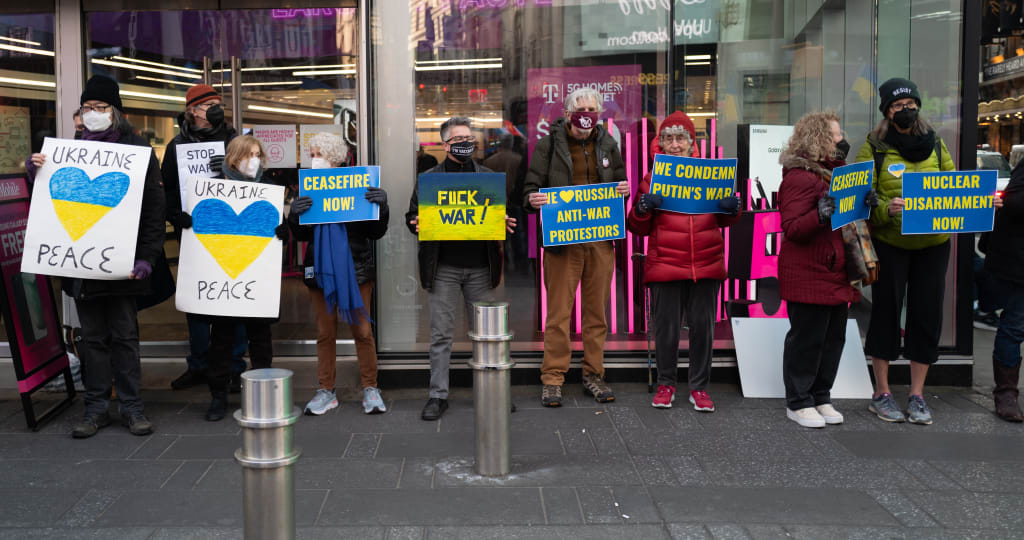
Dozens of psychologists around the world have signed an open letter to President Putin explaining what is happening to him and why he must stop the war. It is not clear what was the motivation of psychologists, but it is hard for me to believe that naivety, because such an approach, if it has no other goal, shows this: boundless naivety. This is what psychologists say. And why their letter will have no effect.
The main ideas in the letter ( you can find the content below) are as follows:
• incitement to war generates feelings of insecurity among the (Russian) population, which, in the short term, accentuates the feeling of national identity and admiration for the leader, but in the long run there will be negative effects for the leader responsible for the war.
• war creates economic problems, people compare their situation before and during the war, and the finding of involution leads to resistance, protest and revolution.
• war involves misinformation, leaders surround themselves with "yesmen", there is a risk that in the end the truth will come out.
• Grinded by insecurity, people will want explanations for what is happening, and will finally find out who is to blame for the war.
• Against the background of the "revelations" that the Russian population will have, the state will be even more brutal in repressing those who oppose it, but this leads to an even greater isolation of the leader, increasing the physical risks for him.
• Finally, psychologists tell him that the solution is simple: Put an end to the war.
The letter content:
Psychologists for peace
10/03/2022
Mr. Wladimir Putin
President of the Russian Federation st. Iljinka, 23,
103132, Moskau
Russland
Open letter
Mr President,
We are contacting you to share with you our academic and practical knowledge about the consequences of initiating a war for the instigator, and to offer a glimpse of a possible way out of such a perilous situation. We believe that we can all agree about the sad and dramatic consequences that war has for innocent citizens in the countries involved, as well as for soldiers conducting it: physical injury, psychological trauma, death. Despite that, for political leaders the instigation of a violent fight with external forces often offers the attractive perspective that such a situation of insecurity and feelings of threat increases one’s own citizens' national identification (Sherif et al., 1961) and admiration for a powerful leader. Such effects of increased national identification and leader admiration are, however, of a short-term nature: They are usually then replaced by mid-to-long-term negative effects for political leaders who are perceived to be responsible for the war. This letter informs you about some of these effects:
• Citizens on both sides in a war suffer from national isolation. Human beings are dependent on an appropriate mixture of the familiar and the novel; they simultaneously look for inclusion and differentiation (Brewer, 1991). National isolation creates unsatisfied identity developments that strive for change.
• Wars create severe economic problems, up to full-blown crashes, on both sides. Citizens typically compare their current economic situation with the situation before the war began and soon recognize that they are losing out. Feelings of deprivation are usually the basis for resistance, protest and revolution against existing state institutions (Foster & Matheson, 2012). These effects hold true both for ordinary people as well as for elites.
• The conduct of war often involves active misinformation about the success of one’s own troops and losses of the enemies, about the moral ‘superiority’ of one’s own group and the ‘damnable’ motivations of the opposite side (Tajfel, 1977). The creation of such a world consumes resources and leaders end up in isolation within a bubble of yeasayers, always endangered by the threat of being unmasked.
• Finding oneself in a situation of maximum insecurity about what is right and wrong and uncertainty about the future activates citizens' desire for explanations (Festinger, 1954). This will ultimately end up in a perception of reality as it actually is: People will discover who is responsible for starting the war, and for all the consequent suffering, injuries and death.
• The processes described above often generate an increasing application of state power and brutal repression (French & Raven, 1959).
• However, such repression also ends up with the increased rejection, isolation and physical endangerment of the political leaders perceived to be responsible.
What can be done to mitigate against such a predictable disastrous development? From our psychological point of view the primary recommendation is to immediately stop shooting, stop bombarding, stop fighting and stop killing. Think again about the reasons for your decision to go to war and what can ultimately be achieved with this violence, for the Russian people as well as for you personally. Think again about the alternative of a peaceful co-existence with neighbouring countries. Think again about the minimal conditions for ending up in a durable peace agreement and, above all, remain open for negotiations.
Yours faithfully,
Prof. Dr. Ulrich Wagner, Social Psychologist, Marburg, Germany
Prof. Dr. Rolf van Dick, Social Psychologist, Frankfurt, Germany
Prof Thomas F. Pettigrew, Social Psychologist, Santa Cruz, CA, USA
Associate Professor Dr. Nina M. Junker, Work and Organizational Psychologist, Oslo, Norway
Prof. Rupert Brown, Social Psychologist, Sussex, UK
Prof. Dr. Llewellyn van Zyl, Positive Psychologist, Vanderbijlpark, ZA / Eindhoven, NL Prof. Dr. Vincent Yzerbyt, Social Psychologist, UCLouvain, Belgium
Prof. Dr. Michal Bilewicz, Social Psychologist, University of Warsaw, Poland
Prof. Roberto Gonzalez, PhD, Social Psychologist, Universidad Catolica de Chile Prof. Linda Tropp, Ph.D., Social Psychologist, Amherst, MA, USA
Prof. Dr. Miguel Moya, Social Psychologist, Universidad de Granada, Spain
Dr. Hermann Swart, Social Psychologist, Stellenbosch, South Africa
Prof. Dr. Jorge Vala, Social Psychologist, University of Lisboa, Portugal
Prof. Dr. Jolanda Jetten, Social Psychologist, University of Queensland, Australial Prof. Dr. Andreas Homburg, Environmental Psychology, Darmstadt, Germany
Prof. Dr. Eva Green, Social Psychologist, Lausanne, Switzerland
Dr. Stephan Braun, Social Psychologist, Frankfurt, Germany
Dr. Sylwiusz Retowski, Organizational Psychologist, Gdansk, Poland
Prof. Dr. Sabine Otten, Social Psychologist, Groningen, NL
Prof. Dr. Patrizia Catellani, Social Psychologist, Milano, Italy
Professor Victoria Esses, Social Psychologist, London, Canada
Dr. Patrick Kotzur, Social Psychologist, Durham, UK
Prof. Dr. Juan A. Moriano, Social Psychologist, Universidad Nacional de Educación a Distancia (UNED), Spain
Prof. Lucas Monzani, Ivey Business School at Western University, Canada
Prof. Dr. Lorenzo Avanzi, Trento, Italy
Stefanie Marx-Fleck, M.A., Social Psychologist, Frankfurt, Germany
Dr. Aldijana Bunjak (Lecturer), Economist, University of St Gallen, Switzerland Christopher M. Federico, Professor of Political Science and Psychology, University of Minnesota, USA
Dr. Ali Ahmad Bodla, Information Technology University, Pakistan
Dr. Dorota Godlewska-Werner, Organizational Psychologist, Gdansk, Poland
Dr Anca Minescu, Social and Political Psychology, Limerick, Ireland
Prof. Dr. Andreas Mojzisch, Social Psychologist, Hildesheim, Germany Professor S. Alexander Haslam PhD, Social Psychologist, Queensland, Australia Prof. Srini Tatachari, Organizational Psychologist, Karnataka, India
Prof. Dr. Julia Becker, Social Psychologist, University of Osnabrück, Germany Prof. Dr. Jan Häusser, Social Psychologist, Gießen, Germany
Prof. Sut I Wong, Organizational Psychologist, Oslo, Norway
Dr. Yannis Markovits, Organizational Psychologist, Thessaloniki, Greece
About the Creator
Mindy Mindy
Hi!
Here is Mindy, a curious person by default. I write articles about topics which I personally have an interest in and share it with you.
Youtube channel for piano music lovers.
https://www.youtube.com/channel/UCJRTMpBooLbsRevfhbuQA9g
Love
Keep reading
More stories from Mindy Mindy and writers in Journal and other communities.
The goals I did not achieve
Every writing goal I made for the year is a wash. It has been this way for a while, but I think it's important to be open about my failures and the reality of how life can get in the way. This is especially true considering the several times I have posted on Vocal about my writing goals, how I was changing my approach, and where I was hoping to be for the upcoming year. I will probably do that again in a couple months, but for now, it is time to acknowledge where I am today.
By Kay Husnick24 days ago in Journal
Borrowing Quiet
No arguments. No announcements. No catastrophe to point to and say, that’s why I feel like this. Just the low, steady sound of the refrigerator cycling on and off, as if it has taken on the responsibility of breathing for the room. It does this whether I am paying attention or not. It does this whether I am okay.
By Megan Stroupabout 11 hours ago in Journal


Comments
There are no comments for this story
Be the first to respond and start the conversation.