
Don't Know What to Do with Your Life? Here Are 8 Strategies to Figure It Out
#8: A career is a journey, not a destination


For many years I had two parallel lives: the writing world and the world of higher education. I did writing and book coaching on the side, while working in higher ed administration and teaching. I had a point not too long ago where I seriously thought about – and planned – to get a Ph.D. before realizing that, although I was interested in my potential research and its contribution to the field, it wasn't what I really wanted to do. However, it was not an easy decision to transition out of higher education into something that on the face of it is much less stable and more risky.
Occasionally my former students still come to me for advice on their own careers, and the questions usually go something like this:
You made a big change in your life - how did you know it was the right thing to do? I thought I knew what I wanted to do for a career, but now I’m not sure. How can I figure it out?
Of course, I’m at a different place in my life. But one of the advantages of experience is that (hopefully) I’ve gained some knowledge and understanding along the way. I’ve been where they are, trying to figure it all out in my 20s. I’ve had a bunch of different “careers” over the years: teacher of English as a Second Language, librarian (in corporate, academic, and public libraries) and higher ed administrator in different roles.
I understand the pressure to have it all figured out; I also know that I became comfortable with not knowing. Instead I followed a path that I could not have foreseen which has led me in all kinds of interesting directions. I paid attention to what I actually wanted to do, and what would lead to the greatest growth for me, personally as well as professionally.
This strikes me as not only a better way to live than slavish devotion to a job you don’t like for the sake of achieving a goal you don’t even know if you want; but also a necessity in this world of ever-increasing change and ambiguity. The pandemic taught us that entire fields could be upended very quickly. AI, globalization, and many other factors will make possible many new careers we haven’t even thought of yet, and wipe out others. In other words, there are few sure paths anymore.
That is one thing I'd say first and foremost:
1. Accept that there will be risk, no matter what you do.
You will face pressure, internal or external, to have it all figured out and to have a specific career path in mind, and focus like a laser on that, doing whatever you have to do to make it happen and rise in the ranks until you reach the level you call success. That is one possible path, and one that makes sense to people because it's clear and straightforward.
However, there is another path, one becoming more and more important:
2. Do different things, building skills and knowledge as you go, then transitioning to a new phase when you've learned all you can.
This is more the path of the present and future, where few jobs and industries will remain constant over time. People who are flexible and can master new skills and develop their network and be open to change will be much better able to ride the waves of economic and personal uncertainty.
By last year I felt that I had done all I could do in my position, and was looking for the next step - which is always a scary and difficult process, and never gets any easier, because there are no guarantees as to outcome. I'd say it took 1–2 years before that of deeply considering what I really wanted to do, what I wanted to contribute, and what I wanted my life to look like on a daily basis. Which leads to:
3. Know yourself well, and be honest with yourself.
Know your hard and soft skills, what you do like to do and what you don't. Commit to journaling, to asking yourself the deep questions. Ask friends and family what they think your strengths are (it may surprise you).
If you're really brave, ask people what they'd love to tell you to work on. You will get real, helpful answers if you phrase it as asking for constructive criticism as part of a goal to be your best self. You can phrase it as, "If you were to tell me one thing I could improve on, what would it be?"
Sometimes what you're good at won't be something you want to build your career around (I'm good at planning and organizing but they're the least interesting to me; I was often advised to build a career around my Japanese knowledge, but didn't want it to become the primary thing in my life).
A corollary:
4. Don't do what someone else thinks is best for you.
It may be scary, but you have to take responsibility for your own life design. You will make mistakes, but you can learn and grow from them. Dedicate yourself to personal and professional development. Keep learning and growing. Your dreams and goals will evolve with you. Be true to your own values and desires.
5. Stay curious.
Don't look for the perfect thing but the next interesting, challenging thing that will enable you to grow as a person and as a professional. Treat every experience as something to learn from. Ask questions: What skills or knowledge can I learn here? Who can I meet and what do they have to teach me (it could be hard skills, soft skills, social skills…)?
6. Build your core skills.
Since you will probably have several "careers" over your lifetime start building core skills: interpersonal skills (communication, leadership, negotiation, etc.) as well as financial, administrative, creative, the use of new technologies, and so on. These are transferable skills that can be applied to many jobs. In my view, the greatest of these are interpersonal: communication (including listening and speaking), the ability to work in a team, to negotiate and compromise, to get along with others despite differences, to network effectively, etc. People are going to hire, and recommend to others, people they like. This will trump other, more technical skills in many cases.
But what if you don't know where to start? This question comes up a lot with new graduates, as well as people in mid-life who realize they've never found their "passion."
7. Don't worry about finding your "one true passion."
Some people find an overarching passion, and that's great. Some pursue it for money; some passions won't bring much income but are incredibly meaningful in your life.
It's fine to have certain areas or skills that you love, and figure out from there how to put together meaningful work. You may want to create a mind map of the following questions (the Life Purpose Diagram; often misconstrued as the Japanese concept of ikigai, but that is true only in part; still, it's a useful guideline):
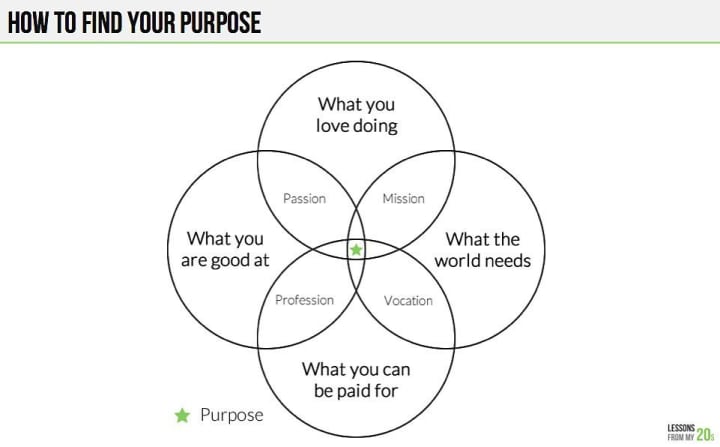
Ask yourself:
What do you love?
What are you good at?
What does the world need that relates to the first two questions?
What can you be paid for that relates to the previous three questions?
The answer to your question of what to do next may be found at the nexus of these. If you can answer them fully and honestly, you will have a much better chance of moving toward something you love that is fulfilling to you and also earns you a living.
8. Accept that a career is a journey, not a destination.
As you gain more experience and self knowledge, you will have a greater chance to maximize both self-fulfillment and impact.
Here are a few books I know of that focus on self-analysis and may help you figure things out:
What Color is Your Parachute - Richard Bolles (a classic)
Start with Why - Simon Sinek
How to Find Fulfilling Work - Roman Krznarik
A Job to Love - Alain de Botton
Career, vocation, life purpose - whatever you call it, it's a process, a journey, and there is no one right answer. It takes time to develop. However, don't let "analysis paralysis" take over. Do the self-work, analyze your strengths and skills, and then act. Trust that whatever you do will lead you to the next right thing. Focus on having an interesting life, not just a career.
About the Creator
Jana Van der Veer
Book and mindset coach for writers. Book lover, chocoholic. Go to www.setyourmuseonfire.com to grab your copy of 10 Questions to Ask to Get Unstuck at Any Stage of the Writing Process!
Keep reading
More stories from Jana Van der Veer and writers in Journal and other communities.
Professional Expectations for Safeguarding PHI
Introduction Protecting patient information is essential. PHI includes sensitive health data. Trust depends on confidentiality. Privacy supports ethical healthcare delivery. Regulations require strict safeguards. Compliance is a professional obligation. Breaches cause serious harm. Financial penalties may follow. Reputational damage can occur. Patients expect protection. Professionals must remain vigilant. Every interaction carries responsibility. Digital records increase exposure risk. Paper records still matter. Strong safeguards reduce vulnerability. Consistent practices protect patients. PHI protection reflects professionalism. Accountability is not optional. Privacy failures damage credibility. Safeguarding PHI supports long-term organizational stability.
By Abdul Mueed4 days ago in Journal




Comments
There are no comments for this story
Be the first to respond and start the conversation.