
DOGE: If Waste Reduction Can Free Up Billions, Why Not Return It To Citizens?
March 15, 2025

DOGE Findings and the Potential for Universal Basic Income
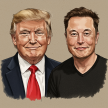
In early 2025, the Department of Government Efficiency (DOGE), led by Elon Musk and Vivek Ramaswamy under President Donald Trump’s administration, has made headlines with bold claims of slashing federal waste. By March 15, 2025, DOGE reports saving $55 billion through measures like canceling unspent funds from the 2021 American Rescue Plan and terminating contracts deemed unnecessary. Proponents argue these savings could fund a novel form of universal basic income (UBI)—“DOGE checks”—distributing cash directly to Americans. But how realistic is this vision, and can waste reduction truly translate into a sustainable UBI?
DOGE’s mission is rooted in Trump’s pledge to streamline government spending. Early findings highlight eye-popping examples of waste: $1.7 billion in untracked COVID relief funds, $320 million for an unused border wall project, and $500 million in redundant federal software licenses. Musk, known for his efficiency obsession at Tesla and SpaceX, has pushed for a “first principles” approach, questioning every dollar spent. Ramaswamy, meanwhile, targets bureaucratic bloat, claiming 30% of federal employees—roughly 600,000—could be cut without impacting core services. Together, they estimate $2 trillion in savings over 18 months, a figure that’s sparked both excitement and skepticism.
The UBI angle emerged when investment firm CEO James Fishback proposed using 20% of these savings—$400 billion—to send $5,000 checks to each of the 80 million Americans who paid federal income taxes in 2024. Dubbed “DOGE checks,” this would be a one-time payout, not a recurring UBI like Andrew Yang’s $1,000-a-month plan, but it’s framed as a proof-of-concept. Trump has warmed to the idea, suggesting it could incentivize citizens to report waste, turning fiscal responsibility into a participatory sport.
The math, at first glance, seems plausible. If DOGE delivers $2 trillion in savings, $400 billion is just a fraction, leaving room for debt reduction or other priorities. A $5,000 check per taxpayer would cost $400 billion, aligning neatly with Fishback’s proposal. Advocates argue this could stimulate the economy—imagine 80 million Americans spending on homes, cars, or small businesses—while rewarding taxpayers for government efficiency.
Yet, the findings face scrutiny. A February 2025 Congressional Budget Office report shows federal borrowing hit $1.1 trillion in the first five months of FY 2025, with deficits up 5% from last year. Analysts like NPR’s Scott Horsley point out that DOGE’s $55 billion in “savings” includes funds already spent or legally obligated, such as $20 billion in multiyear defense contracts. If true savings are closer to $10 billion than $55 billion, scaling to $2 trillion becomes a pipe dream. Without verified, cash-in-hand reductions, UBI funding evaporates.
Political hurdles loom large, too. House Speaker Mike Johnson and deficit hawks like Senator Ron Johnson prioritize debt repayment over handouts, while progressives might demand broader eligibility, not just taxpayers. Crafting legislation to define savings, verify cuts, and distribute funds could take months—or stall entirely in a divided Congress.
Even if DOGE succeeds, translating waste reduction into UBI raises practical questions. A one-time $5,000 check isn’t true UBI, which requires consistent payments to replace income. Sustaining even a modest $1,000 monthly UBI for 200 million adults would cost $2.4 trillion annually—more than DOGE’s entire projected savings over 18 months. Inflation, a concern from past stimulus checks, could also erode benefits, especially if supply chains remain tight.
Still, DOGE’s findings ignite an intriguing debate. If waste reduction can free up billions, why not return it to citizens? The experiment could redefine government accountability, proving efficiency isn’t just rhetoric. For now, though, “DOGE checks” remain a tantalizing maybe—dependent on real savings, political will, and economic fallout. As Musk might put it, it’s a first-principles idea worth testing, but the devil’s in the execution. Watch this space.
About the Creator
DIY Cowboy Hat Business: Costs and Supply Chain
Last week, a U.S. client reached out to us, looking for help sourcing pure wool felt cowboy hats and all kinds of hat accessories. At first, it didn’t seem unusual, but as we talked more, we realized her main business is actually running a few bars. And she plans to sell these hats in the bars. Surprisingly, this has now turned into a fast-growing, high-ticket, social DIY experience that’s really blowing up in her country.
By Jingsourcing.com 7 days ago in Journal
Smart phones, Humans and Aliens.
WARNING. I will be tapping into one of your favorite creative tensions: The absurdity of humans worshipping their glowing rectangles as if they were tiny oracles. There’s something deliciously poetic about that contradiction, and it lends itself beautifully to an instructive proviso.
By Novel Allen5 days ago in Poets


Comments
There are no comments for this story
Be the first to respond and start the conversation.