
Differences Between SEM & SEO
When you should use each one of them to help your business


“Search engine optimization and search engine marketing are important elements for an online businesses. Spending millions of dollars on a website is worthless if no one knows your site” — Unknown
Search engine marketing and search engine optimization often leave our readers confused. Let’s be honest both SEO and SEM terms are used interchangeably without a clear understanding how they are related to each other. Both processes are used to increase visibility in search engines but it is important to know what is the main difference between them.
Search engine optimization (SEO) is a process of increasing website visitors by ensuring high ranking of the website in search engine results.
Search engine marketing (SEM) is a type of internet marketing that involves website promotion by maximizing its visibility in SERPs (search engine result pages) through PPC advertising and optimization.
Before differentiating these terms, you should get a clear idea about how search engines work. Now the question arises:
What is a search engine?

Search engine refers to an online tool that search results from its huge database (programs, images, web pages etc.) based on keywords submitted by the users. For Example Google seeks to provide the most appropriate and relevant result for its users queries.
How Search Engines Work?
Search Engines like Google use a complex algorithm that search out several web pages containing the specific keyword users used to search. Different factors play a significant role in assigning rank to each page i.e. how many times a specific keyword is present on a page.
Basically, Google can scan the index of hundreds and billions of pages within a few seconds to find out a set of results that provide users accurate answers to their queries. Now the question is how the best result is determined by Google.
Even though the working of Google's algorithm is not public and is based upon patents and filed statements, but here are some points upon which your website and the web page is ranked. And, obviously, a website providing the best result will achieve a higher ranking.
● Relevant Keyword
Google only shows content relevant to the entered keywords. For instance, if you are looking for clothes, you don't want to search shoes or jewelry pages. So, Google first finds relevant content then analyzes how close the search is to your unique keyword.
But how Google will show accurate results from millions of websites. And how these web pages are ranked on SERPs based on some other factors.
● Authority of Website
Authority of a website determines the accuracy and reliability of the content. Google can estimate the authority of the web pages and websites by looking at the number of links. If a web page gets more links by back-linking, it will be more authoritative and will come in a higher rank than others.
● High-Quality content
Google's foremost priority is to choose useful and high-quality content. So, you will not be able to get your desired ranking if your content is not useful. The useful content is determined by the organized pattern and clarity of content.
Main Features of SEO and SEM

Search engine optimization is a basic marketing strategy used by brands in order to attract customers, traffic generation, and business growth. But optimization cannot be fulfilled by you unless and until you are not able to differentiate SEO from SEM (search engine marketing). Now, we will discuss the features of search engine marketing and search engine optimization.
What is SEO?
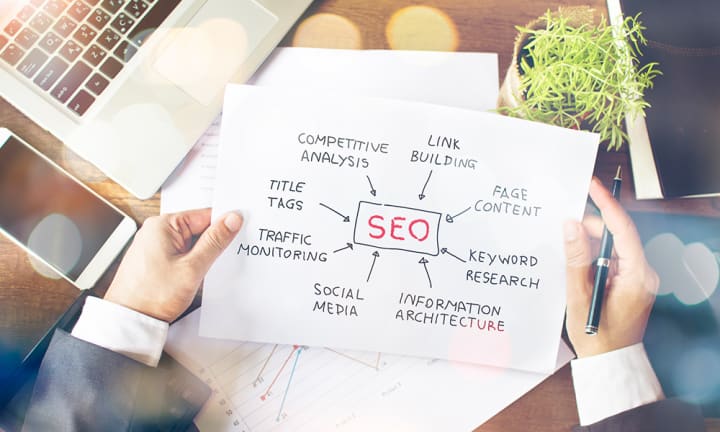
SEO (search engine optimization) is a technique of optimization of a website continuously in order to get the highest rank in organic search engine result pages (SERPs).
SEO contains hundreds of tricks to promote your website on SERPs. It increases the visibility of your content in search engine result pages. Search engine optimization is often categorized into three major types.
● On-page SEO
On-page SEO is used to optimize even a single page of your website for targeting specific keywords which are appealing to search engine. Keyword research, keyword optimization, as well as content creation, comes under this category. On-page optimization helps search engines in understanding the content of your website to give it higher ranks.
● Off-page SEO
Off-page search engine optimization works for earning a good authoritative reputation of your website by linking it to high authoritative websites.
The most common techniques of off-page optimization are gaining high-quality back-links from other websites in order to manage local listings along with directory profiles.
When a number of websites are back-links to your website, Google will consider your business authoritative as it will be considered as trustworthy, reliable, and reputable. This will, in turn, increase the ranking of your website in search engines.
● Technical SEO
Technical search engine optimization is often used in the optimization of other elements of the website. Technical optimization works to bring improvement in the entire structure and foundation of your website.
This type of optimization is related to website speed, indexing, friendliness, crawling, mobile, structured data, website architecture, and security. It will improve the search engine ranking of your website.
The highly ranked websites usually don't focus only on a single category of search engine optimization (SEO) but instead, they combine all the three categories to achieve the highest ranking on the search engine in order to come on the first most page of SERPs.
What is SEM

Search engine marketing is basically a part of search marketing to get more visibility in SERPs by payment. Paid search engine marketing consists of both activities involved in setting up activities by ad optimization. All this is done by a budget that is paid for the placement of every ad.
The strategy of search engine marketing is usually known as paid search marketing or PPC (pay per click) marketing. In this strategy, experts undergo keyword research for your website.
After the creation of a keyword, different campaigns will get initiated to target the best keyword for products and services provided by you.
When any user searches the keyword, they will see custom ads either at the bottom or at the top of search engine result pages (SERPs). You have to pay every time a user clicks on those ads.
● Quality Score
One of the important metrics of Google Ads is Quality Score. This is basically a strategy of Google used to figure out whether your ad perfectly matches to users' searches or not.
This quality score is calculated by Google on the basis of a composite of clicks through rate, the efficiency of the landing page of your website, and the quality score of your Google Ad account. If a website owner is successful in achieving a high-quality score of his ads, he will be provided with a super discount offer on every single click.
● Bidding
Bidding is the main strategy in all paid ads whether these are Google Ads or Bing Ads. You can bid on any specific keyword with pay per click (PPC). When anyone will search for that keyword, Google will show him your ad. The higher bidding you do, the higher will be ranking of your Ads.
Sometimes, Ad copy is also done in order to improve the quality score of your Ads as well as your website in the search engine marketing strategy.
After this overview of search engine optimization and search engine marketing, the main difference is in terms of unpaid search and paid search, respectively.
"SEM and SEO are differentiated as SEO is an organic strategy while SEM is a paid strategy".
SEO VS. SEM

Some main differences in search engine marketing and search engine optimization are explained here.
● SEM results include Ads placement while SEO does not
Search results obtained on search engine result pages are different for SEM from SEO search results. Paid results that are obtained on SERPs by using SEM strategy are often marked as an ad.
On the other hand, search results obtained from an organic strategy of SEO are never marked with such icons that are usually appeared next to the placements.
● SEM use ad extensions while SEO contain featured snippets
Results obtained from the search of search engine marketing on SERPs usually have extensions included in ads. These extensions may include phone numbers, additional links, and call-outs.
While the results obtained from search engine optimization are only appeared along with featured snippets in search engine result pages
Featured snippets are the richest search results obtained on SERPs in the form of a box of content. Such featured snippets results, obtained by SEO, are usually positioned at the topmost of these search pages.
● SEM results require pay per click while SEO does not
Search engine marketing placements are costly as these are paid. If you are improving the visibility of your business through SEM, your website will be charged every time when a user will click on the results. SEM is often regarded as PPC i.e., pay per click which also demonstrates the high cost of this strategy Thus, for SEM, you should have a huge budget for continual ad placements.
Search engine optimization is free of cost. Your website will be never charged by Google per click because you are using organic results which are obtained by accurate optimization of search engine. Due to its low or no cost, most online businesses and websites use SEO to increase the bottom line of their businesses.
● SEM can specify its target audience while SEO cannot
The best way of gathering traffic on your website is to select a specific audience. In search engine marketing, you can select the audience for your website and business. While using SEO (search engine optimization), you are not allowed to specify the audience who can visualize your results.
In SEM, you can select any specific audience by applying different filters on your website. These filters are usually based upon location, age, income, gender, habits, and many more.
● SEM gives immediate results while SEO takes time

If you want to show your results to your audience immediately, you should use search engine marketing. You can put your results in front of your audience with no time only by a few clicks through paid ads of SEM.
In SEM strategy, the sooner you launch a campaign, the earlier your ads will start appearing in SERPs. Thus, you can increase the visibility of your website any time you want only by turning ads on. Conversely, search engine optimization is a time taking strategy. It takes a very long time, even months, to implement prior to the start of the ranking of your business in search engines.
● SEM is more suitable for testing than SEO
Due to the immediate response of SEM paid ads, search engine marketing is more suitable for testing than SEO. as you can easily turn on and off the paid ads, so you can revise your ad copy, change landing page contents, and target a new audience for your website quickly to test the tactics of SEM.
You cannot go for testing with SEO strategy as it will take a very long time to show a change and observing differences in results. This timing flexibility in the case of SEM allows you to test differences in your strategies.
● SEO has a higher CTR than SEM
If you are successful in coming at the top of search engine result pages, you will get a higher click through rate (CTR) with SEO than search engine marketing.
According to research, it is revealed that the first most organic search results usually enjoy the highest CTRs. Thus, if your website is present at the top, you can perform SEM ads as well.
● SEO shows long-lasting results while SEM does not
No doubt SEO takes a very long time in the visibility of results and implementation to enrich the marketing value of your business but once it becomes visible, it will never stop. Results obtained from SEO are long-lasting as it grows and compounds with the passage of time.
Contrary to SEO, search engine marketing is active for driving traffic to your business as long as you continue to pay for every single click on your results. Once you stop paying, it will turn off all the ads and will gather no more traffic to your website.
Which one is better? SEO or SEM?
The answer to this question entirely depends upon the condition of competitors of your business. Because your competitors' condition will tell you whether you have to beat them immediately or you can do it after a while.
The following are some points that will assist you in the decision making of choosing any one of these tactics for your business.
When to use only SEO
In order to increase visibility, marketing value, and traffic generation on your website, you should do search engine optimization of your website when your website has the following features.
● Limited Budget
If you are going to launch a small business with a very limited marketing budget, you should focus on using SEO. It will take some time and you might not be able to see an ROI on your business for months and even years by using SEO. But still, it is very better than burning a large amount on PPC ads.
● Ranking for informational keywords
Informational keywords are basically questioning terms such as "What is X?", "How to do X?", etc. These types of keywords cover a large search volume but these are not the best convertible queries. So, SEO is the best choice only if you can write amazing content.
● Ample Time
Search engine optimization takes a long time to kick in the market for competing with competitors. Thus, if you have patience and you can wait for a long time to see organic traffic on your website in the results of Google search, SEO is best for your business.
● Link building expert
Along with the creation of high-quality content on google, you should be aware of some link building strategies. If you can manage to get the maximum number of back-links on your website from other websites, you will be able to increase the ranking of your business. So, adopt an SEO strategy for your business if and only if you are aware of link building strategies.
When to use only SEM?

Search engine marketing should be adopted for the branding and enriching marketing values of those businesses that have the following features.
● Huge Ad budget
Before starting the visibility of your business through search engine marketing, you should check your budget that whether you can afford consistent PPC ads or not. You should have even more budget than your planned strategy for PPC ads.
You should need a monthly budget for the growth of your website or business in order to figure out which set of ad copy, targeted keywords, index landing pages, and bids work perfectly for your business.
● Good at managing an Ads account
Any website owner should choose this strategy only if he is good at managing an AdWords account. No doubt it sounds very simple to bid on keywords and get traffic in return of pay per click, but it is not such an easy task.
The management of a Google Ads account is a quite tricky process. There is a need to take targeted keywords into consideration for ads. Moreover, the quality score of both ads and website, ROI, conversion rates, and other data security processes should be reviewed for decision making on how is it possible to get more visibility through ads.
● Expert in launching and testing landing pages
If you want to choose search engine marketing tactics for your business growth, you should have expertise in launching and testing of landing pages. The most key factor of using PPC ads is you should have targeted landing pages per ad. If you are not able to manage targeted landing pages for every ad, you should at least have targeted landing pages for a set of ads.
Thus, in order to achieve maximum ranking and benefits from SEM, you should be aware of the easiest and quickest way of launching a number of web pages. Furthermore, you should have the ability of testing which strategy is performing best for your business.
● Limited time
If you want to get a reputation and fame in the market within no time, you should go for SEM ads. By using PPC ads, you can grow your business in lesser time. So, search engine marketing is best for those businesses in which owners can suffer a huge loss after some time if their products and services will not sell.
When to use both SEO and SEM?

At the start of small businesses, some people want to gather more traffic to increase the bottom line of their business. In the meanwhile, they want to bring organic results on their website. So, in this situation, people sometimes use both SEM and SEO together.
Thus, if you have enough budget and capability of ads management, you can use search engine marketing along with search engine optimization. But it is better to use only one of these for improving the ranking of your business.
Hence, both search engine marketing and search engine optimization are search marketing tools for gathering more traffic and improving the visibility of their business in the online market. The only major difference is SEO as organic results while SEM as paid results.
When it comes to select the best process of getting paid results by search engine marketing, it is important to determine your specific requirements. Be sure to understand the SERPs to make your content relevant to the famous keywords. Try to improve your SEM and SEO strategies. Some businesses focus on SEM and others choose to focus on SEO. Based on your business goal you can adopt the best marketing strategies. If you are still confused then take an expert help.
Hence, it is revealed that search engine marketing is different from search engine optimization.
At Sharpn Marketing Inc., we take search engine marketing very seriously, since every business is different, we will design a plan for the execution of your search engine marketing campaign, which will include several of our services to maximize results: from content marketing to social marketing
----

Chris Gulli | Entrepreneur | Content Creator
Chris is a big advocate of free traffic methods, he is always researching websites and strategies to generate free traffic, he is also in love with automation and always on the look for new software to be able to automate the weirdest things. Chris is also in charge of "The Digital Business Owner" project and you can ask him marketing related questions here, which he will then answer on the show.
https://www.sharpn.io/ask-chris
---
Originally published at https://www.sharpn.io on October 1, 2021.
About the Creator
Chris Gulli
I Love to write about about all things, from Digital Marketing to entrepreneurship and mindset
https://chrisgulli.com
Keep reading
More stories from Chris Gulli and writers in Journal and other communities.
Here's How A Sweepstake Can Help Your Online & Offline Business
For small and medium businesses, `Sweepstakes is an effective tool to optimize the promotion. Furthermore, if you have managed sweepstakes properly then you will get the best results from the promotion of your brand or business and it becomes easier for you to increase your customer engagement.
By Chris Gulli5 years ago in Journal
Daily Liturgy — January 21, 2026
Today the Church celebrates the Memorial of Saint Agnes, Virgin and Martyr, and the liturgy invites us to reflect on courage, fidelity, and the quiet strength that comes from trusting God completely. As we continue through the Second Week in Ordinary Time, the readings place before us two powerful images of faith in action: the youthful confidence of David as he faces Goliath, and the steady, uncompromising mercy of Christ as He heals on the Sabbath. Together, they remind us that God’s power is often revealed not through force or status, but through obedience, humility, and love that refuses to yield to fear.
By Sound and Spirit6 days ago in Journal



Comments
There are no comments for this story
Be the first to respond and start the conversation.