

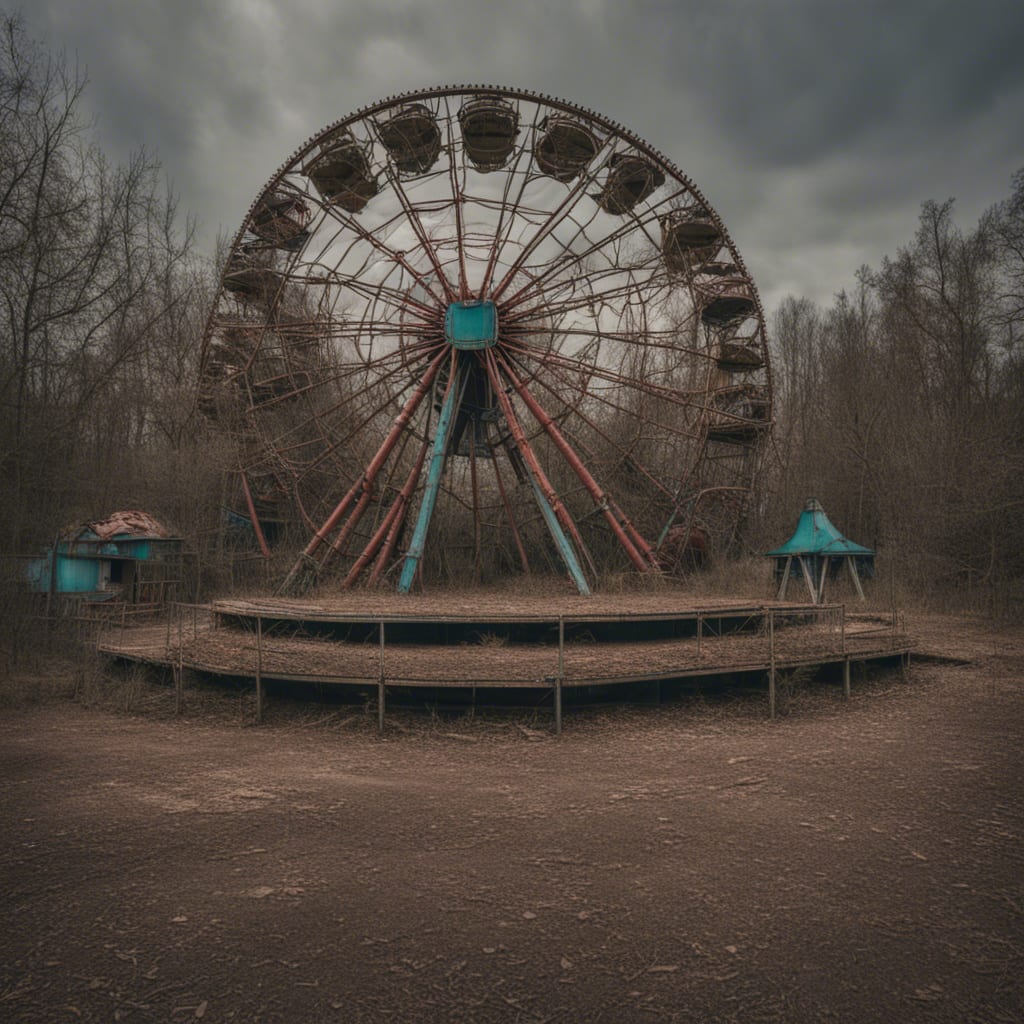
The Entrance
The great diamond-shaped archway that once welcomed millions now stands as a broken crown. Half of its faceted panels have shattered, leaving jagged edges that catch rainwater and funnel it down in rust-colored streams. The turnstiles are frozen solid with corrosion, their chrome surfaces now a mottled brown-green. Scattered across the cracked entry plaza are fragments of the original diamond-embedded walkway, their facets dulled and clouded, crunching underfoot like broken teeth.
The ticket booths lean at impossible angles, their windows starred with impact fractures. Faded promotional posters still cling to their surfaces in tatters: "Experience the Magic!" with only "per nce th ag!" visible through the decay.
Main Street Diamond
Once the park's glittering heart, Main Street now resembles a war zone. The towering Diamond Palace at the street's end has partially collapsed, its crystal spire snapped and hanging by cables. Shop fronts sag under the weight of accumulated debris - fallen roof tiles, twisted metal signs, and years of organic matter.
The street's centerpiece fountain, shaped like a massive cut diamond, is cracked down the middle. One half tilts skyward, filled with stagnant black water that reflects nothing. Skeletal remains of park benches dot the walkway, their diamond-patterned ironwork now abstract sculptures of rust.
Souvenir shops stand open like wounds, their contents spilled across the pavement: plastic diamond tiaras melted into colorful puddles, stuffed mascot toys rotted into unrecognizable lumps, and thousands of postcards bleached white by sun and rain.
Thrill Zone
The Diamond Drop
The park's signature 200-foot drop tower stands like a broken spine against the horizon. The ride car hangs frozen 150 feet up, swaying gently in stronger winds. Its diamond-shaped passenger compartment has become a nesting ground for birds, their droppings creating white stalactites down the tower's sides.
The queue area below is a maze of collapsed barriers, their rope lines now home to aggressive vines that have woven themselves into an impenetrable thicket. Warning signs dangle from single bolts, creating an eerie percussion section when the wind picks up.
Crystal Coaster
The massive wooden roller coaster has become a skeletal monument to engineering ambition gone wrong. Entire sections of track have collapsed, creating gaps that span dozens of feet. The remaining structure groans constantly, a symphony of stressed wood and loose bolts.
The loading station's roof has caved in completely, crushing the control booth beneath twisted metal beams. Train cars rest at impossible angles throughout the circuit - one hangs vertically from a remaining section of track, another has crashed through the station's floor into the maintenance area below.
The coaster's famous "Diamond Cave" tunnel section has become an actual cave, its artificial rock work crumbled inward to create a genuine underground chamber filled with stagnant water and the echoes of dripping condensation.
Kiddieland
The children's area presents perhaps the most haunting decay. Brightly colored rides have faded to pastel ghosts of their former selves. The Mini Diamond Mine train track is buried under years of fallen leaves and debris, visible only as occasional rail segments poking through the organic carpet.
The playground's diamond-shaped climbing structure has collapsed into a twisted art installation, its bright primary colors now a palette of rust browns and mold greens. Spring-riders shaped like cartoon diamonds sit motionless, their springs compressed under the weight of accumulated crud, their painted faces worn down to blank metal stares.
The Kiddie Carousel tells the saddest story of all. Half the horses have fallen from their posts, lying in a tragic heap at the platform's center. The remaining mounts continue their eternal circle, but slowly, powered only by wind and gravity, their painted expressions now cracked and weeping streaks of color.
The Midway
Game booths line the midway like broken teeth in a skull's grin. "Ring the Diamond" - once impossible carnival games - now host different challenges: navigating through collapsed awnings, avoiding tetanus from exposed nails, stepping around the sinkholes where game floors have rotted through.
Prize displays hang like macabre Christmas decorations. Stuffed animals dangle from their perch points, transformed into mold-covered scarecrows. Plastic prizes have melted and reformed in heat waves, creating abstract sculptures that bear no resemblance to their original purpose.
The midway's overhead lights - once strings of diamond-shaped bulbs that twinkled like stars - now hang in twisted tangles, their glass shades shattered and their wires sparking occasionally when moisture creates the right conditions.
Water Park Section: Splash Diamond
The wave pool has become a stagnant lake, its artificial beach now genuine wetlands. The wave machinery rusted solid years ago, but strange currents still move through the dark water - perhaps from underground springs, perhaps from things better left undisturbed.
Water slides tower above like the ribcage of some massive beast. Their fiberglass surfaces have cracked and separated, creating razor-sharp edges that gleam when sunlight penetrates the perpetual mist that hangs over this section. The slides' diamond-pattern tiles have mostly fallen away, littering the ground below with colorful shards.
The lazy river has become genuinely lazy, its current barely moving, choked with algae and debris. Abandoned inner tubes float like bloated corpses, their bright colors faded to the gray-green of pond scum.
The Funhouse: Mirror Maze of Madness
The funhouse presents its own special brand of horror. The exterior facade - once covered in flashing lights and painted with grinning diamond mascots - now resembles a diseased face. Paint peels in skin-like strips, revealing the rotting wood beneath.
Inside, the mirror maze has become something far more sinister. Humidity and temperature changes have warped the glass, creating funhouse reflections even in the "normal" mirrors. Many mirrors have developed silver-spot disease, their reflective coating eaten away in organic patterns that look disturbingly biological.
The maze's pathways, once clearly marked, are now uncertain. Collapsed ceiling sections have created new routes while blocked passages have forced different paths. Navigation requires as much luck as skill, and the mirrors multiply every wrong turn into an infinity of failure.
The tilted room still tilts, but now at random angles as its support structures have shifted and settled. The spinning tunnel no longer spins - its motor long dead - but it has developed its own motion as wind creates unpredictable rotation.
Dining Areas
Diamond Diner
The main restaurant complex resembles a bomb site. The building's diamond-shaped roof has partially collapsed, creating a skylight effect that illuminates the devastation below. Tables and chairs lie scattered and broken, their bright 1980s color schemes now muted by years of exposure.
The kitchen is a museum of rust and mold. Industrial appliances have seized solid, their stainless steel surfaces pitted and stained. The walk-in freezer door stands ajar, its interior now home to colonies of mushrooms that glow faintly in the perpetual darkness.
The serving counter, once a gleaming display of American abundance, now showcases nature's abundance instead. Vines have grown through the sneeze guards, creating an organic canopy over the empty warming trays.
Snack Stands
Scattered throughout the park, small food stands tell individual stories of decay. The "Diamond Dust" cotton candy stand has become an actual spider's paradise - their webs, heavy with morning dew, create natural cotton candy in delicate, deadly beauty.
A popcorn cart sits tilted against a light pole, its red paint now pink, its brass fittings green with verdigris. The cart's interior is a small ecosystem - mice have nested in the old kernels, and their abandoned homes are now claimed by insects and small lizards.
Backstage Areas
Maintenance Tunnels
Beneath Diamond World lies a network of service tunnels that has become the park's most dangerous area. Years of flooding have created a maze of standing water and unstable foundations. The tunnels echo with the sounds of dripping, scurrying, and the occasional groan of settling structures above.
Electrical panels hang open like mechanical wounds, their components corroded beyond recognition. Emergency lighting systems failed long ago, leaving the tunnels in perpetual darkness broken only by the occasional shaft of light from storm drains above.
The tunnels still serve their original purpose in a way - they're the circulatory system of the park's decay, carrying moisture, debris, and the occasional explorer through the body of this dead giant.
Employee Areas
Break rooms and administrative offices have become time capsules of the park's final days. Calendars still hang on walls, forever frozen on the last month of operation. Personal belongings left in lockers have become archaeology - family photos curled and faded, work uniforms transformed into abstract textile art by mold and time.
The employee parking lot is now a forest. Cars abandoned during the evacuation have become gardens, their interiors filled with soil blown in through broken windows, now sprouting full-grown trees through their sunroofs.
The Perimeter
Security Stations
Guard booths at the park's entrances lean like drunken sentries. Their windows are spider-webbed with cracks, and their doors hang open on rusted hinges that sing mournful songs in the wind. Security monitors display only static now, but sometimes, in the right light, you can almost see ghostly images of the park's busy past flickering across their dead screens.
The perimeter fence, once topped with cheerful diamond-shaped finials, now serves as a gallery for nature's artwork. Rust has created abstract patterns across the chain link, and vines have woven themselves through the gaps to create a living wall that shifts and breathes with the seasons.
Seasonal Changes
Spring
The park experiences a brief resurrection each spring as new growth pushes through every crack and crevice. Wildflowers bloom in the carousel's center, creating a natural bouquet where once mechanical horses danced. The sound of flowing water returns as winter ice melts and temporary streams carry debris toward lower ground.
Summer
Heat transforms Diamond World into a different kind of hell. Metal surfaces become untouchable, and the humidity rising from stagnant water creates perpetual mist that makes navigation treacherous. The park becomes most alive during summer nights, when the cooling air creates currents that move through the structures, generating the sounds and movements that fuel local ghost stories.
Fall
Autumn paints the park in colors its original designers never imagined. Leaves accumulate in drifts that hide dangers and treasures equally. The changing air pressure causes the structures to settle and shift, creating new sounds and opening new passages while closing others.
Winter
Snow mercifully covers many of the park's wounds, creating a temporary beauty that echoes its former grandeur. Ice forms in interesting patterns on the remaining glass surfaces, and the cold preserves things that might otherwise decay completely. But winter also brings its own dangers - freeze-thaw cycles that accelerate structural damage and ice that makes every surface treacherous.
The Heart of Diamond World
At the park's center stands what was once the Crown Jewel - a massive artificial diamond that served as both landmark and symbol. Now it's a fractured monument to broken dreams. The crystal structure has developed a network of internal cracks that catch and scatter light in unexpected ways. During certain weather conditions, when the sun hits it just right, the damaged diamond still throws rainbows across the ruins - brief moments of beauty that remind visitors what this place once aspired to be.
Around the base of the Crown Jewel, the park's time capsule lies buried under decades of debris. Somewhere beneath the rubble of fallen dreams and broken promises lie the hopes and memories of millions of visitors who once believed in the magic of Diamond World. Perhaps that's what makes the decay so beautiful and so terrible - it's not just the destruction of a place, but the visible decomposition of joy itself.
About the Creator
Autumn
Hey there! I'm so glad you stopped by:
My name is Roxanne Benton, but my friends call me Autumn
I'm someone who believes life is best lived with a mixture of adventures and creativity, This blog is where all my passions come together
~ Fired ~
— Ai Intrusion ~ Are you Next ~ Is Ai Evolution after your job? — Few workplaces haven't been affected. Ai is in supermarkets, at doctors' offices, and even monitoring farms. I just can't think of anything this machine is not getting into, can you? For instance: Education ~ Law and Tech jobs will one day have a major influence or be taken over by these inanimate machines, with accuracy and vigor. From mechanics' diagnoses to a wide variety of everyday jobs, including fast food workers, with this input having the ability to cut their unnecessary work hours. I'm certain all of us have been touched by this with our short stories and colorful headings, have you? Even comments are very questionable 'Non-Robot' insertions.
By Jay Kantor28 days ago in Journal
Automotive Sensors Market: Why Cars Are Getting Smarter
You merge onto the highway. From the corner of your eye, a notification flashes. A gentle beep reminds you that a vehicle is approaching in your blind spot. Behind the wheel, your reflexes are ready. Ahead, your vehicle’s sensors are watching.
By james robert5 days ago in Journal



Comments (1)
very descriptive it almost feels like I'm there