
David Souter, Supreme Court Justice Known for Judicial Restraint, Dies at 85
The quiet and independent jurist leaves behind a legacy of moderation, integrity, and respect for constitutional boundaries

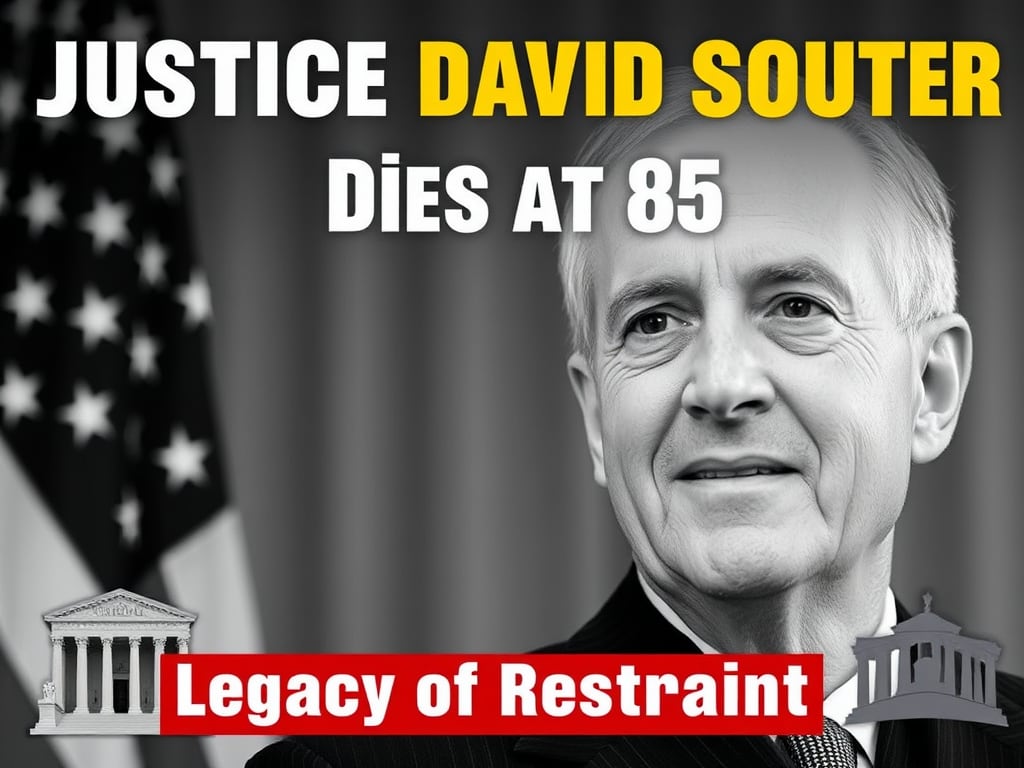
David Souter, Supreme Court Justice Known for Judicial Restraint, Dies at 85
David Souter, a former U.S. Supreme Court Justice known for his commitment to judicial restraint and measured interpretation of the Constitution, passed away at the age of 85. A reserved and principled figure, Souter served on the nation’s highest court from 1990 to 2009 and became known for his thoughtful decisions and refusal to be bound by ideological expectations.
A Quiet Path to the Supreme Court
Born on September 17, 1939, in Melrose, Massachusetts, David Hackett Souter was raised in rural New Hampshire. He attended Harvard College, where he studied philosophy before earning a Rhodes Scholarship to Oxford. He later graduated from Harvard Law School and began his legal career in New Hampshire as a prosecutor and later as the state’s attorney general.
In 1990, President George H.W. Bush nominated Souter to the U.S. Supreme Court, expecting him to be a reliably conservative voice. However, Souter quickly demonstrated a more nuanced approach to the law. He was confirmed with little opposition and replaced Justice William J. Brennan Jr., one of the court’s most influential liberal voices.
A Champion of Judicial Restraint
Justice Souter became widely respected for his principled stance on judicial restraint. He believed deeply that judges should not legislate from the bench and should instead respect precedent and the limited role of the judiciary in a democratic system. His opinions reflected a cautious, fact-driven approach, rooted in a deep understanding of constitutional law.
Souter often emphasized that the judiciary’s role was not to impose personal beliefs or political ideologies but to interpret laws within the framework of the Constitution. He viewed the Court as a guardian of constitutional order, not a vehicle for policy change.
He once said, “The Constitution is not a crystal ball,” reflecting his belief that courts must interpret the Constitution through rigorous analysis and historical understanding, not personal conjecture or political desire.
Independent Decisions and Notable Cases
Though nominated by a Republican president, Souter defied simplistic ideological categorization. He frequently sided with the Court’s liberal bloc in key decisions, particularly on issues of civil rights and personal liberties. His most famous moment came in 1992 with Planned Parenthood v. Casey, where he joined Justices Sandra Day O’Connor and Anthony Kennedy in a pivotal opinion that upheld the core principles of Roe v. Wade, while allowing for certain state restrictions.
In that case, Souter demonstrated both his judicial independence and his commitment to stare decisis—the legal principle of respecting precedent. His willingness to preserve Roe’s constitutional protection for abortion rights placed him at odds with many conservatives but aligned with his belief in institutional stability and restraint.
He was also known for his dissent in Bush v. Gore (2000), the controversial decision that effectively decided the outcome of the presidential election. Souter expressed grave concern over the Court’s involvement, fearing it damaged the judiciary’s credibility.
A Humble Life Off the Bench
Justice Souter was known for his modest lifestyle and disdain for the trappings of Washington. He never married, avoided the spotlight, and lived much of his post-retirement life in the same farmhouse in Weare, New Hampshire, where he grew up. He did not own a television and preferred reading and hiking to media appearances or public engagements.
He retired from the Supreme Court in 2009, expressing a desire to return to his quieter life in New England. President Barack Obama appointed Justice Sonia Sotomayor as his successor.
Despite his retreat from public life, Souter occasionally participated in lectures and public events related to constitutional law. He remained an admired figure in legal circles for his dedication to principle over partisanship and his unyielding respect for the judiciary’s role in American governance.
A Lasting Legacy
David Souter’s legacy is one of balance, restraint, and intellectual honesty. In a time of increasing polarization, his career stands as a reminder of the importance of judicial independence and the value of humility in public service. He believed in the Constitution as a living document, one that must be interpreted with both respect for history and awareness of contemporary reality.
Though he rarely sought attention, Souter’s influence is enduring. His writings and opinions continue to be cited in courts and legal scholarship. His life’s work demonstrates the impact a single justice can have through quiet integrity and unwavering commitment to justice.
Final Reflections
David Souter died as he lived—out of the spotlight, yet deeply respected. In an era when judges are often cast in partisan terms, Souter remained true to his vision of the judiciary as a neutral arbiter, guided by law and principle, not politics. As the nation reflects on his passing, it also remembers a man who gave his life to the service of law, democracy, and the enduring ideals of the Constitution.
He is survived by distant relatives and a grateful legal community that continues to learn from his example. Justice Souter’s calm, careful voice may be gone, but its echo remains in the chambers of justice and the hearts of those who value thoughtful, principled leadership.
About the Creator
kb daily
Covering today’s trends, tomorrow’s conversations. I publish daily stories on the hottest topics in entertainment, culture, and the internet—one scroll-worthy headline at a time
The goals I did not achieve
Every writing goal I made for the year is a wash. It has been this way for a while, but I think it's important to be open about my failures and the reality of how life can get in the way. This is especially true considering the several times I have posted on Vocal about my writing goals, how I was changing my approach, and where I was hoping to be for the upcoming year. I will probably do that again in a couple months, but for now, it is time to acknowledge where I am today.
By Kay Husnick22 days ago in Journal
Why Florida Car Dealers Must Carry a Surety Bond
If you’re planning to open a used car dealership in Florida, one of the first compliance requirements you’ll encounter is the dealer surety bond. Many people assume this is just another formality in the licensing process, but it plays a much bigger role than most applicants realize.
By American US Insurance3 days ago in Journal




Comments
There are no comments for this story
Be the first to respond and start the conversation.