
Conversion is absolute must -Dr.Ambetkar
If you want equality, change your religion. If you want independence, change your religion. If you want to make the world in which you live happily, change your religion. -Dr. Babasaheb Ambedkar

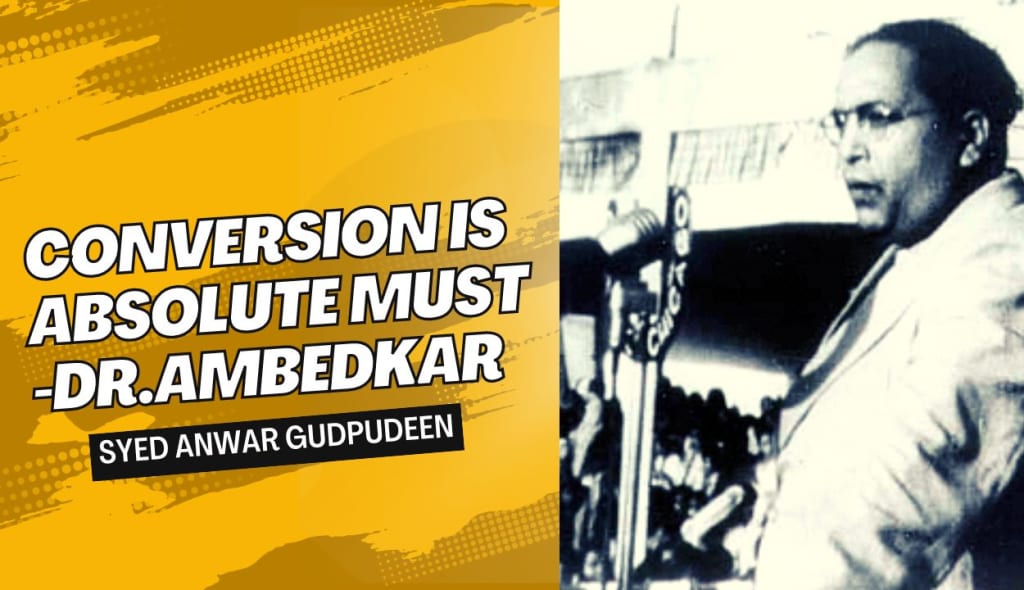
Dr. B.R. Ambedkar, the chief architect of the Indian Constitution, is widely known for his relentless fight against casteism and his contribution to the upliftment of the marginalized sections of Indian society. However, one of the most significant events of his life, which had far-reaching consequences, was his conversion to Buddhism on October 14, 1956. This article examines the reasons for Ambedkar's conversion and the impact it had on Indian society.
Ambedkar was born in a family of Mahars, who were considered the lowest of the low in the caste hierarchy of Hindu society. Despite being highly educated and accomplished, Ambedkar was a victim of caste-based discrimination and prejudice throughout his life. He was denied access to public places, water bodies, and temples, which were reserved for the so-called upper castes. As a result, Ambedkar developed a deep sense of resentment towards Hinduism and the caste system, which he believed perpetuated inequality and injustice.
Ambedkar's disillusionment with Hinduism deepened over time, and he began to explore other religions as a means of escaping the shackles of casteism. He studied Islam, Christianity, and other religions but was not satisfied with their teachings, which he believed were also tainted by casteism. It was only after his extensive study of Buddhism that Ambedkar found a religion that resonated with his values and beliefs.
Buddhism, which originated in India, is a religion that rejects the caste system and believes in the equality of all human beings. Its core principles of non-violence, compassion, and morality, aligned with Ambedkar's philosophy of social justice and equity. Furthermore, the fact that Buddhism was once popular in India but had been supplanted by Hinduism due to the Brahminical revival, made it an attractive option for Ambedkar, who sought to revive the religion in India.
On October 14, 1956, in Nagpur, Ambedkar embraced Buddhism along with over 500,000 of his followers. This was a significant event in Indian history, as it marked the beginning of a new era in the country's social and religious landscape. Ambedkar's conversion had a profound impact on Indian society, and it inspired thousands of Dalits to follow in his footsteps.
One of the most notable outcomes of Ambedkar's conversion was the emergence of a new political force in Indian politics, the Bahujan Samaj Party (BSP). The party was founded by Kanshi Ram, who was inspired by Ambedkar's vision of a casteless society and the revival of Buddhism. The BSP has since emerged as a major political force in several Indian states and has been instrumental in bringing the issues of the Dalits and other marginalized sections to the forefront of national politics.
Furthermore, Ambedkar's conversion to Buddhism had a significant impact on Indian culture and society. It led to a revival of interest in Buddhism and its teachings, which had been largely forgotten in India. It also encouraged the growth of new Buddhist institutions, such as the Dalit Buddhist movement, which sought to provide a space for the marginalized communities to practice Buddhism.
In conclusion, Ambedkar's conversion to Buddhism was a significant event in Indian history and had far-reaching consequences for the country's social and religious landscape. It was a testament to Ambedkar's unwavering commitment to social justice and equity and his belief in the transformative power of religion. Ambedkar's legacy continues to inspire millions of people in India and around the world, and his journey from casteism to Buddhism remains a powerful example of the resilience of the human spirit in the face of adversity.
Dr. B.R. Ambedkar was a prolific writer and orator, whose words continue to inspire generations of people in India and around the world. Here are some of his most powerful quotes:
"I measure the progress of a community by the degree of progress which women have achieved."
This quote reflects Ambedkar's deep commitment to gender equality and his belief that the progress of a society should be measured by the status of its women. He was a strong advocate for women's rights and believed that women's empowerment was essential for the development of any community.
"I do not want that our loyalty as Indians should be in the slightest way affected by any competitive loyalty whether that loyalty arises out of our religion, out of our culture or out of our language."
This quote highlights Ambedkar's commitment to a secular and inclusive India, where people of all religions, cultures, and languages can coexist peacefully. He believed that India's diversity was its strength, and that any attempts to promote sectarianism or parochialism would be detrimental to the country's progress.
"Caste is not a physical object like a wall of bricks or a line of barbed wire which prevents the Hindus from co-mingling and which has, therefore, to be pulled down. Caste is a state of mind."
This quote captures the essence of Ambedkar's fight against casteism, which he believed was a mental construct that perpetuated inequality and discrimination. He argued that the only way to eradicate caste was to change people's attitudes and beliefs, which required a sustained effort to educate and enlighten the masses.
"Political tyranny is nothing compared to the social tyranny and a reformer who defies society is a more courageous man than a politician who defies Government."
This quote highlights Ambedkar's belief in the power of social reform and his conviction that social change was more important than political change. He believed that social tyranny, which manifested in the form of casteism, was a greater threat to individual freedom and dignity than political tyranny, which could be addressed through democratic means.
"I measure the progress of a community by the degree of progress which the weakest members have achieved."
This quote is a testament to Ambedkar's commitment to social justice and equity, and his belief that the progress of a community should be judged by how well it takes care of its most vulnerable members. He believed that a society that left behind its weakest members was a society that had failed to achieve true progress.
In conclusion, Dr. B.R. Ambedkar's words continue to inspire millions of people around the world, and his legacy as a social reformer, politician, and thinker is an enduring testament to the power of ideas and the human spirit. His vision of a society free from discrimination, inequality, and injustice remains as relevant today as it was during his lifetime, and his words continue to challenge us to strive for a better, more just world.
About the Creator
SYED ANWAR GUDPUDEEN
I have amassed two decades of experience in the logistics industry. possess extensive knowledge on the workings of the stock market and hold expertise in the facilitation of contract procurement from public sector firms in India..
Keep reading
More stories from SYED ANWAR GUDPUDEEN and writers in Journal and other communities.




Comments
There are no comments for this story
Be the first to respond and start the conversation.