
Comparing Service-Oriented Architecture and Microservices
This blog explores the differences between Service-Oriented Architecture (SOA) and Microservices, providing you with the key insights you need to make the right choice between the two.
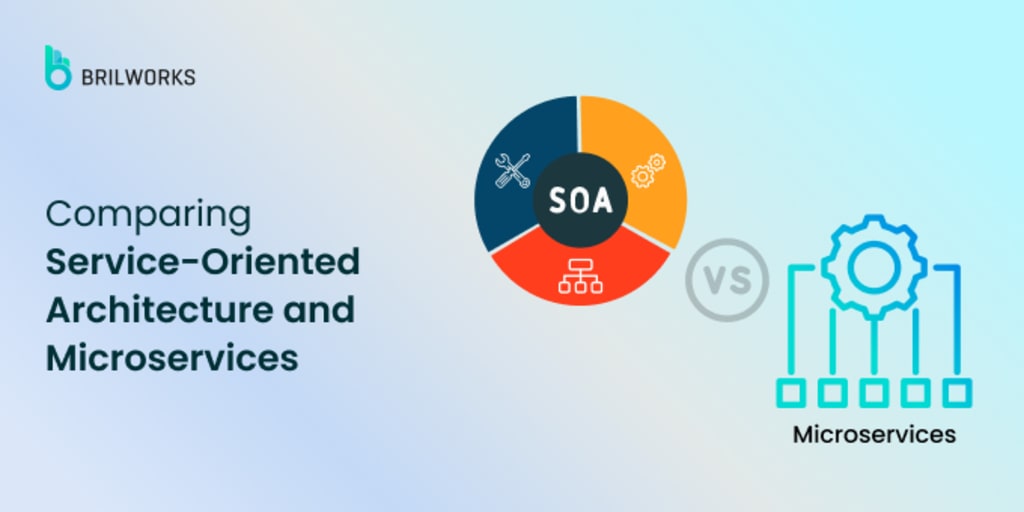
The fast-moving world of technology has made it imperative for companies and developers to find ways to make software more efficient and scalable. With digital transformation at such a breakneck speed, the demand is being placed on organizations to improve their IT infrastructure.
Among these two architectural styles that have flooded into the landscape are Service-Oriented Architecture (SOA) and Microservices, which give their schemes to evolve with the business’s needs and remain ever-changing. Although they share certain conceptual similarities, they also tend to be quite differentiated to cater to different operational scenarios.
The article covers the essential features, advantages, and differences between SOA and Microservices in order to help you choose the most appropriate architecture for your technological endeavors.
A Service-Oriented Architecture, or SOA, is a software design pattern where application components provide services to other components through the means of a communication protocol over a network. The structure of SOA is designed to integrate numerous services, whether newly developed applications or legacy systems, to ensure seamless operation. This approach is especially beneficial for enterprises that have a technological gap between generations.
How SOA Works?
The base of SOA is its ability to reuse existing IT assets, allowing organizations to get the most life from valuable legacy systems. By applying a service layer to wrap these systems in, business functionality can be accessed via standardized interfaces — not only preserving past investments but also opening new windows of opportunities for innovation and growth.
Key Features of SOA
Interoperability: SOA enables different services to communicate with each other, irrespective of the platform or technology on which they are built. Interoperability ensures easier integration, especially for those companies with diverse technology stacks. It also ensures that even more mature systems can interact meaningfully with newer applications; this creates an integrated operational environment.
Reusability: Services within an SOA can be deployed for use in multiple applications thus saving developers time and resources on creating new services from the ground. Once a service is built, it can be leveraged in multiple applications and will significantly contribute to increased productivity and consistency across projects.
Scalability: SOA enforces scalability across businesses by allowing them to increase their operations with services or enhanced versions of their existing services that don’t affect the system at large. This modularity ensures that systems grow incrementally with increased loads or to meet new business requirements without significant overhaul.
Loose Coupling: Services, in SOA, are loosely coupled, independent of one another. This means that it is relatively easy to make updates and maintain services, since changes in one service do not necessitate updates in other services. It also provides flexibility for a quick response to market changes.
Benefits of SOA
Cost-Effective: Reusing existing services reduces development and operational costs. Therefore, this is an advantage for organizations looking for ways to increase their IT budgets and still expand their capabilities.
Flexibility: SOA provides the flexibility to mix and match services to create new applications or enhance existing ones. This allows more room for innovation, as businesses can quickly piece together or modify services to meet emerging needs or exploit new market opportunities.
Improved Integration: SOA helps to integrate separate systems. This allows inter-departmental communication and collaboration. Integration is a crucial factor in breaking down departmental silos and creating transparency through shared objectives.
Understanding Microservices
The microservices architecture represents a new generation of software architecture. It’s an application composed of lots of small, independent services communicating with other services through APIs instead of the more monolithic traditional architectures.
Decomposition based on specific functionality is emphasized for each service since this structure supports rapid development cycles and scalable solutions well aligned with modern agile methodologies.
Each microservice in this architecture is autonomous in nature, which allows for continuous deployment and integration. Since each team can innovate and iterate on services without the constraints of a broader application, this fosters a much more dynamic development environment.
Key Features of Microservices
Autonomy: Each microservice has independence, meaning teams could work on different services at the same time without interfering with each other. This greatly reduces bottlenecks because development, testing, and deployment can all happen in parallel along multiple teams.
Resilience: Failure should be handled gracefully in Microservices. If one of the services fails, it does not affect the application. This resilience is vital for maintaining high availability and reliability, such that applications continue to operate regardless of various service disruptions.
Scalability: Microservices can be scaled individually, so resources can be allocated where they are most needed. This focused scalability optimizes the utilization of resources because only the necessary components are enhanced according to demand.
Continuous delivery: With microservices, updates and features can be deployed more frequently by the developer, keeping the application lighter and more agile. It supports faster time-to-market, enabling businesses to respond extremely quickly to customer feedback and market trends.
Read the full article here.
About the Creator
Vikas Singh
Vikas is the Chief Technology Officer (CTO) at Brilworks, leads the company's tech innovations with extensive experience in software development. He drives the team to deliver impactful digital solutions globally.
Keep reading
More stories from Vikas Singh and writers in Journal and other communities.
Essential Input Strategies in Building Microservices Architecture
Nowadays, building scalable and efficient software solutions is more important than ever because of the fast pace of today’s digital world. Among those popular design patterns is microservices architecture, which allows developers to break down complex applications into smaller, manageable services. The most important aspect of building effective microservices is understanding and implementing essential input strategies. In this article, we will explore how to build microservices input strategies, including input sensors and input bots, to enhance performance and reliability in your applications.
By Vikas Singhabout a year ago in Journal
🅼🅸🅳🅽🅸🅶🅷🆃 🆂🅽🅰🅲🅺🆂
"It's 10 in Tuscon! We all know what that means... It's Time for Midnight Snacks with your man, Gerald Gee! Ready to spend the night together? Me too! I'm full of snacks and can't wait to regurgitate them all back into your hungry ears. Crack a brew! Pop some corn! Anything to get ready for one hell of a show where the talk maybe cheap but the words cut deep...
By Lamar Wiggins3 days ago in Fiction




Comments (1)
Leveraging the Power of Managed IT Services for Small Businesses https://teksupportsquad.com/managed-IT-services-support.html Managed IT Services offer businesses expert IT management and support, ensuring secure, efficient, and scalable operations. By outsourcing to providers like Tek Support Squad, companies save costs, enhance productivity, and protect against cyber threats. Services include network monitoring, cloud solutions, data backup, and 24/7 support. Partner with us today!