
Coding Is Not Enough: Why 2026 Demands Full-Spectrum Product Engineering
Navigating the shift from syntax mastery to value-driven development in a post-AI landscape.

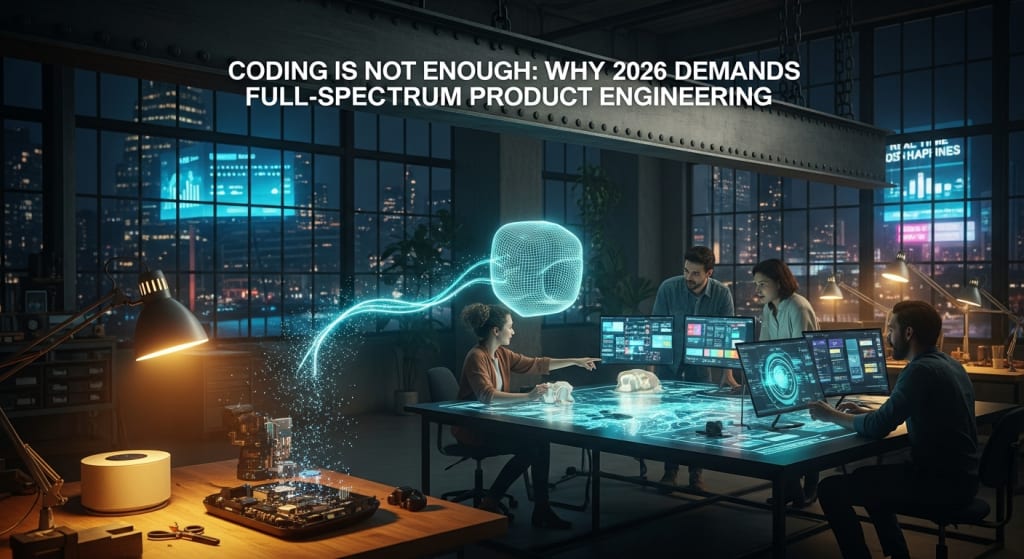
In 2026, the barrier to creating functional code has vanished. Autonomous coding agents now handle the heavy lifting. Advanced neural IDEs manage boilerplate, debugging, and refactoring tasks. This change represents a major tipping point for the industry. Generating code is now a commodity rather than a rare skill. For developers, "just coding" is no longer a competitive advantage. The market now rewards those who bridge technical execution and business outcomes. Success requires delivering genuine value that goes beyond simple syntax.
The 2026 Reality: Syntax is a Commodity
The era of the "pure programmer" has officially ended. We have transitioned into the era of the Product Engineer. In early 2024, proficiency meant navigating complex frameworks. Today, specialized AI layers manage those frameworks automatically. Basic coding has become a low-value commodity. The primary challenge in 2026 is not making code work. The challenge is ensuring the code solves the right problem. We see a growing "Obsolescence Gap" in the current market. Developers focusing only on syntax are being left behind. Elite engineers now master systems architecture and user psychology. They must also understand evolving market-fit dynamics.
The Full-Spectrum Engineering Framework
To stay relevant, professionals must adopt a new framework. This framework prioritizes decision logic over simple keystrokes. It consists of three core pillars for modern development.
- Contextual Architecture: Engineers must see how features impact the entire ecosystem. This includes managing server costs and global data privacy laws. Strict 2026 regulations make this architectural oversight vital.
- User-Centric Logic: Development must move beyond simple "user stories." Engineers need to identify deep friction points in the journey. They must understand the "why" behind every user action.
- Economic Impact: Technical debt is more than just a messy codebase. In 2026, it is a direct financial liability for firms. It slows down time-to-market and increases operational risk.
Real-World Application: Bridging Strategy and Code
Consider a fintech startup trying to scale transaction processing. A traditional coder might only optimize the SQL queries. A Product Engineer analyzes the broader transaction patterns. They might find that 40% of latency comes from APIs. Redundant third-party calls for identity verification cause the delay. They would implement a local cache under zero-trust architecture.
In a real 2025 case, a retail firm failed. They tried to automate inventory using an AI-first template. The code was perfect, but the logic was flawed. The developers ignored the physical reality of warehouse latency. The digital system did not match the human workflow. Workers could not keep up with the automated triggers. Solving this required assessing the physical environment first.
When organizations build complex systems, they need local context. Businesses in urban hubs seek specialized regional expertise. Many firms prioritize mobile app development in Chicago for this reason. This ensures digital products align with local consumer behaviors. It also accounts for specific regional infrastructure requirements.
AI Tools and Resources
- Cursor & Windsurf: These are next-generation "Agentic IDEs" for 2026. They understand the entire repository context, not just lines. Use these for rapid prototyping and large-scale consistency. They are best for engineers managing complex system architectures.
- Linear B: This is an engineering intelligence platform for teams. It identifies bottlenecks in the actual development lifecycle. Team leads use it to translate activity into value. It helps prove the economic impact of engineering decisions.
- LangSmith: This tool is vital for LLM-powered applications. It provides observability needed to debug AI agent logic. It ensures agents do not hallucinate critical business data. Developers use it to maintain high-level decision accuracy.
- Vercel V0: This is a leading generative UI tool. It turns wireframes into functional React components instantly. It allows engineers to focus on high-level interaction design. Avoid it if you need highly bespoke, low-level CSS.
Risks, Trade-offs, and Limitations
Shifting focus away from deep coding carries real risks. There is a danger of "Abstraction Blindness" in teams. An engineer might understand the product but ignore details. They may fail to troubleshoot low-level system failures.
The "Black Box" Failure Scenario: A team uses an AI agent for encryption. The module passes all standard functional tests easily. Six months later, a catastrophic data leak occurs. An edge case in an unvetted library caused it. The AI inherited a vulnerability the team didn't check.
- Warning Signs: Relying on "Generated" tags without performing manual reviews. The team cannot explain the "why" behind architecture.
- Alternative: Always keep a "Human-in-the-Loop" for security layers. Manually vet all code involving data persistence.
Key Takeaways
- Value over Volume: In 2026, your value is the problems you prevent. Shipping many features matters less than shipping the right ones.
- Master the "Why": Learn when a library is the wrong business choice. Move beyond learning how to just use a tool.
- Cross-Disciplinary Literacy: Gain basic proficiency in UX and business analytics. These are now technical requirements for modern engineers.
- Strategic Regional Focus: Digital products require local context to succeed globally. Regional expertise remains a vital component of product engineering.
About the Creator
Keep reading
More stories from Del Rosario and writers in Journal and other communities.
Shell Scripting in 2026: Mastering System Automation with Claude Code
Shell scripting has undergone a radical transformation. The barrier between writing a script and orchestrating a system has dissolved. This is thanks to autonomous coding agents like Claude Code. Engineers no longer need to memorize obscure syntax like sed or awk. The challenge now is managing the logic of generated scripts. You must also ensure security and smooth integration for these tools. This guide is for intermediate to expert developers. It helps you adapt to the 2026 landscape of systems programming.
By Del Rosario6 days ago in Journal
The goals I did not achieve
Every writing goal I made for the year is a wash. It has been this way for a while, but I think it's important to be open about my failures and the reality of how life can get in the way. This is especially true considering the several times I have posted on Vocal about my writing goals, how I was changing my approach, and where I was hoping to be for the upcoming year. I will probably do that again in a couple months, but for now, it is time to acknowledge where I am today.
By Kay Husnick18 days ago in Journal
10 Ways Avionics Testing Prevents Catastrophic Failures
When people think about aircraft safety, they often picture pilots, engines, or airframes. From my perspective, avionics systems sit quietly at the center of almost every safe flight. These systems control navigation, communication, flight displays, sensors, and increasingly, automated decision-making.
By Beckett Dowhan5 days ago in Journal
'20/20'
"Do It Again" the track that would ultimately open the Beach Boys final album on Capitol Records which was released on February 10th 1969 had originally been released as a single in August of 1968. The track was the first of many post-Pet Sounds era throwbacks to the early Beach Boys sound which would become continually more cliched and eventually lead the Beach Boys to the level of self-parody they would eventually succumb to in the 1980s while their closest contemporaries The Beatles nearing the end of their run in 1969 would go on to be viewed as the most influential band of all time. However, the song itself is not bad on its surface, and it opens with a futuristic sounding (for 1969) drumbeat captured by then-Beach Boys engineer Stephen Desper using tape delays on the drums performed by Dennis Wilson and John Guerin. The song has been re-recorded numerous times over the years on various Beach Boys-related projects most notably the 2011 re-recording at Capitol studios featuring the five surviving Beach Boys at the time backed instrumentally by various members of both the Brian Wilson Band and Mike Loves touring "Beach Boys" to promote the then upcoming Beach Boys 50th Anniversary reunion tour in 2012. The hammering and power drill sound at the end of the song was an excerpt from a track called "Workshop" that was to be a part of the uncompleted "SMiLE" album.
By Sean Callaghan8 days ago in Beat


Comments
There are no comments for this story
Be the first to respond and start the conversation.