
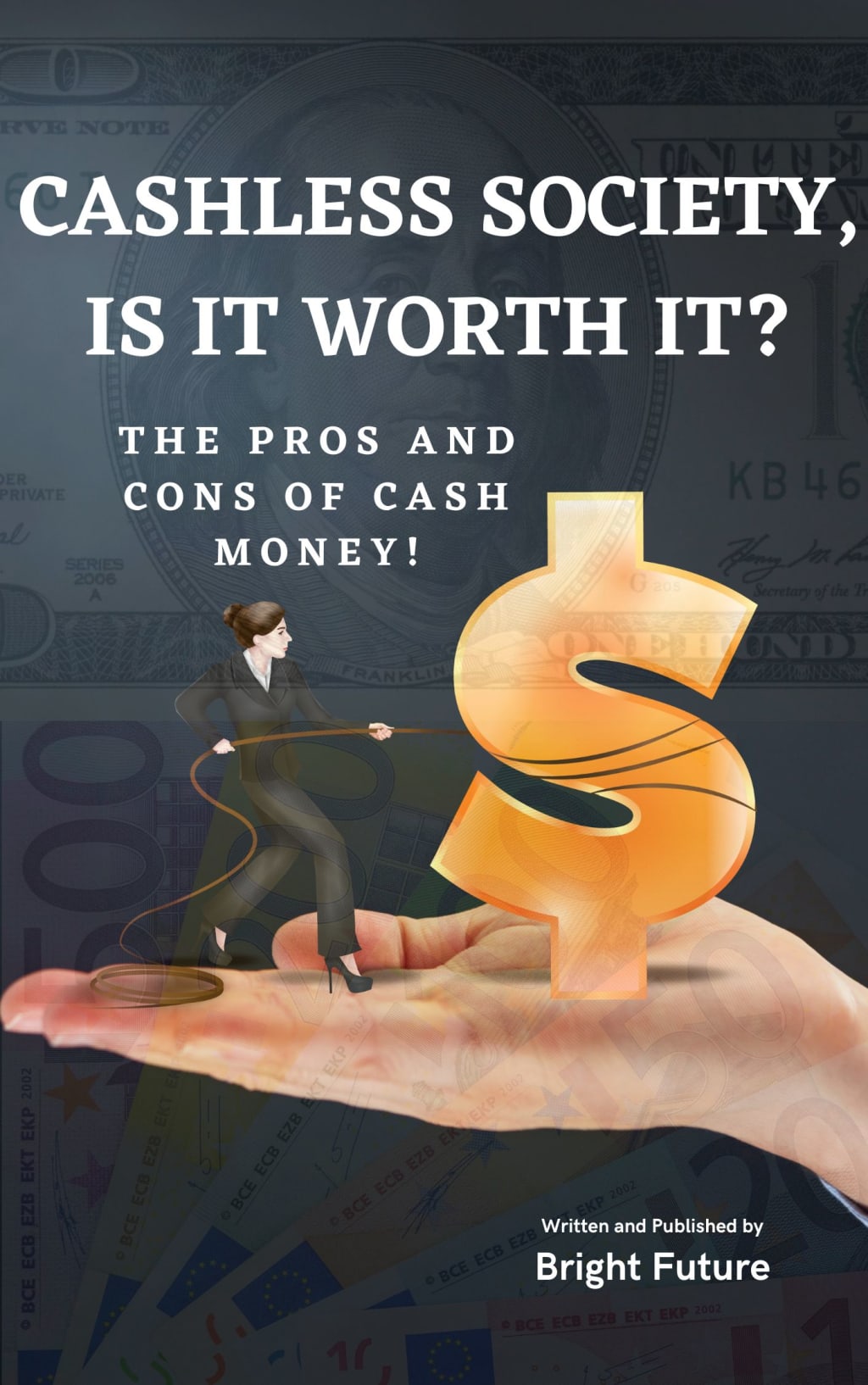
Cashless Society, is it Worth it?
The Pros and Cons of Cash Money!

1 Pros and Cons of Cash Money
1.1 Benefits
1.1.1 Anonymity
Paying with cash money is anonymous. When purchasing various items and goods, it is not necessary to provide your own initials, details or home address. The consumer's privacy is guaranteed - unlike with digital transactions, which are traceable. The time and date of any purchases and the buyer's initials are not recorded for cash payments. Buyers and sellers enjoy the so-called "payment anonymity".
In principle, buyers and sellers do not have to know anything about each other, but there are 3 different types of cash payment methods: 1)If a buyer buys a product at a flea market, for example, both (buyer and seller) can remain anonymous. 2)If you buy goods in the supermarket, the seller is not anonymous, but the buyer is. 3)If a consumer has goods delivered to his home by a furniture store, neither the anonymity of the buyer nor that of the seller is guaranteed.
1.1.2 Macroeconomical Benefits
Macroeconomics is a subcategory of general economics. By analyzing economic sectors, the economy can be viewed as a whole. Statistics and growth, including the negative growth of individual nations, are researched and improved by governments or companies through theoretical procedures. In theory, macroeconomics governs a nation's economic growth. The demand for cash during financial crises increases. People withdraw cash and prefer to keep it at home during crisis or pandemics. Having an “emergency cushion” in cash within your own four walls conveys a feeling of security. Cash is thus seen as the last resort and it is very important to keep it at home.
Inflation rates are high in many less developed countries around the world. The local currency is often unstable and unsteady in value. Therefore, whenever possible, citizens change their savings into more stable currencies such as euros or dollars. This circumstance makes it clear that the inhabitants of such states do not have much trust in the state-owned banks and the prevailing local politics.
Holding cash privately does not incur any interest. In return, some banks in Austria even charge negative interest, which can lead to a certain percentage of the citizens' capital falling. ‘’Bank Austria” charges management fees on customers with an equity worth over EUR 100,000. “Erste Bank” also charges administration fees of 0.5 percent.
1.1.3 Microeconomical Benefits
Like macroeconomics, microeconomics is a subcategory of general economics. Individual economical objects, such as individual households, are examined and their behavior researched. For example let’s assume that the household ''Alexander Peterson'' includes two elderly working citizens. After receiving their salaries, they both withdraw certain sums of cash money from their bank accounts and store it at home to ensure having enough money in their own household. Why? So both of them can get through the month financially if they lose their credit cards or the banks freeze their accounts (like Mastercard did to it’s Russian Members) or any other worst case scenario. This household refrains from ordering food delivery and very rarely visits restaurants. The conclusion is that both use the classic method of cash payments and go shopping physically. The main benefit of cash is its control. With every payment and the reach into the wallet, the expenditure of one's own money is realized. When it comes to digital payments, looking at your own account balances can often lead to painful surprises.
Handling cash is easy. Children or citizens with limited cognitive abilities and poor or no education at all, or people who are unfamiliar with handling a bank account or cannot speak the english language properly and their understanding is limited, such as refugees, are very dependent on cash. The euro is characterized not only by numbers, but also by visible images and colors, which makes it easy to use for the previous mentioned individuals. People who are inexperienced in dealing with online banking or credit card institutions are therefore not completely excluded from society by using cash.
An interesting international study from 2016, called "Banal", looked at the correlation between cash handling and educational attainment. Seven different countries were analyzed: Australia, Germany, France, Canada, the Netherlands, Austria and the USA. The study came to the conclusion that the level of education is an important factor in the use of cash. The income and level of education of individual households were checked - and it turned out that the usage of cash payments is higher among tenants than among property owners. In the US, it is clear that more African American and Hispanic populations are using cash.
1.1.4 Cash makes you Self-Reliant
In 2014, the US imposed sanctions on Russia after annexing the Crimean Peninsula. The credit card companies Visa and Master Card blocked their cards at 4 Russian banks for several days. So it was not possible for Russian Master Card or Visa holders to use their own debit cards/ credit cards - neither in Russia nor abroad. During the Cuba embargo of 2011, the United States of America put pressure on PayPal and threatened European PayPal users with having their accounts suspended if they sold Cuban products.
1.2 Disadvantages of Cash
1.2.1 Tax Evasion
Essential reasons for the abolition of cash is undeclared work. In the case of undeclared work, the remuneration is untaxed, bypassing the tax office. This is very common in the catering trade and tourism sector. If there was no cash, restaurant owners would have to pay their employees digitally. As a result, the payments flow would be documented and traceable. In this way, undeclared work could be slowed down and the factor it plays in tax evasion minimised. In Austria there were several reports of undeclared work in 2021. In addition to gastronomy, the construction industry is particularly affected as well.
1.2.2 Illegal Activities
There are two major risks with cash transactions: counterfeit money and the risk of it's loss once being robbed or scammed. In addition, many transactions in the criminal milieu are carried out in cash like for example Illegal payments, such as drug dealing. The main reason for getting rid of cash money is, it is very difficult to trace back. Many illegal activities are financed with cash and the money acquired usually ends up abroad or outside of one's own national borders. For example, illegal activities such as arms or human trafficking and terrorist financing.
1.2.3 Cash is Impure
After the current corona pandemic, it is not wrong to say that cash transports viruses and bacteria and that it is much more hygienic to pay with the ATM card, which is mainly used by it's owners. Credit cards are rarely passed between individuals, which is not the case with cash money. Banknotes move between countless people. Legally, 90 percent of all dollar bills could pose a problem for their owner. A study by the American Chemical Society of Washington DC found out that in cities such as Washington, the likelihood of cocaine traces on banknotes can increase by up to 93 percent.
1.2.4 Inconvenience
Let's imagine the following situation: A consumer buys a soda in a supermarket pays in cash. In the late afternoon, after work, the same consumer wants to buy more groceries in another supermarket - but forgets that it purchased a soda during lunch and is not aware, that it rests in it's backpack. Arriving at the cash desk, the cashier asks the consumer to open the backpack and the soda is discovered. Due to the lack of a cash receipt for purchasing the soda back then, it cannot be determined whether it was purchased before entering the second supermarket, or not. In worst case scenario, there is a suspicion of theft. If there were no cameras in the supermarket that can confirm the innocence of the shopper, it would be difficult for the police to determine whether the consumer is guilty or not. If the bottle had been purchased digitally, the transaction could be proven and the innocence of the buyer approved. Handling cash is inconvenient. A number of citizens are in possession of oversized wallets. Coins are tucked away in the pants and there is no certainty as to how much and where exactly the cash is. Digital payments are easier to make and a number of bills and metal coins can be replaced with a card. After financial transactions, it is possible to check the account balance with a few clicks.
2 Reasons For and Against getting rid of Cash Money
2.1 Reasons for Eliminating Cash
2.1.1 Uncertainty
Carrying large amounts of cash always creates a feeling of insecurity. If you carry out bigger investments, such as buying a car or even real estate, the transactions are usually carried out digitally - and rightly so. The transport of large amounts of cash alone can be very risky. There is a risk of getting robbed, or when completing the transaction itself: fraud or theft can also occur here. For example, title deeds or land registers could be forged and only found out after the purchase has been handed over. This situation could be prevented with digital transactions: every bank requires its customers to identify themselves for security reasons. All transactions can be traced back. Even if some time later it turns out that the purchase of a property was incorrect or illegal, the transferred money can be traced and reclaimed.
2.1.2 Online Market
The online market is booming. From groceries to fashion, it is now possible to place orders online in almost all areas. The products are then delivered within a few hours or days. During the Corona pandemic there were several "lockdowns" during which only grocers and shops for everyday use were allowed to be open. On the other side, clothing stores remained closed. Online marketplaces were able to help families, for example, to keep their fast growing little children warm and fashionable throughout the winter with suitable clothing. The 21st century is characterized by the great technical revolution of the internet and therefore paying with cash is almost too ''old-fashioned'' for many citizens. It is much easier to make payments online and this saves people a lot of time. Another great example are vacations. Not so long ago - in the early 2000s - holidays and hotels were still booked through travel agencies. Nowadays such agencies are almost irrelevant for many people. Travel deals can be found online and last-minute flights can be found at a ridiculously low price. Another example would be that, with PayPal or Western Union it is possible to transfer money on an international basis in merely minutes and thus help out friends or family members or pay off old debts. Many students who are studying abroad from their homes can be financially supported by their parents.
2.2 Reasons Against Eliminating Cash
2.2.1 Privacy
Every transaction that takes place digitally can be traced. The buyer often has no control over the further use of his data, which in totalitarian regimes such as China can lead to strict state surveillance. Such a restriction of privacy would be very detrimental. Although we, in Europe are largely protected by the GDPR, cyber crime is constantly increasing and there is always the risk of being digitally robbed16. On the one hand, giving up one’s own privacy is unimaginable for many people and frightening for many citizens. On the other hand, the handling of sensitive personal data in online payment transactions is often very negligent. Restricting cash means restricting the freedom of choice by citizens. Modern information technology is advancing at a massive pace. A possible reality, in which the digital payment behavior of citizens could have a direct influence on social evaluation systems evaluated by algorithms. These algorithms or programs could monitor citizens' income and expenditure and could issue liquidity assessments based on financial behavior or classify people into specific categories. If one pursues this idea further, not only banks and credit institutes but also retailers and online platforms could adapt their behavior towards customers to these ratings. The result: a caste society and massive distrust on the part of the citizens.
2.2.2 Freedom
Digital surveillance by the state or banking institutions could limit the purchase of certain goods enormously. We can already see today how quickly consumer activities can be restricted or controlled: Many people are aware that cigarettes can only be purchased from modern cigarette machines with valid ATM cards. The small chip inside the card carries a lot of information about the owner, such as age, which makes purchasing the cigarette pack possible in the first place. But other information about the owner can also be stored on the chip on an ATM card, such as eating habits or criminal histories. In a cashless society, banking institutions could, for example, prevent or make it difficult for addicts with a criminal background to buy alcohol or for overweight people to buy sweets. A slightly more realistic scenario would be that purchases would still be possible, but health insurance and treatments fees could be increased tremendously depending on individuals.
2.2.3 Technical Failure
Another major risk of a cashless world is total dependence on technical infrastructure. If there was a long-lasting power failure, a blackout or cyber attacks on our banking systems, millions of people would be cut off from their money meaning, acquiring food, medicine or petrol. The result could be, in the worst case scenario, even a short-term collapse of society. An immense catastrophe.
Without cash, we are completely dependent on the functionality, of digital transactions. When making a purchase, it can quickly happen that you find out that the debit card does not work because it is either dirty or the card reader is scratched. Without cash, the purchase could not take place. Cash money has been the most successful tool for payments in over 1000 years and today, contrary to the much-cited trend, its popularity among many social classes and older people has even increased again.
2.2.4 Injustice
Banning cash in the European Union would also be unfair, because tourists who have the euro banknotes, could no longer pay with it. A ban would entail an immense tragedy for habitants outside the EU, but even if they were allowed to pay in cash, on the other side, it would be unfair to Europeans who are not allowed to do so. The withdrawal of all banknotes would have to take place on an international basis. It is theoretically possible, but difficult to implement in practice, because not everyone manages to switch to a digital payment system. Many social classes would not have the necessary basic understanding to use them. Central banks would have to buy back their own currencies and not every country compromises with the European Union. Banks launder money. The British bank HSBC is known for their international drug and arms trade. Some proceedings for aiding and abetting money laundering and tax evasion in a number of cases have been discontinued as a result of fines being paid. HSBC Bank has awarded $1.4 billion to the United States for the cessation of money laundering of Latin American drug trafficking. A cash abolition could allow credit card companies to charge more money by raising the price of their services, and doing less to the interest of their customers.
To complete reading Click here to access my self Written and Published E-BOOK
About the Creator
Bright Future
Become the Best Version of Yourself.
📍https://bright-future.at/products/cashless-society-is-it-worth-it
Keep reading
More stories from Bright Future and writers in Journal and other communities.
Reasons Why You should Visit the Snowy Woods this Winter
It’s winter and that means it’s time to hit the snow! Whether you want to ski, snowboard, or just sit by the fire and watch the world go by, there are plenty of great reasons to head up north this year and experience the joy of snow sports in the great outdoors. Here are five reasons why you should visit the snow woods this winter.
By Bright Future3 years ago in Wander
My New Book is Finally Here
My poetry collection Beautiful and Brutal Things is done. It's actually done and finally published over 270 pages. Over a year of my life went into this book. More than a year, really. Long days at my computer, sometimes seven days a week because I couldn't stop even when I probably should have. Then two months of editing that felt harder than the writing itself. But it's finished, and I'm still standing, and the book is real.
By Tim Carmichael3 days ago in BookClub




Comments
There are no comments for this story
Be the first to respond and start the conversation.