
Capacity Considerations for Boat Hoists and Marine Lifts
Ensure Safe, Efficient, and Cost-Effective Boat Handling Operations
Boat hoists and marine lifts play a vital role in shipyards, marinas, boatyards, and waterfront maintenance facilities. Whether hauling vessels out of the water for maintenance, storage, inspection, or launching them back into the sea, these machines must be engineered to safely handle a wide variety of vessel types and sizes. Among the most critical factors when selecting the right marine lift system is lifting capacity.
This article explores the key capacity considerations for boat hoists and marine lifts, how to determine the right lifting capacity for your operations, and the consequences of improper capacity selection.
What Is a Boat Hoist or Marine Lift?
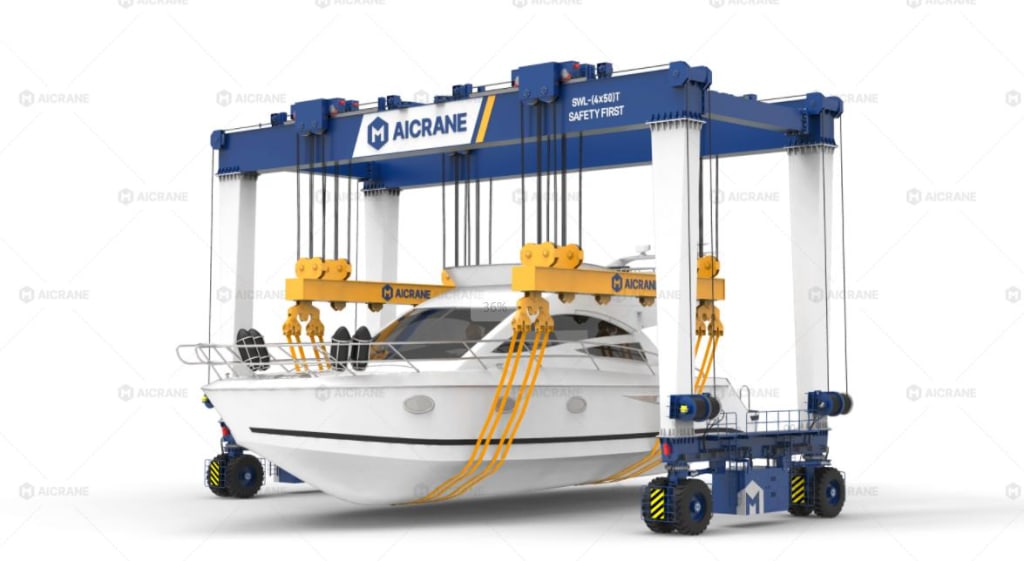
A boat hoist, also known as a marine travel lift or mobile boat hoist, is a specialized type of mobile gantry crane designed to lift boats and yachts out of the water and transport them over land. These systems are typically rubber tyred, powered by diesel or electric drives, and equipped with slings to cradle the hull during lifting.
Marine lifts come in a wide range of lifting capacities - from 10 tons to over 1200 tons - and are highly customizable to match the dimensions and operational demands of the user.

Why Capacity Matters
Selecting a marine lift with the correct capacity is essential for:
Safety: Overloading a marine lift can lead to catastrophic failure, risking damage to the vessel and equipment, as well as injury to personnel.
Operational Efficiency: A correctly sized lift can handle the full spectrum of vessel sizes in your facility without delay or over-engineering.
Cost-Effectiveness: Overspecifying capacity can result in excessive capital and maintenance costs, while underspecifying leads to downtime and service limitations.
Key Capacity Considerations
1. Boat Displacement (Weight)
The most obvious factor is the displacement weight of the boat, which is the total weight of the water a vessel displaces when afloat - effectively its wet weight.
Boat displacement varies significantly depending on vessel type:
Small fishing boats: 5–20 tons
Medium-size yachts: 30–100 tons
Commercial vessels: 100–800+ tons
Large catamarans or ferries: 800–1200+ tons
Important tip: Always plan for a margin of safety above the known maximum displacement to accommodate onboard fuel, water, equipment, or inaccuracies in vessel weight data.
2. Boat Dimensions and Shape
In addition to weight, the length, beam (width), and draft (depth) of the boat influence the lift’s structural and operational design.
Longer vessels require wider spreader beams or longer frame spans.
Wider beams need more sling spacing for stability.
Deep-draft boats need taller lifting frames or adjustable sling points.
Even if a vessel is light, unusual hull shapes - such as catamarans or trimarans - may need dual-point lifting or custom sling positions, which can place asymmetrical loads on the hoist structure.
3. Number of Slings and Lifting Points
Most boat hoists use 4 to 8 lifting slings, connected to hoisting points on the frame. The load must be evenly distributed across these slings, and their positions must match the boat’s structural lifting points to prevent hull damage.
If a lift is rated at 100 tons, that doesn’t mean each sling can independently lift 25 tons - the load may be uneven due to center of gravity, hull shape, or boat contents. This makes it vital to assess individual hoist unit capacity and the hoisting arrangement as part of total system capacity.
4. Load Distribution and Center of Gravity
Vessels rarely have uniform mass distribution. Engines, fuel tanks, and cargo create load concentration zones, shifting the center of gravity. If the hoist slings are not properly aligned, it may:
Overload one side of the hoist
Cause tilt or sling slippage
Damage the vessel structure
Modern marine lifts may include load monitoring systems, allowing operators to ensure equal load sharing and make real-time adjustments to avoid imbalance.
5. Environmental Conditions
Capacity requirements are also influenced by operational conditions, such as:
Wind Load: When lifting tall vessels in coastal or open areas, side wind forces can create additional lateral load on the hoist.
Tide and Wave Motion: If lifting from floating docks or directly from sea level, waves can cause vessel movement during the initial lift.
Ground Conditions: Soft or uneven terrain may reduce the effective capacity of rubber tyred boat hoists unless ground pressure distribution is optimized.
When selecting a marine lift, these factors must be considered to prevent overstressing the structure during non-ideal conditions.
6. Usage Frequency and Work Duty
A hoist's duty cycle - how often and how long it operates daily - affects what lifting capacity and system class you need.
Light-duty applications (e.g., seasonal marinas) may use smaller-capacity lifts with lower duty ratings.
Heavy-duty operations (e.g., commercial shipyards or military bases) need high-capacity, continuous-duty systems with enhanced structural design, stronger components, and high-powered engines.
Choosing a boat travel lift with the proper work classification (FEM, CMAA, etc.) ensures long-term durability under your expected workload.
Customizing Capacity for Your Operation
✅ Capacity Range Options
Most suppliers, like Aicrane, offer marine lifts in standard capacity ranges:
10–50 tons: Light boats, yachts, and small repairs
50–200 tons: Medium yachts, fishing boats, catamarans
200–600 tons: Ferries, tugboats, commercial vessels
600–1200+ tons: Shipyards, military craft, mega yachts
✅ Tailored Frame Width and Height
Custom frame sizing allows boat hoists to match vessel dimensions, giving sufficient clearance during transport and lift.
✅ Adjustable Sling System
Advanced systems feature adjustable sling spacing, hydraulic adjustment, and load sensors, which adapt to varying hull types without compromising safety or efficiency.
Consequences of Choosing the Wrong Capacity
Underestimating capacity can result in:
Structural failure or tipping
Boat hull damage
Costly operational delays
Insurance claims or regulatory violations
Overestimating capacity can lead to:
Unnecessarily high equipment and fuel costs
Oversized footprints that limit maneuverability
Wasted investment in capabilities you don’t use
Therefore, capacity selection must balance performance, safety, and economy.
Conclusion
The lifting capacity of a boat hoist or marine lift is one of the most critical factors influencing its safety, effectiveness, and overall value. Capacity is not just about weight - it involves a comprehensive assessment of vessel dimensions, hull type, center of gravity, operational environment, and usage frequency.
Whether you're running a seasonal marina or a full-scale shipyard, carefully assessing your capacity needs ensures smoother operations, reduced risks, and long-term equipment value. Collaborating with an experienced marine lift supplier can help you design or choose a boat hoist that aligns with your unique requirements.
About the Creator
Aicrane01
Welcome to the Aicrane Blog, your practical guide to lifting solutions. Discover articles covering overhead cranes, gantry cranes, winches, steel structures, boat lifts, and more.
Website: https://steelmillcranes.com/
Author’s Advice
If you would’ve asked me 20 years ago did I know I’d become a writer and an author, I would’ve said “nope, ain’t happening”. As fate would have it I did become an author and I can honestly say I’m loving it so far. It really does feel good to be a writer. I’ve learned a lot on this journey and I feel like with even me being as new to this world as I am, there’s some wisdom I need to share with every other aspiring author.
By Joe Patterson3 days ago in Journal
My Journey as an Actress
From the Bahamas to the Big Screen: The Rising Journey of Tamara Bernell Pesino-Hanna My name is Tamara Bernell Pesino-Hanna, and my story begins on the vibrant shores of Nassau, the capital of the Bahamas. Two years ago, l made the life-changing decision to come to the United States to pursue professional acting—a leap of faith that has since evolved into a blossoming career in the entertainment industry.
By Tamara Hannaabout 20 hours ago in Journal




Comments
There are no comments for this story
Be the first to respond and start the conversation.