
Boss or Leader: What Is the Difference?
A boss bosses people, while a leader leads people.


Definitions of Boss and Leader
According to the dictionary, a boss is a person in charge of others in the workplace. A boss is responsible for assigning tasks, setting schedules, and approving leave for those under his authority.
A leader, on the other hand, is the person who leads or oversees a group in the workplace or organization.
With those two definitions in mind, it is safe to say that a boss bosses people while a leader leads people.
How to Talk Like a Boss and Leader
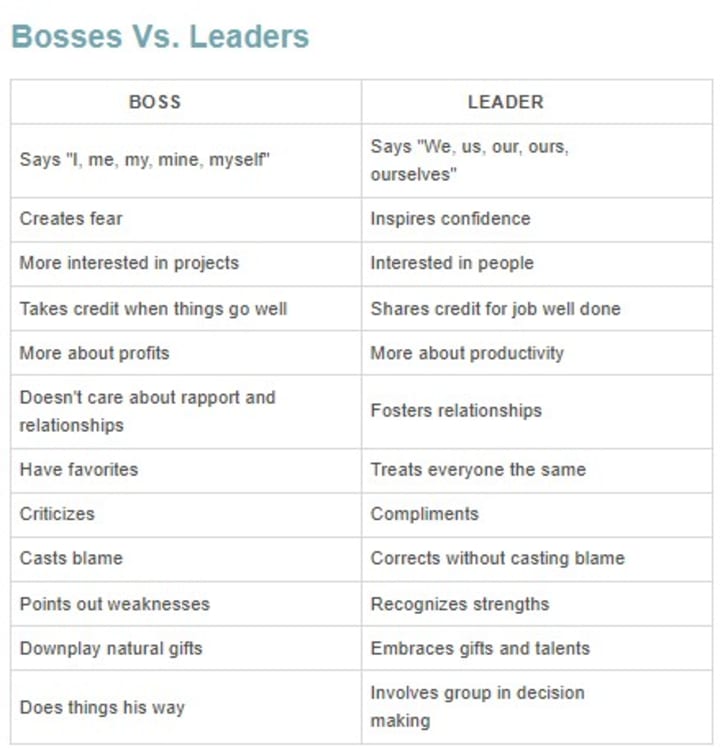
The conversations of a boss are quite different from the conversations of a leader. A boss tends to believe it is all about him and his position. In his conversations, he tends to say, “I,” “me,” “my,” “mine,” and “myself.”
A leader involves others in his conversations. He focuses on shared responsibility. The evidence is recognized in his conversations. Leaders frequently say, “We,” “us,” “our,” and “ours.” This is different from what a boss says.
How Bosses and Leaders Differ in the Treatment of Employees
A boss drives and pushes with invisible chains. A leader knows those under his leadership will do more if there is encouragement along the way. While people who work for a boss do so in fear, those who work for a leader do so with confidence.
A boss is more interested in completing projects than in keeping morale among his workers.
A boss relies on his authority. However, a leader knows he can trust employees to get the job done right and on time. He usually gets complete cooperation from those under his leadership without micromanaging.
Different Approaches to Relationships
A boss rules over the workforce with an iron fist. A leader knows he can get things done by working alongside his employees.
A boss is not interested in fostering relationships and establishing rapport. In fact, he often pits employees against other employees. An effective leader believes in establishing relationships among employees.
A boss plays favorites. He even makes himself part of workplace clichés. A leader doesn't play favorites under any circumstances. He makes everyone feel worthwhile.
Bosses Boss, Leaders Lead: Different Approaches
A boss tells workers how a job should be done and expects them to do it on time without making mistakes. A leader shows others how a job should be done. He frequently works along with them until they get the hang of it. Then he follows up without being intrusive.
A boss places blame and doesn't take responsibility for his mistakes. However, he has no problem taking credit when things go right. A leader shares the blame as well as the credit.
Working for some bosses is no picnic. However, it is a joy to work with a leader who typically cares about those under his authority.
A boss does his job mainly for the money. A leader is passionate about his job. He does his best for his family and his employees. His workers depend on him, and he depends on them.
Anyone can be a boss. However, it takes a very special person, male or female, to be a good leader. Unfortunately, some bosses who have been given authority do not meet the expectations of those working under them. Then, on the other hand, some go beyond the call of duty to do what's right for everyone.
Origin of National Boss' Day
Boss' Day originated in 1958 when Patricia Bays Haroski honored her father, who was her boss at State Farm Insurance. She appreciated the advice he gave her not only as a daughter but as an employee. Haroski chose October 16 as National Boss's Day because that was her father's birthday.
It does not have to be on National Boss' Day to examine the characteristics of a boss, especially when compared to those of a leader.
About the Creator
Margaret Minnicks
Margaret Minnicks has a bachelor's degree in English. She is an ordained minister with two master's degrees in theology and Christian education. She has been an online writer for over 15 years. Thanks for reading and sending TIPS her way.
Keep reading
More stories from Margaret Minnicks and writers in Journal and other communities.
Streetwear Studios: The Premium Streetwear Brand Built for Street Culture
Fashion used to be a top-down industry. For decades, a handful of designers in elite studios decided what the world would wear. But the tide has turned. Today, the most influential trends don’t start on the runways of Paris; they start on the street corners of Tokyo, London, and New York. This is the era of Streetwear, a movement that has transcended clothing to become a lifestyle, a philosophy, and a billion-dollar economy.
By Muhammad Owais SEOabout 17 hours ago in Journal
Cassie and Johnny
I’m the kind of dame you notice. I’m no femme fatale, but you can’t ignore me, at least not until I warn you about what’s coming, then everybody ignores me. Hell, they usually blame me afterwards and give Johnny all the credit for saving the day, but my Johnny couldn’t save a seat at the movies without my help. Sure, he’s brawny, but brainy? Not so much. Like that time I asked him to spot me five bucks, and he said he didn’t see it anywhere on me, and believe you me, he looked but good.
By Harper Lewis6 days ago in Critique


Comments
There are no comments for this story
Be the first to respond and start the conversation.