
Behind the Art
The story and intent of Pantocrator

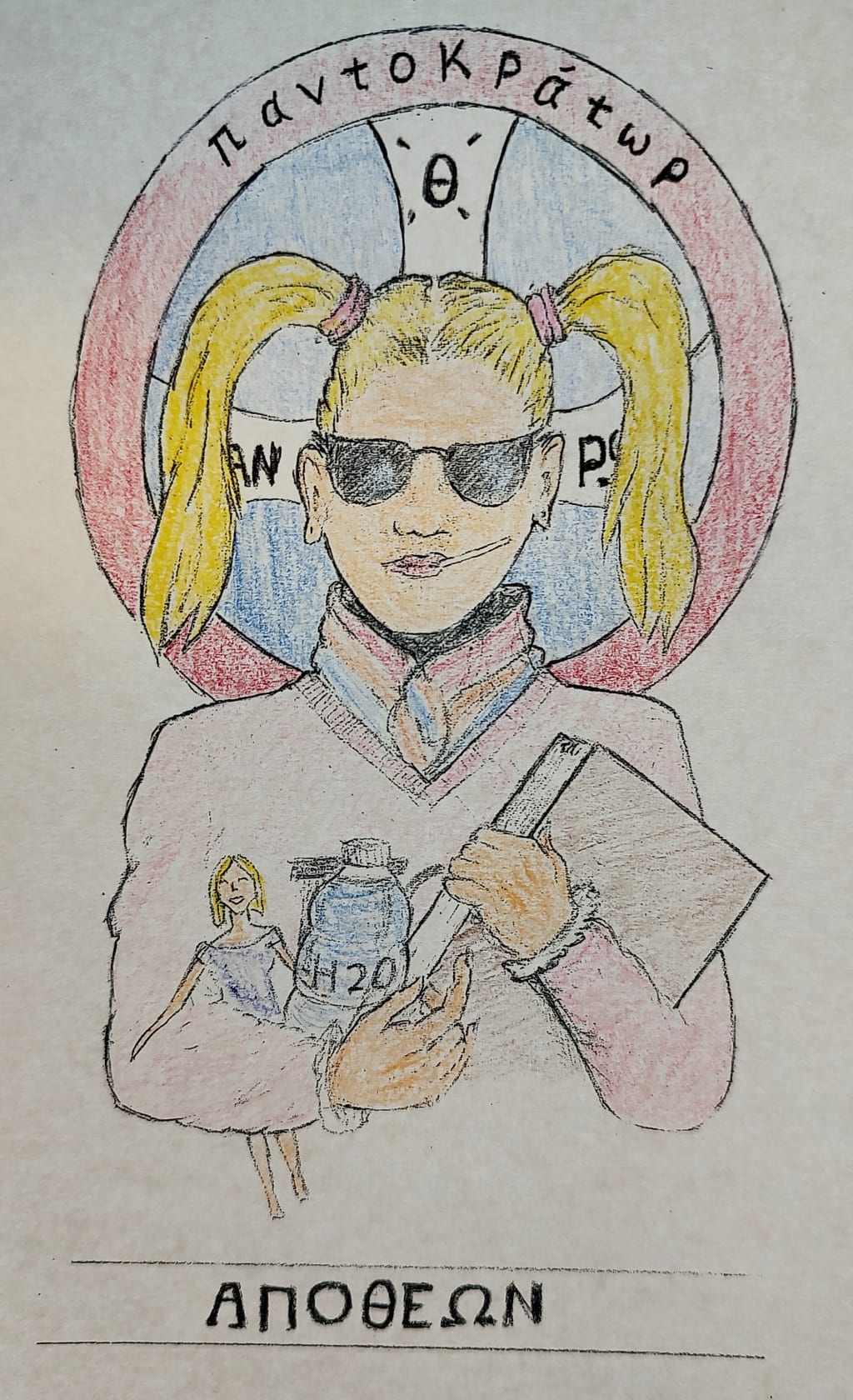
Some time ago I saw a little girl in the bank.
She was maybe 6 years old, and her blonde hair was tied up in pigtails; her face was obscured by large sunglasses, and she wore a pink sweater. In her arms she carried a few treasures: a barbie, a water bottle, and a baggie from the dentist. She had such a compelling presence that I was reminded of an image of Christ I’d seen in some art class or other: the Byzantine church painting called “Pantocrator” which denotes Christ’s power of the world.
The drawing of “Apotheon,” takes the idea of power and applies it to the little girl with pigtails. She shares the pose of the Byzantine Christ: she faces forward, her right hand held in a blessing, her left holds a book. Under her right arm, she holds a doll and a plastic water bottle. Behind her is a circle quartered by a cross, which forms a halo behind her head to represent holiness. On the upper arm of the cross, above her head, is the Greek letter 'theta'; on the horizontal arms of the cross, obscured by the girl's pigtails, are the Greek letters "Alpha, Nu” on the viewer’s left, and “Rho, Omega," on the viewer’s right.
The Greek words and lettering in this drawing are based on abbreviations Christian Church paintings. The word etched along the top of the circle is “Pantocrator,” which is Greek for “Lord of all” which notes her power over the world. Above her head is the letter “theta”, which represents the word “Theos” meaning ‘God’. Placed as it is, the Theos acts as a statement to the nature of the girl: a god or deity.
Along the arms of the cross, the letters “Alpha-Nu-Rho-Omega” merge with the central Theta to hint at “theos anthro”, my own abbreviation for “Theos Anthropos: God-Man,” which is a term for the dual nature of the Christ.
Finally, the whole image is positioned over a placard that says “Apotheon”; a word that means “One exalted to a state of godhood,”. The title acts as a summary of the idea of the work: that she, the human, has become the self-determiner of her own moral reality; her own god.
To me, she represents the way ideas of moral codes have shifted from divine, spiritual sources to human, material sources. It seems to me that religions share, at minimum, the belief that the human nature has a spiritual element; that human activity is influenced by a spiritual realm; and that human action has a spiritual implication as well as a material one. In religion, this belief of a spiritual realm then acts as a guiding force for our material interactions through ideas of relationship, promises of reward, and threats punishment.
This idea of a spiritual realm seems to be fading: The faeries and sprites that governed Nature have been replaced by ideas of Natural Resources, and the Spirit Guides and deities are buried by social psychologies and civil constitutions. The core idea growing, as I see it, is one of Self-Determinism: that the individual is the lord almighty of their own life and the source of their own moral code and conduct. The individual is guided, perhaps, by a shared social order, but the order must be made by humans for humans, and not given or guided by gods or some intangible spiritual realm.
Whether this shift is a good thing or bad thing has yet to be seen, but I do wonder: if we strip the world of wonders; what’s left?
About the Creator
Judah LoVato
My collection of sometimes decent writing
Which I've left "there" for seekers to seek
Though I lack the grandeur of that Pirate King
Perhaps these pebbles can be a light
In this life, this laughing tale
Keep reading
More stories from Judah LoVato and writers in Journal and other communities.
One Who Seeks the Light
I’m leaving it all, my love: The village, the temple, this life we’ve built, and you. I don’t expect your forgiveness, but even so I’ve loved you since the day we met, and I love you still. I didn’t tell the temple, I can think of no good words for them, but for you above all I wanted to leave an explanation, a reason, if only to ease my own guilt.
By Judah LoVato9 months ago in Journal
Car Audio Market: How In-Car Sound Is Becoming a Premium Experience
The driving experience is no longer defined only by horsepower and handling. Today, sound quality plays an equally powerful role. Whether it is music streaming, navigation prompts, or hands free calls, in car audio systems shape comfort, entertainment, and connectivity on every journey.
By james robert6 days ago in Journal
Magic
Note from the Author: I want to let you know that this is an unusual story, and it has been written purely from whatever is in my unconscious mind, because before I start writing, I get into a flow state that reaches my unconsciousness. I also write in my subconscious mind, which is like a mid-flow state between the conscious and unconscious mind.
By Denise Larkin6 days ago in Fiction


Comments
There are no comments for this story
Be the first to respond and start the conversation.