
Automation Testing: The Key to Reliable Software
Automation testing ensures consistent, efficient, and reliable software performance by running repetitive tests, identifying bugs early, and improving overall quality

A continuous testing cycle is necessary to provide high-quality software, regardless of whether you use a waterfall methodology, an Agile model, or another model. Automation works in partnership with manual testing to ensure that application testing is completed efficiently. Automation testing incorporates new techniques and technologies into the testing process, allowing for a speedier market release of high-quality products.
In this blog, we will gain knowledge about the importance of automation via learning what it is, why it’s needed, and the automated testing benefits. Moreover, we will look into different types of automation testing, how to choose the right tool and framework, what strategies and best practices should be used, agile integration, what will be the future trends, the role of CI/CD, how to measure ROI, How much project success in the market after using automation testing, why BDD framework. Whether you are fresher in your career or a seasoned software development engineer in test looking to keep up with the newest developments, this blog will help you comprehend the world of automation testing.
What is Automation Testing?
Automation testing involves specialized software tools or scripts to check the quality of a product without the need for significant human intervention. This process eliminates the repetitive tasks previously carried out by humans and allows for the efficient management of tests, comparison of actual versus expected outcomes, and storing of findings reports.
The importance of Automation Testing and the benefits it delivers
Manual testing can be an obstruction in the development process as it becomes time-consuming and expensive to test applications, particularly the testing types like regression testing, performance testing, cross browser testing. As a result, product release might be delayed and costs increased. Here, automation testing offers a smooth testing process by automating repetitive tasks, unlocking a range of test automation advantages:
Improve quality and scalability: Automation testing enables detailed testing for various scenarios such as regression testing, load testing, parallel testing in various browsers. Thus, the development process can handle the user demands without compromising the quality of the product.
Early Bug Detection, Accuracy and Consistent Results: Automation testing runs faster than the manual testing which allows testers to log the bug earlier if present. The steady result of the repetitive scripts increase the accuracy of the product and share the manual testing burden to allow them to work on more complex scenarios.
Increased Test Coverage: Automation testing covers a larger area of the testing scenarios compared to manual testing and adds enhancement to the accuracy of the product.
Reusable: The written test scripts are reusable for testing when the development process has new changes, which will save time and effort from manual testing and the tester can focus on other tasks and scenarios.
Parallel Testing: The simultaneous execution of automation scripts on numerous devices reduced the significant amount of time spent on the testing.
Faster Releases, Reduced Costs and Resources: Automation performs a few tasks for the developer and tester, freeing them up to work on more important duties while saving money for additional resources and time for the present resource.
↪️To know more about advantages of automation testing, read our blog: Why Automation Testing is Essential: Key Benefits Explained.
Fiction about the Automation Testing
In the tech industry, there are several false beliefs and misunderstandings about automation testing. One of the most prevalent myths is that automation testing will completely replace the job of manual testers. However, in actuality, automation testing complements manual testing by enhancing product quality and expediting product releases. Another common belief is that automation testing is only for large-scale projects. In reality, small projects can also benefit from the automation scripts for the tasks that manual testers have to perform repeatedly. Automation testing does have some cons, but with proper planning and implementation, it can be overcome.
↪️For a deeper understanding of common myths and misconceptions about automation testing, and to uncover the real story behind these beliefs, check out this insightful Blog: Automation Testing Myths & Misconceptions vs. The Real Story.
Types of Automation Testing
Automation testing makes the testing process efficient by using various tools and techniques. Automation testing types are divided into two categories: Automated UI Testing and Automated API Testing.
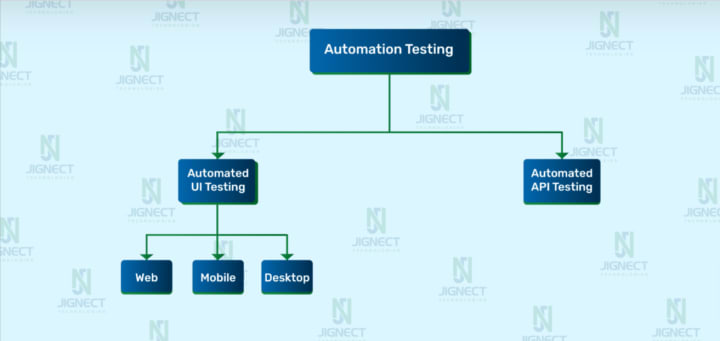
Automated UI Testing
This testing involves the interaction of the software application’s UI elements, such as buttons, menus, dropdowns, checkboxes, and textboxes using automation tools. It verifies that the software application from the UI side works as expected from the business perspective. For instance, automating the login page of the application where username, password textboxes, and a login button are present with the ‘Login’ header, check that the user can login successfully while entering correct data and get user-friendly validation messages while entering incorrect data, along with comparing the design of the page with the expected UI.
Automated API Testing
This testing involves interaction with the application programming interface to verify functionality and its behavior. It focuses solely on the backend logic and data exchange without interacting with the user interface. By automating the API, testers can verify the data accuracy, consistency, performance, security, endpoint, and reliability of the application for every case within minutes. For illustration, automating the login API with all valid and invalid data inputs with assertion verifies the response format, response time, response data, and status code matched with the expected business requirements and frontend integration requirements.
Leveraging both types of automation testing in projects helps teams achieve rapid feedback, enhance product quality, and decrease the workload of the manual tester.
How to choose the best Automation tool for a project?
The selection of the correct automation tools depends on the project’s requirements. It is like finding the right diamond from the sea. There are some steps that you can follow to identify the best tool for your project.
Understand the project: What is the domain of application? What kind of scenarios need to be automated? In which platform do automation scripts need to run?
Team members: What skill set does the team have? What is your budget?
Understand the tools: Is it easy to use? Does it offer the features that the project requires? Does it easily integrate with other tools that are required to use in a project?
Long-term support: Does the tool have community support?
The project success ratio will be increased if you follow the mentioned steps by considering project requirements carefully.
Click on this link to read more about it:
https://jignect.tech/automation-testing-the-key-to-reliable-software/
About the Creator
Jignect Technologies
At JigNect Technologies, we believe that software testing is an art, a science, and a passion. Our team of experts combines years of experience, cutting-edge technology.
Keep reading
More stories from Jignect Technologies and writers in Journal and other communities.
Automation Testing Myths & Misconceptions vs. The Real Story
Automation testing is gaining popularity in the software development life cycle by offering numerous advantages such as rapid feedback, quick release, and improved accuracy. Despite these benefits and popularity, there are several false beliefs present in the market that stop product owners from taking advantage of automation testing. In this blog, we will discuss the common myths and realities for testers, developers, stakeholders, companies, and the general audience so they can leverage the benefits of automation testing efficiently.
By Jignect Technologiesabout a year ago in Journal
Exploring Dubai on a Budget: Affordable Things to Do
Let's be real, Dubai has a reputation for being a playground for the wealthy. But scratch beneath the gold-plated surface, and you'll discover a city brimming with surprisingly affordable adventures. After living here for three years and chatting with locals who know where the real value lies, I've learned that experiencing Dubai's magic doesn't require an endless wallet.
By Silverstone Rent a Car6 days ago in Journal
📢 Raise Your Voice Thread: 01/22/2026
Our “Raise Your Voice Threads” are hosted most alternating Thursdays at 12PM ET to offer creators more avenues to uncover exceptional stories on Vocal. As we are continuously searching for fresh creators and inspiring stories, this thread provides an opportunity to exchange and discuss the stories that have moved and motivated us on Vocal.
By Raise Your Voice by Vocal5 days ago in Resources



Comments
There are no comments for this story
Be the first to respond and start the conversation.