
Australia Textile Recycling Market: Modest Growth, Big Sustainable Potential
As consumer demand, regulations, and technology converge, Australia’s textile recycling sector is poised for steady expansion — growing from USD 108 million in 2024 to USD 133.93 million by 2033.

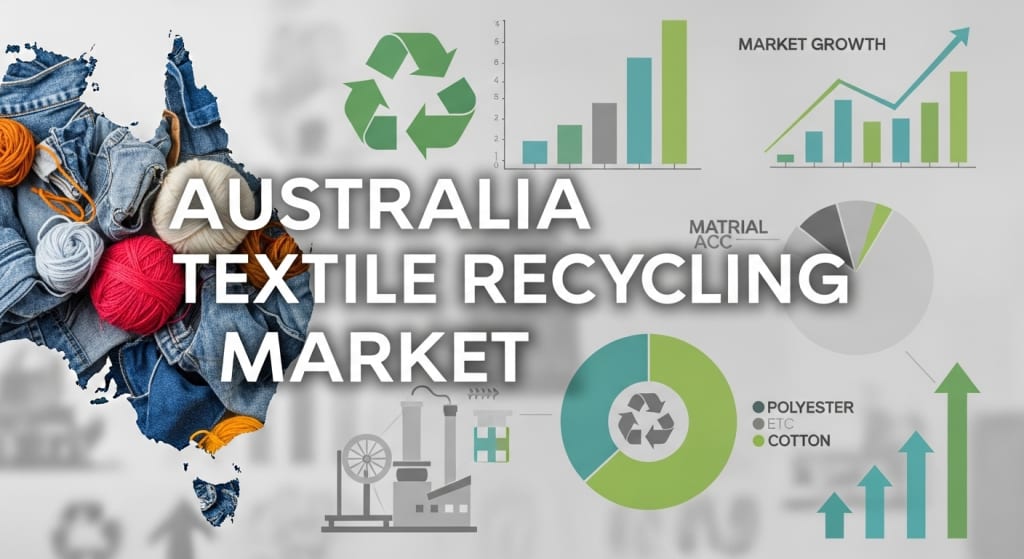
Market Overview
- In 2024, the Australia textile recycling market was valued at about USD 108.00 million.
- By 2033, it is forecast to reach approximately USD 133.93 million, reflecting a compound annual growth rate (CAGR) of 2.42% over the period 2025–2033.
- Segmentation in the IMARC report covers: product types (cotton, wool, polyester, nylon, others), textile waste source (pre-consumer vs post-consumer), distribution channels (online, retail/departmental stores), end-use (apparel, industrial, home furnishings, non-woven, others), and regional breakdowns (ACT & NSW; Victoria & Tasmania; Queensland; Northern Territory & South Australia; Western Australia).
Key Trends & Market Drivers
1. Environmental Awareness & Policy Push
Australians are increasingly conscious of textile waste: high volumes of clothing and garments go to landfill each year. Government policy (such as the National Waste Policy Action Plan) and state-based circular economy initiatives are pushing for extended producer responsibility (EPR) schemes, textile take-back programs, and waste diversion goals.
2. Technological Advancements
Recycling technologies are improving: fiber-to-fiber regeneration, chemical separation methods, AI-assisted fabric sorting, enzymatic and mechanical recovery of natural fibers (cotton, wool) are becoming more feasible. These innovations help address the issue of mixed or blended textiles and improve the quality of recycled material.
3. Corporate Collaboration & Circular Economy Integration
Retailers, clothing brands, recycling firms, and local governments are forming partnerships to build infrastructure for collecting, sorting, and recycling textiles. Take-back schemes by fashion brands and department stores allow consumers to return used garments. Public-private efforts are helping create closed loop systems where textile waste becomes feedstock for new fabric or products.
4. Rising Textile Waste & Landfill Pressure
Fast fashion, high rates of apparel consumption, and low rates of textile reuse are resulting in large volumes of post-consumer textile waste. Landfill capacities, environmental concerns, and rising waste management costs are driving urgency for recycling solutions.
5. Consumer Shift Toward Ethical & Sustainable Fashion
Customers increasingly prefer brands that incorporate recycled content, ethical sourcing, transparency, and eco-friendly practices. Social awareness through media, education, and influencers plays into purchasing decisions. This demand is pushing manufacturers toward recycled fabrics, upcycled lines, and waste reduction in supply chains.
Get a PDF Request Free Sample Report: https://www.imarcgroup.com/australia-textile-recycling-market/requestsample
Opportunities in the Australia Textile Recycling Market
Scaling Fiber-to-Fiber & Chemical Recycling
Companies investing in or scaling chemical recycling technologies (for blending synthetic fibers, polyester, nylon) and fiber regeneration (restoring natural fibers) have room to capture premium recycled input markets.
Enhanced Collection & Sorting Infrastructure
Improving textile collection programs (especially in regional/rural areas), investing in AI or automated sorting, and creating standardized drop-off/return networks can supply better quality input material to recyclers.
Brand Take-Back Programs & Retailer Engagement
Fashion brands and department stores can strengthen sustainability credentials through nationwide garment return programs, rewards for returns, and marketing around recycled products.
Expansion in End-Use Applications Beyond Apparel
Roofing insulation, home furnishings, industrial non-woven textiles, mattress stuffing, automotive/textile composites—these are potential growth areas for recycled textile feedstock.
Government and Policy Incentives
Leveraging grants, subsidies, or tax incentives for recycling innovation and infrastructure, as well as regulatory frameworks (EPR, mandates for recycled content), can lower barriers and increase investment.
Consumer Education & Awareness Campaigns
Educating consumers on how to recycle textiles, what to look for in recycled products, and supporting reuse / resale (secondhand, upcycled fashion) helps drive demand and improve recycling input supply.
Recent News & Developments in the Australia Textile Recycling Market
- February 2025 – Pact Group and BlockTexx sign MoU to assess feasibility of a large-scale polyester and cotton blend recycling operation. This would include collection, sorting, and chemical recycling of garments into raw materials suitable for new clothing or other sustainable applications.
- April 2024 – Textile Recyclers Australia (TRA) partners with the ARC Research Hub for Microrecycling of Battery and Consumer Wastes, led by the UNSW SMaRT Centre. The goal: develop scalable technologies for difficult-to-recycle fabrics, boosting material recovery and reducing landfill.
Browse Full Report with TOC & List of Figures: https://www.imarcgroup.com/australia-textile-recycling-market
- While growth is modest (2.42% CAGR), the textile recycling market’s importance is disproportionately large in environmental impact: reducing landfill, lowering greenhouse emissions, conserving water and resources.
- For fashion brands, textile product manufacturers, waste management firms, and policymakers, this sector presents strategic relevance: aligning with ESG expectations, meeting regulatory pressure, and responding to consumer values can build competitive advantage.
- Technology innovators that can reduce cost, improve recycled fiber quality, or solve sorting challenges will be well-positioned in the supply chain.
About the Creator
Kevin Cooper
Hi, I'm Kavin Cooper — a tech enthusiast who loves exploring the latest innovations, gadgets, and trends. Passionate about technology and always curious to learn and share insights with the world!
Keep reading
More stories from Kevin Cooper and writers in Journal and other communities.
Author’s Advice
If you would’ve asked me 20 years ago did I know I’d become a writer and an author, I would’ve said “nope, ain’t happening”. As fate would have it I did become an author and I can honestly say I’m loving it so far. It really does feel good to be a writer. I’ve learned a lot on this journey and I feel like with even me being as new to this world as I am, there’s some wisdom I need to share with every other aspiring author.
By Joe Patterson4 days ago in Journal
A Beginner’s Guide to Trading NASDAQ and Dow Jones
Trading NASDAQ and Dow Jones requires a clear understanding of what these indices represent and how they function in global financial markets. Both indices track groups of large companies listed in the United States, but they differ in composition, sector focus, and market behavior.
By Agast Mishraabout 23 hours ago in Journal




Comments
There are no comments for this story
Be the first to respond and start the conversation.