
Australia Hybrid Vehicles Market: High Demand, Trends, Rapid Growth
With the market scaling from USD 15.93 billion in 2024 to a projected USD 194.03 billion by 2033 (CAGR ~28.40%), hybrid vehicles are becoming a major bridge in Australia’s journey toward cleaner transport.

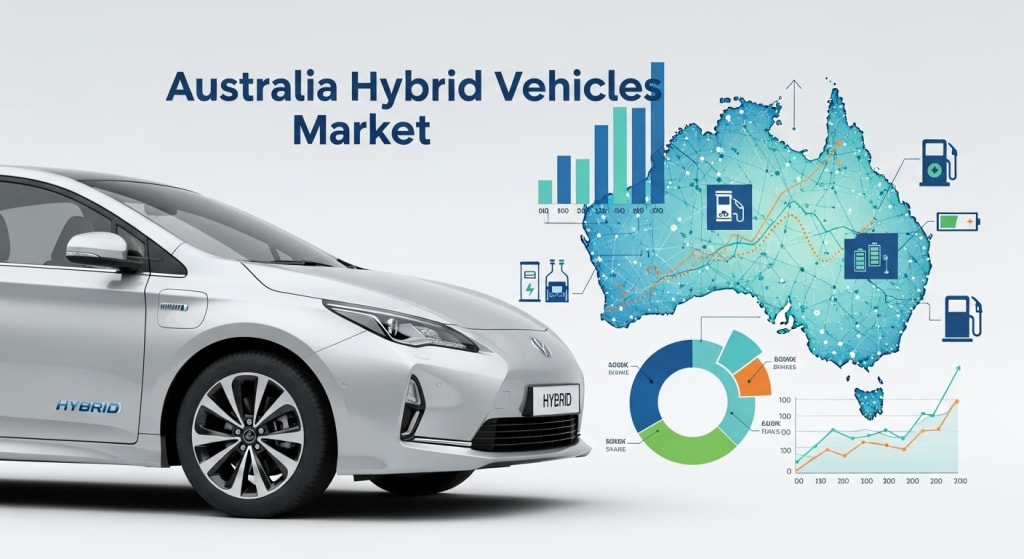
Market Overview
- In 2024, Australia’s hybrid vehicles market (including hybrids of all types) was valued at USD 15.93 billion.
- Forecasts suggest the market will reach USD 194.03 billion by 2033, growing at a compound annual growth rate (CAGR) of 28.40% between 2025-2033.
- In terms of units, about 360.2 thousand hybrid electric vehicles were sold in Australia in 2024. By 2033, the volume is expected to climb to 2,710.5 thousand units.
- Hybrid vehicle types include micro-hybrid, mild-hybrid, full-hybrid, and plug-in hybrid (PHEV) models. Vehicle categories cover passenger cars and commercial vehicles across regions like NSW/ACT, Victoria & Tasmania, Queensland, Northern Territory & South Australia, Western Australia.
Key Trends & Market Drivers
1. Fuel Cost Volatility & Environmental Awareness
High petrol/diesel prices, along with growing concern over emissions and climate change, are pushing more consumers toward hybrids. Hybrids offer improved fuel economy compared to conventional vehicles—especially in stop-start city traffic.
2. Government Incentives & Regulatory Pressure
Support via tax incentives, rebates, reduced registration fees, lower duties, and public fleet procurement is helping hybrids gain traction. On the flip side, newer regulations, like the New Vehicle Efficiency Standard (NVES), are raising emission targets and penalising heavier polluting vehicles—making hybrids more necessary for compliance.
3. Expansion of Hybrid Models & Automaker Commitments
Automakers are rapidly expanding their hybrid lineups. More full and plug-in hybrid choices are being introduced—SUVs, utes, commercial vehicles included. Examples: Mitsubishi emphasising PHEVs for popular models like Outlander; brands like Chery launching hybrid SUVs with strong electric-only range.
4. Changing Incentive Landscape (e.g. Tax Exemptions)
A major change: as of 1 April 2025, plug-in hybrids (PHEVs) no longer qualify for the Fringe Benefits Tax (FBT) exemption. This removes an important financial incentive for buyers using novated leases. This policy shift may alter buying behaviour.
5. Infrastructure Growth & Reduced Range Anxiety
While hybrids don't always need external charging (for full or mild hybrids), PHEVs benefit when charging infrastructure is available. Governments and private firms are investing in fast and ultra-fast chargers, especially in urban and regional areas, making plug-in hybrids more practical.
Get a PDF, Request for a Free Sample Report: https://www.imarcgroup.com/australia-hybrid-vehicles-market/requestsample
Opportunities in the Australian Hybrid Vehicles Market
Hybrid Fleets for Commercial, Government, and Utility Use
Organisations with high mileage (fleet operators, delivery services, government fleets) stand to gain from lower fuel costs and reduced emissions by switching to hybrids, especially full-hybrids and PHEVs.
Rural and Regional Demand
In areas where full EV infrastructure is limited, hybrids (especially those offering good electric range) provide a compelling middle ground. For long-distance drives, utility usage, and mixed road types, hybrids still offer reliability and savings.
Model Availability in Popular Segments
Consumers often demand SUVs, utes, crossovers. Auto-makers that bring hybrid variants of these vehicles will likely succeed. The strong early interest in models like the BYD Shark 6 (a plug-in hybrid ute) hints at demand in segments traditionally dominated by petrol/diesel. IMARC Group+1
Refreshing Incentives & Policy Clarity
Given the removal of some benefits (e.g. the FBT exemption for PHEVs), there’s opportunity for state/federal governments to introduce alternative or replacement incentives (rebates, tax breaks, charging infrastructure grants) to maintain momentum. Clear guidance helps consumers and businesses make long-term purchase decisions.
Localized Assembly / Manufacturing
There’s potential for domestic production, or local assembly of hybrid models or components (battery packs, hybrid drivetrain), which could reduce cost, improve supply chain resilience, and create jobs.
Consumer Education & Awareness
Many buyers still don’t fully understand hybrid types (mild, full, plug-in) or their relative benefits. Clearer messaging from manufacturers and incentives for dealerships to inform buyers can remove barriers.
Recent News & Developments in the Australia Hybrid Vehicles Market
FBT Exemption for PHEVs Ends on 1 April 2025
This marked a key policy change. Buyers using novated leases won’t get the FBT benefit for plug-in hybrids anymore. Many in the auto industry (e.g. Mitsubishi) argue this will dent PHEV sales unless replaced by other incentives.
Mitsubishi Emphasizes PHEVs Amid Policy Shift
In July 2025, Mitsubishi Motors Australia (MMAL) reaffirmed its strategy to lean on PHEV and hybrid powertrains to meet forthcoming NVES emissions targets. Despite the loss of some incentives, they argue hybrids are essential interim solutions.
Strong Launch and Demand for Hybrid Utes (e.g. BYD Shark 6)
The BYD Shark 6 plug-in hybrid ute saw enthusiastic pre-orders—orders counting in thousands within hours. These vehicles combine typical Australian preferences (utes, size, utility) with hybrid technology. It reflects clear demand in segments previously under-served by hybrids.
Surge in Hybrid and Electric Vehicle Financing
Data from finance bodies revealed that in 2024, financing for hybrid and EVs exceeded AUD $6.17 billion, increasing quite sharply (≈ 50%) from prior year. The number of vehicles financed (EV + hybrid) rose significantly—showing strengthened consumer and business acceptance.
Warning from Manufacturers About Hybrid Pricing Under Emissions Policies
With emission standards tightening, automakers warn hybrid and petrol vehicle prices may rise. Honda Australia, for example, has cautioned that under NVES targets and upcoming emission thresholds, costs for hybrids will increase as manufacturers absorb costs for compliance.
Browse Full Report with TOC & List of Figures: https://www.imarcgroup.com/australia-hybrid-vehicles-market
For consumers, hybrids are increasingly a real compromise — offering lower running costs and fewer emissions without the full range anxieties or infrastructure dependency of pure electric vehicles. However, policy shifts like ending the PHEV exemption could alter the cost calculus. Renting, novated leases, upfront costs, and resale value all matter.
For auto industry / manufacturers, hybrid technology is no longer optional—it’s a key part of meeting emission standards, expanding product lines, and staying competitive. Models that blend electric and ICE power, especially in popular segments (SUVs, utes), are potential winners.
For policymakers, the challenge is balancing incentives, regulatory mandates, and infrastructure investment. Ensuring that hybrids remain attractive under the evolving emissions regime, while continuing to build EV charging infrastructure, is essential.
For environment & climate goals, hybrids offer a transitional tool: reduced emissions, lower fuel consumption, less dependency on fossil fuels. While the ultimate target may be zero emissions vehicles, hybrids can play a significant role in getting there—especially in the near term.
About the Creator
Kevin Cooper
Hi, I'm Kavin Cooper — a tech enthusiast who loves exploring the latest innovations, gadgets, and trends. Passionate about technology and always curious to learn and share insights with the world!
Keep reading
More stories from Kevin Cooper and writers in Journal and other communities.
Australia Energy-Efficient HVAC Systems Market: Share, Growth Drivers, Cooling Smarter
Market Overview The market size for energy-efficient HVAC systems in Australia reached approximately USD 1,563.64 million in 2024. Forecasts project it will grow to USD 2,716.68 million by 2033, with a Compound Annual Growth Rate (CAGR) of around 6.33% between 2025-2033. The report breaks the market into product types such as heat pumps; water heating & cooling systems in buildings; efficient air conditioning systems; and others. Applications span residential, commercial, office buildings, and more. Key regions include New South Wales & ACT; Victoria & Tasmania; Queensland; Northern Territory & Southern Australia; Western Australia.
By Kevin Cooper3 months ago in Journal
The goals I did not achieve
Every writing goal I made for the year is a wash. It has been this way for a while, but I think it's important to be open about my failures and the reality of how life can get in the way. This is especially true considering the several times I have posted on Vocal about my writing goals, how I was changing my approach, and where I was hoping to be for the upcoming year. I will probably do that again in a couple months, but for now, it is time to acknowledge where I am today.
By Kay Husnick23 days ago in Journal
AcehGround: A Leading Voice for News in Aceh and Beyond
In Indonesia's northernmost province of Aceh, staying connected to local events, governance developments, cultural stories, and national issues remains essential for residents, businesses, and visitors. AcehGround has established itself as a prominent online news portal dedicated to providing up-to-date coverage across these areas. Operating primarily through its website, acehground.com, the platform focuses on delivering Berita Aceh—news from the region—while also incorporating national and international stories relevant to local audiences.
By Eliana Daisy3 days ago in Journal
Wild Card Weekend Recap: What Happens Now?
I think I figured out why I love Wild Card Weekend so much. It's because it's the first playoff anything of the calendar year. The NFL season starts in the fall, and once upon a time, the champion was crowned either on or slightly before New Year's. The evolution of the NFL schedule has resulted in the playoffs starting just into the New Year, and currently, the final week of the season falls on the first weekend of the New Year, with Wild Card Weekend coming a week after that. So yes, chronologically, the NFL's Wild Card Weekend serves as the first playoff anything of the calendar year.
By Clyde E. Dawkins5 days ago in Unbalanced



Comments
There are no comments for this story
Be the first to respond and start the conversation.