
Asteroid Impact in 2032? NASA’s Warning and the Science Behind the Threat
Is Earth at Risk? NASA’s Tracking of Asteroid 2013 TV135 and the Future of Planetary Defense

Introduction
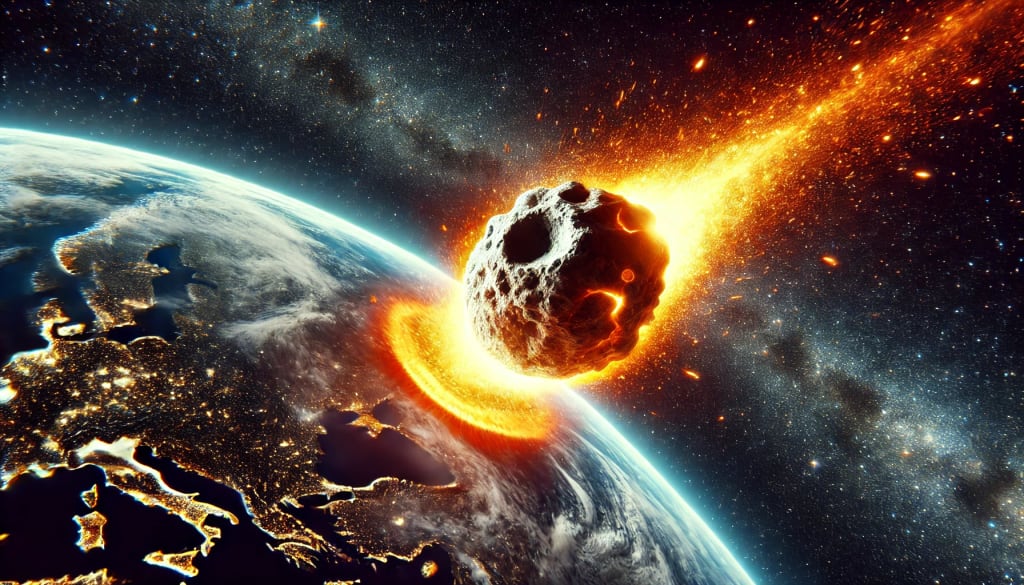
The idea of an asteroid hurtling toward Earth and causing catastrophic destruction has long been a topic of science fiction, but what if it became a real possibility? In recent years, scientists at NASA and other space agencies have been closely monitoring potentially hazardous asteroids (PHAs)—space rocks that could pose a threat to our planet. One particular asteroid, identified in 2013, was initially predicted to have a small chance of impacting Earth in 2032, raising concerns across the scientific community and media.
But how real is this threat? Should we be preparing for an asteroid impact, or is it just another false alarm? In this article, we will explore:
The asteroid in question and how NASA tracks near-Earth objects (NEOs).
The potential impact consequences if a large asteroid were to hit Earth.
NASA’s plans to prevent future asteroid collisions.
Let’s separate fact from fiction and dive into the science behind this celestial threat.
The 2032 Asteroid: What Do We Know?
In October 2013, astronomers at the Crimean Astrophysical Observatory discovered an asteroid named 2013 TV135, which was initially calculated to have a 1 in 63,000 chance of striking Earth on August 26, 2032. The asteroid is estimated to be about 400 meters (1,300 feet) in diameter—large enough to cause massive regional devastation if it were to impact our planet.
At the time of its discovery, NASA, the European Space Agency (ESA), and other space agencies closely monitored its trajectory. Fortunately, as more observations were made, scientists recalculated its path and ruled out a 2032 impact, significantly reducing the probability of a collision to nearly zero.
However, the discovery of 2013 TV135 serves as an important reminder: asteroids do pose a real threat, and we must remain vigilant in tracking them.
How NASA Tracks Potentially Hazardous Asteroids (PHAs)
NASA’s Planetary Defense Coordination Office (PDCO) is responsible for tracking near-Earth objects (NEOs), which include asteroids and comets that come within 50 million kilometers (30 million miles) of Earth.
Key Methods of Tracking Asteroids:
Ground-Based Telescopes:
Observatories like Pan-STARRS (Hawaii), Catalina Sky Survey (Arizona), and the Crimean Astrophysical Observatory scan the skies for new asteroids.
Space-Based Telescopes:
NASA’s NEOWISE mission (a repurposed space telescope) helps detect asteroids that may be difficult to see from Earth.
Radar Observations:
NASA’s Goldstone Deep Space Communications Complex and the Arecibo Observatory (before its collapse) provided detailed radar images of asteroids, helping scientists calculate their size, shape, and trajectory.
Defining a “Potentially Hazardous Asteroid” (PHA):
An asteroid is classified as a PHA if:
It comes within 7.5 million kilometers (4.6 million miles) of Earth.
It is larger than 140 meters (460 feet) in diameter, as an impact of this size could cause significant regional damage.
As of today, NASA has detected over 30,000 near-Earth asteroids, with over 2,300 classified as potentially hazardous. Fortunately, none currently pose an imminent threat to Earth.
What Would Happen if an Asteroid Hit Earth in 2032?
If 2013 TV135 or a similar-sized asteroid were to impact Earth, the consequences would be devastating. While it would not be an extinction-level event (like the one that wiped out the dinosaurs 66 million years ago), it could cause widespread destruction.
Potential Impact Scenarios:
Ocean Impact:
If an asteroid crashed into the ocean, it could trigger massive tsunamis, potentially wiping out coastal cities.
Land Impact:
A land impact could create a crater several kilometers wide, flattening everything within a hundred-mile radius and causing firestorms.
Atmospheric Explosion (Airburst):
Some asteroids explode before hitting the ground, as seen in the Tunguska Event (1908) in Siberia. This would still cause shockwaves and destruction over a large area.
Scientists estimate that a 400-meter asteroid like 2013 TV135 could release energy equivalent to hundreds of nuclear bombs, leading to global climate effects such as temperature drops and crop failures.
NASA’s Plan to Prevent an Asteroid Collision
NASA and other space agencies are not just monitoring asteroids—they are actively working on defense strategies to prevent future impacts.
1. The DART Mission: Deflecting an Asteroid
In September 2022, NASA successfully launched the Double Asteroid Redirection Test (DART) mission, the world’s first real-life test of asteroid deflection. DART targeted the asteroid Dimorphos, crashing into it to slightly alter its orbit. This proved that we can change an asteroid’s trajectory using kinetic impact technology.
2. Nuclear Option (Last Resort)
If a massive asteroid were on a collision course with Earth, scientists might consider detonating a nuclear device near it to break it apart or push it off course. However, this method remains controversial and risky.
3. Gravity Tractors and Solar Sails
Other proposed solutions include:
Gravity Tractors – A spacecraft hovering near an asteroid could use gravitational pull to slowly change its path.
Solar Sails – Reflecting sunlight onto an asteroid could gradually alter its course using solar radiation pressure.
While none of these methods are foolproof, continued research in planetary defense is essential for protecting Earth from future threats.
Should We Be Worried About an Asteroid in 2032?
As of now, NASA has ruled out any significant asteroid threats in 2032. However, the discovery of 2013 TV135 highlights the importance of staying prepared. New asteroids are being discovered all the time, and while most pose no risk, it only takes one to cause a catastrophe.
The good news is that with improved detection systems and asteroid defense projects like DART, humanity is taking steps to ensure that we are not caught off guard. The key is continued investment in space research and technology.
Conclusion: The Future of Asteroid Defense
The threat of an asteroid hitting Earth in 2032 has been largely ruled out, but the broader challenge of protecting our planet from space threats remains. With NASA’s ongoing efforts, new tracking systems, and potential deflection methods, we are better prepared than ever to prevent an asteroid disaster.
While Hollywood films like Armageddon and Don’t Look Up may dramatize the asteroid threat, scientific progress and real-world missions like DART prove that we are not helpless. The more we invest in space research, the safer our planet will be from celestial dangers.
So, will an asteroid hit Earth in 2032? Most likely not. But the work being done today ensures that if a real threat ever emerges, we will be ready.
About the Creator
Keep reading
More stories from Razia Aman and writers in Journal and other communities.
United Airlines Flight Emergency Landing: A Crisis in the Skies
Introduction Air travel is widely regarded as one of the safest modes of transportation, thanks to stringent safety regulations and highly trained pilots. However, emergencies can still occur, sometimes requiring an aircraft to make an unexpected landing. One such event happened recently when a United Airlines flight was forced to make an emergency landing due to mechanical issues. This article explores the incident, the possible causes, emergency protocols followed by the airline, and what passengers should know about airline safety.
By Razia Amanabout a year ago in Journal
Author’s Advice
If you would’ve asked me 20 years ago did I know I’d become a writer and an author, I would’ve said “nope, ain’t happening”. As fate would have it I did become an author and I can honestly say I’m loving it so far. It really does feel good to be a writer. I’ve learned a lot on this journey and I feel like with even me being as new to this world as I am, there’s some wisdom I need to share with every other aspiring author.
By Joe Patterson4 days ago in Journal
The White House’s Wii Sports War Video — and Iran’s AI Propaganda — Show How War Has Turned Into Internet Content
In the past, governments communicated war through formal speeches, press briefings, and official statements. Today, they’re posting video-game clips, AI animations, and meme-style propaganda.
By Navigating the World2 days ago in Journal
The Forsyth House Fire
Since 1851, Forsyth House has stood on the corner of Union Street and Gordon Street in the heart of Glasgow. Its iconic, or was... because on Sunday 8th of March, 2026, a fire broke out in a small, seemingly un-named shop in the building and tore all that history down. As I write, the rubble is still unsettled and the street is still blocked off. Central Station is quiet on the upper level, and around 30 small businesses have quite literally gone up in smoke.
By S. A. Crawford3 days ago in The Swamp




Comments
There are no comments for this story
Be the first to respond and start the conversation.