
American Graffiti
The American Cinematic Classic About Nothing

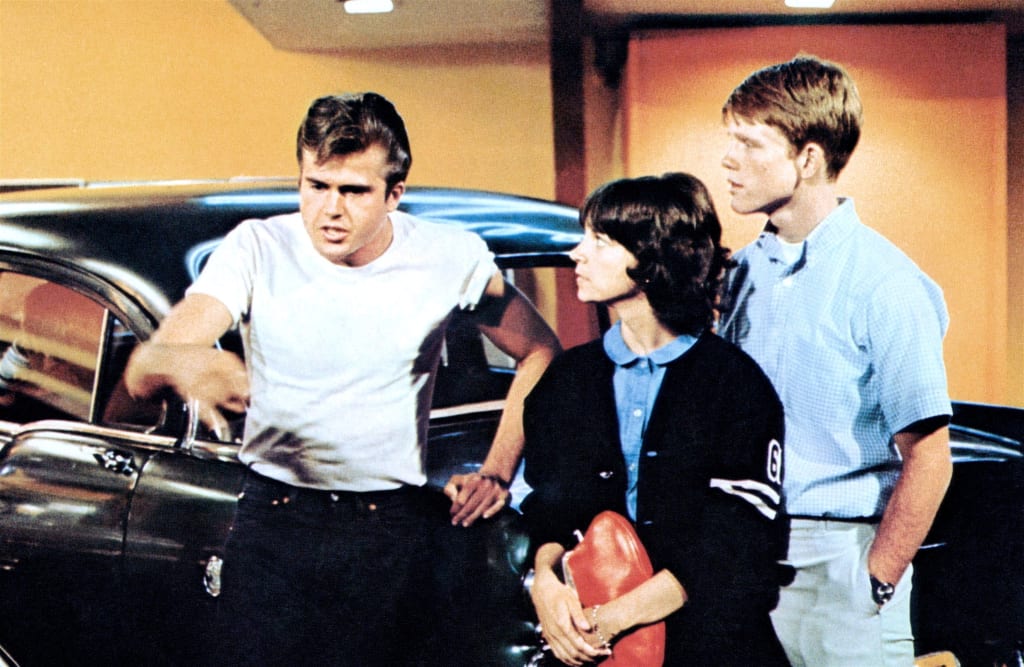
I had heard of American Graffiti my entire life, but had never actually seen it. I expected a film that did for early 1960s American culture what Star Wars did for space opera: celebrate and exalt its most exemplary and memorable aspects. (Minus, perhaps, Ron Howard bitching that he was going to go "into Toshi Station to pick up some power converters!")
Both films were helmed by George Lucas, creator of that legendary saga that takes place "a long time ago, in a galaxy far, far away." Both films evidence his love for drag racing and vehicles of every stripe. But that's about where the similarities end.
American Graffiti, which stars a Day of the Locust roster of weirdos—some destined for fame and fortune, others to fade into genteel obscurity—goes on for an hour and close to another hour without ever letting the viewer in on what the hell the story is supposed to involve. As best as I can tell, a guy named Curt (Richard Dreyfuss) is going away to college on a scholarship, and his sister's boyfriend (Ron Howard) is going away too (to college, I guess. Maybe I wasn't paying close enough attention).
Both of them hang out at Mel's Drive-In, which must be a 24-hour joint. But it's a 1962 place with carhops on roller skates, plenty of classic cars, fluorescent lights, and a decor that screams kitsch. At some point, and I seemingly missed this too, Curt has a vision of an ice-blonde goddess in a T-Bird and spends the rest of the flick looking for her, getting embroiled with a gang of greasers called "The Pharaohs," who compel him to rob pinball arcades and destroy police vehicles—both of which are felonies.
Ron Howard's character, Steve, and his girlfriend Laurie (Cindy Williams) get into it over Steve's insistence that they see other people while he's gone, to "strengthen our relationship" (roll eyes now). Then John (Paul Le Mat), a really long, lean, cool dude with a James Dean ducktail hairdo, picks up the 12-year-old anachronism Carol (Mackenzie Phillips), a snotty and annoying brat he spends the rest of the picture babysitting. (John and Carol weirdly echo, visually, the very real 1950s killer couple Charlie Starkweather and Caril Ann Fugate, who was a minor of fourteen. I don't know if this was intentional, but there it is.)
Terry "The Toad" (Charles Martin Smith, who directed the heavy metal horror flick Trick or Treat in 1986), while babysitting the fuzzy-dice-bearing hot rod belonging to his cousin Steve, picks up a precocious blonde, Candy Clark, who is dressed like a parody of a 1962 television Girl Next Door, with some undeniably suggestive quirks. "The Toad," a bespectacled Seymour Krelboin who obviously never had any nookie, spends the rest of the picture doing what he can to try and impress her—buying alcohol illegally, trying to pass the car off as his, before it's stolen.
Han Solo himself, Harrison Ford, rolls up (everyone here is always "cruising," which Lucas contends was rather the point of the picture), wearing a cowboy hat and driving a car with a skull dangling from the rearview mirror. This all culminates with a visit to a suspiciously Wolfman Jack-like DJ, played by Wolfman Jack, whose radio persona was—and so likely still is—a persistent fascination for Lucas (who, at one point, planned a documentary on the Wolfman that never panned out).
The final scenes pull our ensemble cast of kids out of the darkness of the early morning cruising and into the crisp, terrifying daylight of a final, epic race. I can't say much more. You'll have to see the thing for yourself. Vroom-vroom, va-va-va-voom! Daddio!
Of the undeniable titans of the cinematic Dream Machine, the two names that stick out the most memorably from the last fifty years are Steven Spielberg and George Lucas. Both utilized the undeniable talents of movie leading man heartthrob Harrison Ford. Both lionized their epic visions of those eras of filmmaking that influenced them the most: from cliffhanger serials to JD flicks and drag races, James Dean, and the whole early-Sixties mythos of American culture. I'm not sure American Graffiti is specifically about anything, although performances by all and sundry are flawless, and the direction borders on cinema-verité. It's like little circles that go nowhere, never raising the pitch of the film beyond the same subtle pulse, and so on. I DO know one thing, though: I inexplicably want to see it again.
It's good. It's like a dream of a perfect movie. But you can't quite figure out why.
American Graffiti Official Trailer #1 - Richard Dreyfuss Movie (1973) HD
Connect with me on Facebook
About the Creator
Tom Baker
Author of Haunted Indianapolis, Indiana Ghost Folklore, Midwest Maniacs, Midwest UFOs and Beyond, Scary Urban Legends, 50 Famous Fables and Folk Tales, and Notorious Crimes of the Upper Midwest.: http://tombakerbooks.weebly.com
Paths of Service: Teaching to Outreach, Why?
Paths of service often start with teaching, but have you ever stopped to ask why teaching counts as service in the first place? Many people think of service as something physical, like volunteering or giving resources. Yet teaching is one of the most practical ways to serve because it equips people with understanding, confidence, and direction. In faith communities, teaching can happen through Bible classes, youth lessons, discipleship training, and small group discussions. Each of these settings helps people learn how to apply faith to everyday life.
By Mike Signorelliabout 4 hours ago in Journal
Smart phones, Humans and Aliens.
WARNING. I will be tapping into one of your favorite creative tensions: The absurdity of humans worshipping their glowing rectangles as if they were tiny oracles. There’s something deliciously poetic about that contradiction, and it lends itself beautifully to an instructive proviso.
By Novel Allen4 days ago in Poets


Comments
There are no comments for this story
Be the first to respond and start the conversation.