
AI Meets Art: The Cultural Revolution of Creative Technology
How Artificial Intelligence is Reshaping Music, Visuals, and Live Performances in the Age of Creative Innovation
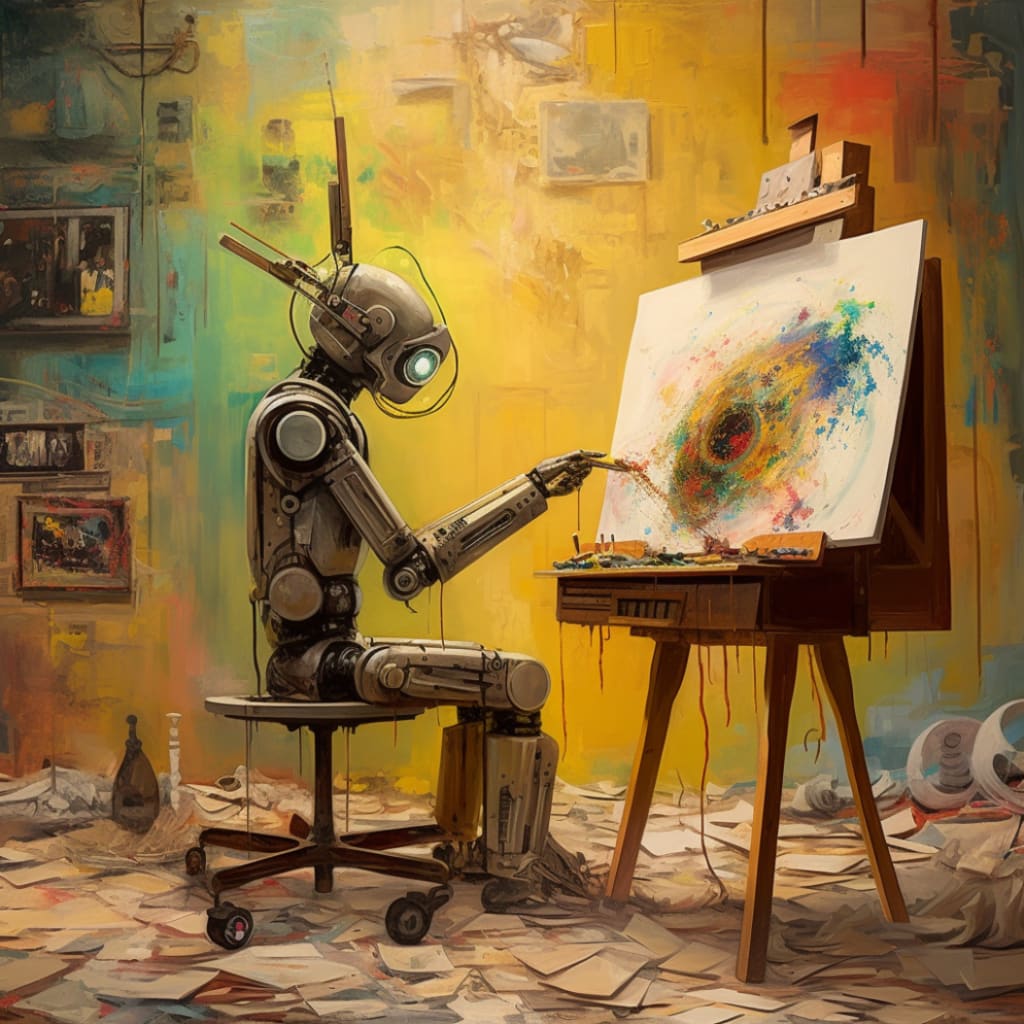
In an age where imagination was widely seen as the exclusive realm of human awareness, there is a new player in town: artificial intelligence. What was previously the exclusive territory of science laboratories and Silicon Valley behemoths is now transforming the world of visual art, music, performance, and even storytelling. Where artists and code converge, a revolution is brewing that turns centuries of assumptions about authorship, creativity, and originality on its head.
The Emergence of a New Medium
AI is no longer a tool; it's a medium in its own right. From DALL-E and Midjourney generating surreal images, to ChatGPT helping writers come up with concepts for poetry and prose, AI is redefining the creative process. Musicians are feeding massive amounts of data into neural networks to generate entirely new soundscapes, blending genres and languages in ways that it would take human minds years to achieve. In doing this, artists are not replacing themselves but adding to their creative kit.
Take, for example, Grammy Award-winning artist Holly Herndon, who created an AI rendition of her own voice named "Spawn." Not only does this virtual personality sing with her in compositions, but it also evolves with each performance, adapting from audience feedback and vocal improvisations. Visual artist Refik Anadol uses data-driven AI to create hypnotic digital installations that pulse and move like living tissues, transforming architectural spaces into sensory experiences.
A Democratic Turn toward Creativity
AI technologies are also lowering entry barriers in the arts. Software like RunwayML and Adobe Firefly allow new artists to create quality graphics and animation without training. Software like Soundraw and Amper Music allow single artists to generate orchestral music with the click of a button. In this manner, AI is making the playing field even in creativity so that those who were previously muzzled by limited means or formal schooling are now given expression.
Social media buzzes with AI-generated content that blurs the line between creator and spectator. Artists on TikTok use AI filters to build surreal short videos, and Instagram is replete with AI-assisted imagery that gets millions of hits. As algorithms become more accessible, more people are stepping into the role of creator, leading to an explosion of diverse opinions and experimental formats.
Ethical Questions and Human Identity
Of course, this revolution comes with questions. Who owns a piece of artwork created by an AI? Can a machine be credited as a work of art? What does it mean when AI-generated art imitates human emotion so strongly that audiences are unable to differentiate?
These are problems at the center of the argument. WIPO and other global agencies are grappling with how to define and protect AI works. Meanwhile, battles are being fought in the creative world about what constitutes "real" art. There are others who think that while AI can copy style and shape, it lacks the soul, intuition, and context that human artists can bring into a work of art.
But some perceive it not as a threat but an evolution. Just as photography and digital media upended traditional art forms in the past, so too is AI merely the next in the ongoing dissemination of human expression. Artists like Mario Klingemann, who has worked with neural networks for years, do not view AI as a threat but as a partner in discovery.
Performance in the Age of Algorithms
The performing arts are also experiencing an AI renaissance. AI-generated choreography is being used in modern dance, where programs suggest sequences based on emotion, rhythm, or physical limits. The result? Performances that are otherworldly and strangely human.
On stage, authors are now incorporating AI to craft dialogue and narrative, even permitting the algorithm to take over sometimes in improvisational scenes. AI characters that talk back to the audience on stage react to cues, making every performance different. These hybrid performances push the standard script and invite the audiences to rethink what it means to experience something "live."
Even fashion and design are adopting this trend. Companies such as The Fabricant and Auroboros are designing digital-only fashion lines with the help of AI, expanding the frontiers of wearability and sustainability. These clothes are purely digital but have an impact on actual trends, reflecting the influence of AI on aesthetics as well as ethics.
The Future: Co-Creation, Not Competition
The union of AI and art is man and machine, not man against machine. With artists mastering the use and management of these tools, they are finding new ways to express timeless human concepts: love, fear, joy, memory, identity. AI thereby is more a collaborator than a creator—a clever mirror that bounces back and magnifies human imagination.
While some fear AI will dilute art's integrity, history shows that every major technological stride was met with skepticism. The printing press, photography, and computer editing once were considered dangers to "true" art. Today, they are incorporated into it.
As we travel further along in this century of revolutionary technology, the most profound works may not be done by man or machine but by the seamless merging of both. With artist hands, AI is not the death of art—it is its brazen, enchanting new book.
About the Creator
Keep reading
More stories from Shahjahan Kabir Khan and writers in Journal and other communities.
Around the World Travel: Top Destinations to Visit in 2025
Travel is the greatest pleasure of life, offering the chance to discover new cultures, landscapes, and experiences. With the world ushering into 2025, there are wonderful places that abound somewhere—some well-known and some yet-to-be-discovered secrets to be uncovered. You might be an adventure seeker, a culture seeker, or simply a quiet retreat. Whichever the case, this travel guide is a selection of the top destinations that are at the height of fashion in 2025.
By Shahjahan Kabir Khan11 months ago in Journal
Author’s Advice
If you would’ve asked me 20 years ago did I know I’d become a writer and an author, I would’ve said “nope, ain’t happening”. As fate would have it I did become an author and I can honestly say I’m loving it so far. It really does feel good to be a writer. I’ve learned a lot on this journey and I feel like with even me being as new to this world as I am, there’s some wisdom I need to share with every other aspiring author.
By Joe Patterson4 days ago in Journal
The First Rainbow Baby
Pitter-patter, pitter-patter. The rain fell in rhythmic splatters, slowly slowing, but still constant. Mira rolled onto her side pulling the blanket tight against her ears, but still she could hear chitter-chatter and scurrying feet of the creatures that refused to sleep in the lower decks.
By A. J. Schoenfeld2 days ago in Fiction



Comments
There are no comments for this story
Be the first to respond and start the conversation.