
ADVOCATING FOR THE DEVELOPMENT OF THE NIGERIAN INDIGENOUS GLASS INDUSTRY FOLLOWING AFTER THE FIROZABAD PARADIGM
Development of the glass industry of Firozabad

Abstract
This paper highlights a few concepts of technology transfer and examines the issues that militate against the successful transfer of technology especially as it concerns developing economies such as Nigeria. The development of the Firozabad glass industry from its humble beginnings to its current status as an employer of labour and a viable foreign exchange earner for India was examined and has been recommended as a suitable paradigm and an alternative route to technology development rather than the ever elusive notion of technology transfer. The Masaga Glass bead industry of Nigeria was also examined and comparisons drawn between it and the Firozabad glass industry of India and it was argued that if the right government policies are put in place, together with other enabling factors such as research efforts and patronage of locally produced goods by Nigerians, then perhaps the success story of the Firozabad Glass city of India could also be ours. The paper concludes by insisting that systematic development in indigenous technology to international standards, rather than adapting up-to-date, ready-made and difficult-to-maintain technologies from advanced countries, will result in significant impacts on the national economy.
Keywords: Nigeria, Indigenous technology, Glass Industry, Firozabad, Paradigm
Introduction
The development of any nation is hinged on how well it is able to develop and deploy indigenous technology to her industries; and Nigeria as a nation has a number of such indigenous industries from which such indigenous technologies can be developed. Such indigenous industries include: Traditional soap making industries (e.g. dudu osun commonly known as ‘black soap’), black smith, Brass/Bronze casting works, wood carving, herbal medicines, basket/cane weaving, textiles weaving/dyeing, calabash carving, glass bead making, brewing/distilling, to mention just a few. There is no better time, in the life of our nation, to give serious attention to the development of indigenous technology than now when Nigeria’s major source of foreign exchange earnings, that is, crude oil exportation, is experiencing a downward turn and the cry for diversification of the national economy is at its loudest. Essien (2011) observes that efforts by several administrations in Nigeria at redirecting the nation’s economic policy reforms and technology is yielding very little result and he attributes this to the fact that Nigeria is over-dependent on imported consumer goods. The same attitude is being demonstrated
towards the development of indigenous technology, where technology transfer is being preferred above the development of indigenous technology.
Issues in transfer of technology
Chesnais (1986) in Wahab, Rose and Osman (2012) argues that technology transfer does not only transfer the technical know-how required to produce the product to the recipient but also the capacity to master, develop and later produce autonomously the technology underlying the products, while Hoffman and Girvan (1990) in Wahab, et al., (2012) in the context of developing countries, advances that technology transfer needs to be perceived in terms of achieving three core objectives, which are firstly the introduction of new techniques by means of investment of new plants; secondly, the improvement of existing techniques and thirdly, the generation of new knowledge. There are, however, issues related to the whole idea of technology transfer as it is not as easy as it is presented. Reddy and Zhoa (1990) in Wahab, et al., (2012) point out that the transfer of technology requires a sustained relationship between two enterprises over a period of time to enable the receiving enterprise to produce the product with the desired level of quality standards and cost efficiency. The period of time over which such a relationship between donor enterprise and the receiving enterprise will be sustained is usually not definite even if such were to be stated in written agreements, especially if this transaction is between countries. There would usually be software upgrades especially if such technologies are related to Information and Communications Technology (IC&T), secondly if the ‘transferred’ technology is hardware related, and the receiving enterprise/country has not developed other industries germane to the acquired technology which may be necessary to provide replacement parts, then the assistance of the donor enterprise/country would continually be sought in order to provide these replacement parts and this with the concomitant foreign exchange dissipation.
Harry (2013) observes that, while technology transfer efforts have been largely successful in some Asian economies such as China, South Korea, India and Malaysia, it has not been successful in Nigeria particularly because the so-called success in technology transfer achieved by some of these Asian countries, for example China, has not been without underhand practices and in most cases, outright stealing best describes the method by which such transfers have been achieved. In other cases however, there have been genuine efforts and positive results in developing indigenous technology and a case worth noting is the development of Glass technology in Firozabad in India.
Development of the glass industry of Firozabad
India, just like Nigeria is notable for indigenous glass production, with the bulk of this glass production taking place in Firozabad, a small industrial town located nearly 200km from India's capital, New Delhi, known for its glass industry, particularly its famed bangles.
Adegbeye (2008) Reports that:
The glass industry of Firozabad ... started in the 15th century when invaders of India would bring along with them many glass articles. These glass articles when discarded were collected by the Firozabad indigenes and melted in a locally made furnace called “Bhainsa Bhatti”, which used wood as fuel. These old traditional furnaces are still in use in Sasani near Aligareh and at Purdal Nagar. During this time, only small bottles and “Kadechhal Ki Chudi” bangles which had no joints, could be made, one at a time.
The glass industry in Firozabad had a small beginning that was marked with crude items that were not perfected as well as furnaces that were very basic .
However, things did not continue as they were because there were developments and great successes recorded in the glass making activities that were carried out in Firozabad as reported by Adegbeye (2008):
… Slowly and steadily bangles, beads, kangans, kada and similar items were produced in bulk for the general public and remain popular as marriage items in Indian and international markets till date. Known as the world capital for beads, the bead industry in Firozabad is famous for the glass beads it produces which are exported all over the world for use in all kinds of items such as clothing, accessories and shoes. Since 1989, it started production of artistic glass ware in different colors and shades and today about four hundred glass industries are registered in Firozabad which export about 50% of their manufactured units to different countries. Natural gas as opposed to coal is now used to fuel the regenerative pot furnaces that characterize this blowing and modeling industry.
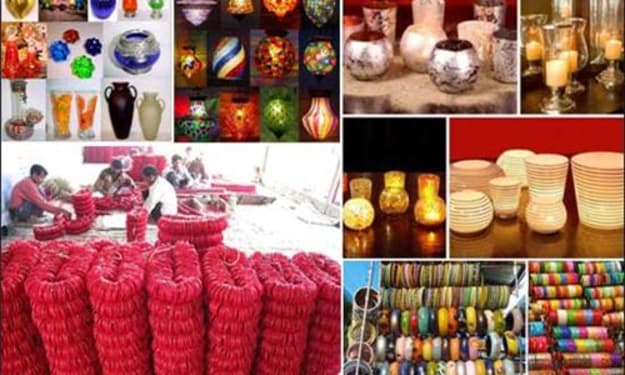
The glass bead industry in Firozabad now earns foreign exchange for India, besides the empowerment it provides for the local people and freedom from dependence on government jobs. Firozabad with a population of 279,102 boasts of having 75% of this population involved either directly or indirectly in the glass industry and has come to be referred to as “The Glass City of India”. From the humble beginning of the glass industry in Firozabad where only simple glass items were being produced, today, the range of glass products made in Firozabad includes: glass hardware for decoration purposes, glass art-ware such as toys, candle-stands, crosses, Christmas trees, fruits, bird and animal figurines and images of gods and goddesses, glass domestic wares such as drinking glasses, beer glasses, wine glasses, dinner tableware are made both in cottage industries and automated plants, scientific and laboratory glassware such as beakers, flasks, containers made for college, university and factory laboratories; glass automobile wares such as light bulbs, battery bulbs and other light and sight equipment for two and four wheelers, Glass street-and-domestic light ware for urban and rural areas for lighting and utility purposes are made including miniature bulbs and high power voltage bulbs (Firozabad Glass City of India).
The Paradigm
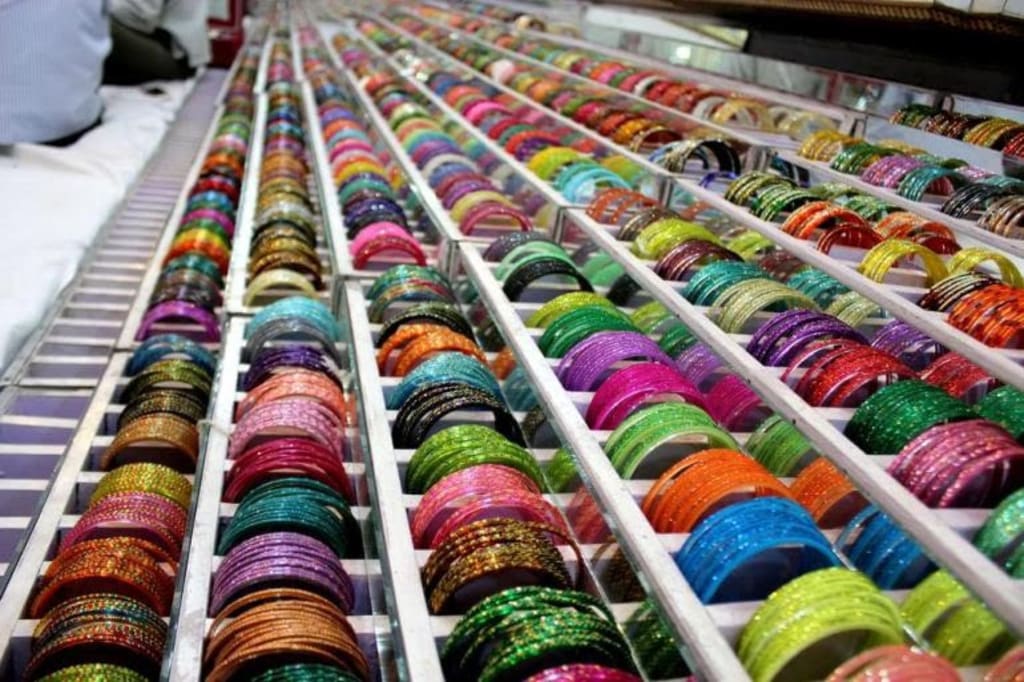
Bangle-making in Firozabad is a household business with traditional technique being passed on through generations. Firozabad has been producing glass bangles for more than 200 years now and is the biggest manufacturer of glass bangles in the world (Shafi, 2015). The bangle market in the town’s Gali Bohran has rows of colorful shops selling glittering, beautifully hand-crafted glass bangles . Shafi (2015) reports that there are more than 191 glass-bangle factories registered by government and in a single factory there are around 200 people working to produce these bangles. Unlike the Masaga glass bead industry, which is operated exclusively by men, the Firozabad glass industry is operated by both men and women and is reputed to involve whether directly or indirectly, about 90 percent of the population. Despite the apparent success of the Firozabad glass bangle industry, there have been some initiatives by the government of India to bring development to the glass industry. This initiative includes the setting up of a Centre for Development of Glass Industry in Firozabad (CDGI, 2016) as a joint venture project of the government of India, United Nations Development Programme (UNDP), United Nations Industrial Development Orgranisation (UNIDO) and the government of Pradesh.
The Centre for Development of Glass Industry in Firozabad provides both Physical and Chemical laboratory services; The Physical Laboratory is equipped with equipment used for the determination of Softening Point, Annealing point, Strain point, Liquidus temperature and Coefficient of Thermal Expansion. In addition to these the Physical laboratory is equipped with facilities for Petrographic Analysis to identify the defects in Glass; Polariscope and Density Comparator are also available for Strain measurement and determination of specific gravity of Glass. The Chemical laboratory on the other hand is fully equipped to carryout qualitative as well as quantitative analysis of raw materials, finished Glass, refractory materials etc. It is equipped with Flame Photometer and Absorption Spectrophotometer. Batch formulation and melting facilities for different types of glasses are also available (CDGI, 2016).
There are several units or departments in the Centre for Development of Glass Industry in Firozabad which provide certain services and these include:
Pollution Control Division: This division is equipped to carry out Stack Monitoring, Ambient Air Quality Measurement such as Suspended Particulate Matter (SPM), RSPM, Sulphur dioxide & Oxides of Nitrogen etc.
Combustion Engineering: This division aims at conservation of energy through various measures. It has facility for combustion monitoring of furnaces through waste gas analysis and also has the capability to design and construct various types of fuel-efficient furnaces for application in the small scale glass unit.
Product and Technology Development Unit (PTDU): this unit was established to demonstrate best practices of batching, melting, forming and finishing technologies for glass units. Batch formulation, preparation of new glass compositions and products are an integral part of the PTDU. The unit has facilities for melting 2-1000kg/day glass in Pot furnaces and Day Tank furnace and currently a studio glass facility is being installed for glass artists.
Pot Development Unit: having discovered that the quality of glass melting pots used in Firozabad is much inferior in terms of glass quality and campaign life compared to the pots used elsewhere, the Centre for development of glass industry in India has developed a modern facility for manufacturing of glass melting pots under the financial assistance of Department of Science & Technology of the government of India and high quality processed materials and finished pots are supplied to Glass industry
Consultancy and Troubleshooting Services: The Centre has a team of professionals available to offer consultancy services in such areas as Plant Lay out, Preparation of Project report, Furnace Design & construction, Equipment selection, Product development, Batch formulation, Quality Control, Energy conservation & Pollution Control etc. Troubleshooting services are also available in the areas of Glass defect analysis, identification of its source as well as the remedy.
Design and Decoration Units: an assortment of techniques for hot glass working such as Glass Casting, Slumping & Fusing and Lamp Working as well as those for cold glass working such as Glass Cutting, Engraving, Painting, Screen Printing, Stained Glass, and Frosting by Sand Blasting, are being practiced at the Centre. There exist facilities for training in all of the areas which have been listed out above. (CDGI, 2016)
Currently the Centre for development of Glass industry in India is carrying out certain developmental activities which center around:
- Design and development of gas fired glass melting furnace for glass beads
- Development of improved quality glass, compatible lamp torch and high surface finish, dies and mould for glass bead
The Nigerian indigenous glass industry
In Nigeria, glass bead making, occupies a prime position among the local indigenous industries in Nigeria. Historically, two indigenous centres were reported to be involved in glass bead making in Nigeria – the Yoruba glass bead making centre located in Ife (Ige, 2006) and the Nupe glass bead making centre located in Masaga in Bida. Presently there is no available record or activity to suggest that the Yoruba centre is still functional, however, the Nupe glass bead making centre, specifically located in Masaga in Bida, which is still operational, functions only on a diminutive level. Harris (2014) opines that apart from Egypt, Nigeria is the only other known place in Africa where glass beads were not just recycled from imported glass beads or fragments but were produced from sand, furthermore that Bida beads (Masaga furnace wound) of Niger state, Nigeria are very popular as the tradition remains till this day.
Glass beads produced by the Masaga Guild of glass makers are produced at a beehive- shaped furnace which is built up with red clay and constructed on the ground. The primary fuel for this furnace is wood while the combustion air for this furnace is supplied by a manually worked cloth bellows attached to the furnace. After producing the glass articles, the guild of glass bead makers then display these items in a small showroom, which doubles as a shop, for would-be buyers; most times
As it is currently at the Masaga glass bead industry, the state of affairs is not any different from what was obtainable in Firozabad at the early stages; the craft is currently being practiced by indigenous people who had glass bead making as part of their tradition for a very long time. The trade currently enjoys some level of patronage by tourists from Europe and other parts of the African continent.
The imperatives for developing the Nigerian glass industry
What is required, inter alia, is for the Federal government of Nigeria to develop and put in place appropriate national policies that will encourage the development and promotion of indigenous crafts, also researches should be directed at how to integrate modern equipment, methods and materials into these indigenous crafts and slowly build up indigenous technology. Importantly, there is the need for a joint effort of the Federal government of Nigeria and the Niger state government, with assistance from such international bodies as the United Nations Development Programme (UNDP) and United Nations Industrial Development Organisation (UNIDO) to create a Centre for the development of the glass industry in Nigeria with similar mandate(s) as earlier discussed with respect to that of Firozabad in India. Obviously, there is the need to introduce some form of modification in the tools that are currently being deployed in the process of glass bead making; additionally, the furnace as well as the fuel (fire wood in this case) need to be upgraded and redesigned for greater efficiency – these will provide viable research areas for research institutes as well as tertiary institutions involved having such research focus. Currently production of the beads and other articles of glass is carried on manually and as such the output in terms of volume of products is small and this may require that some form of automation be introduced into the production process for better output in terms of volume of production. There is also the need for aggressive production promotion on the international arena and one of the most potent means to achieve this is through the instrumentality of the Internet, currently information relating to the Nigerian glass bead industry is scarcely available on the Internet. In addition to the aforementioned imperatives, there is also the need to exercise patience and to carefully nurture our indigenous technologies until they attain international standard; needless to say that the nation must as a matter of duty be the first on the line of patronage of made in Nigeria products so as to create an enabling environment for the growth and development of indigenous technology.
Conclusion
In order to attain a fully developed and thriving glass technology sector of the national economy and to achieve the first of the Millennium Development Goals, that is, to eradicate extreme poverty and hunger, there need to be efforts geared towards research in indigenous technology. It is also advocated here that systematic development in indigenous technology to international standards will result in significant impacts on the national economy. The development of indigenous technology, which was experienced in Firozabad, is unlikely to result without a systematic developmental strategy in terms of modification of certain facilities like the furnace and introduction of better fuels like natural gas in place of coal and wood and glass forming methods. If it worked in Firozabad, there is a high possibility that it will work out in Nigeria as long as the necessary conditions for the development of indigenous technology are put in place. The advantage of developing indigenous technology is that indigenous technology can easily be maintained without recourse to expatriate recommendations and consequent foreign exchange dissipation.
About the Creator
Keep reading
More stories from Harsh Mohan Sharma and writers in Journal and other communities.
BANGLE MAKING IN FIROZABAD
Firozabad is a city in Uttar Pradesh. This industry employs almost two million people in India. It is the biggest glass industry center where different types of products are made with great accuracy and precision. The glass products include:
By Harsh Mohan Sharma4 years ago in Journal
The goals I did not achieve
Every writing goal I made for the year is a wash. It has been this way for a while, but I think it's important to be open about my failures and the reality of how life can get in the way. This is especially true considering the several times I have posted on Vocal about my writing goals, how I was changing my approach, and where I was hoping to be for the upcoming year. I will probably do that again in a couple months, but for now, it is time to acknowledge where I am today.
By Kay Husnick24 days ago in Journal



Comments
There are no comments for this story
Be the first to respond and start the conversation.