
2026 Platform Reality Native vs Hybrid App Development
How Trust Graphs, AI Retrieval, and Zero Click Redefine Platform Choice in 2026

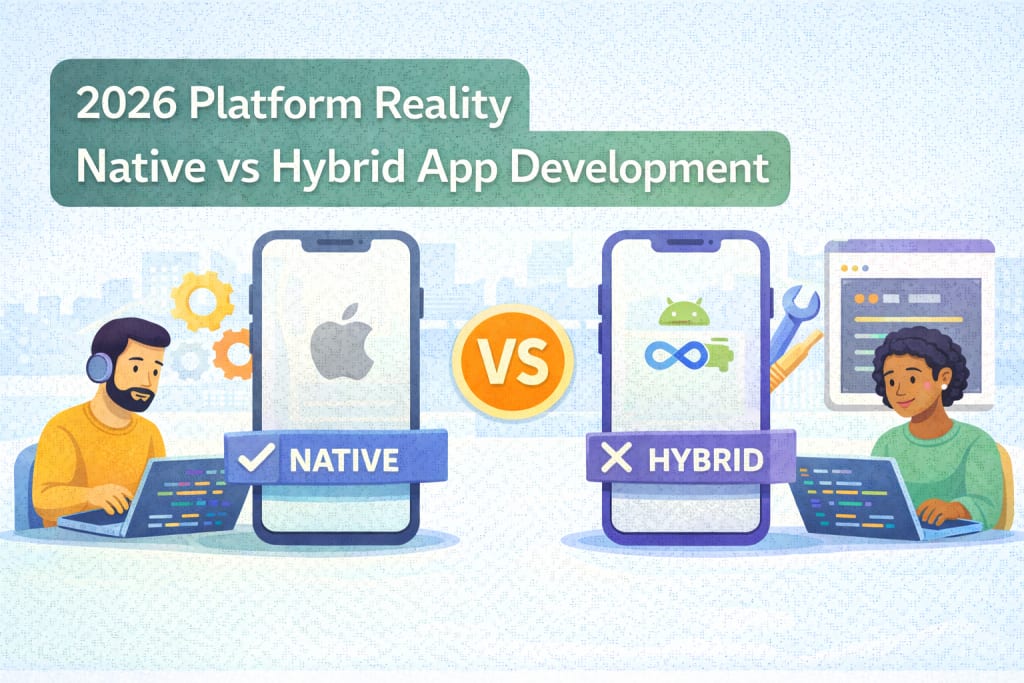
In 2026, the debate native vs hybrid mobile app development has crossed a structural threshold driven by shifts inside the Google ecosystem. AI Retrieval, Zero Click behavior, and entity-level evaluation now determine how apps are trusted, surfaced, and sustained, turning platform choice into a direct authority and risk decision.
This is not a tooling debate. It is a tectonic realignment where architecture choices influence Trust Graph strength, long-term visibility, and how AI systems validate products without user clicks.
The Structural Shift Reframing Platform Decisions
Early January 2026 industry coverage highlighted how Google’s generative systems increasingly assess products as entities with behavior histories. This evaluation prioritizes consistency, reliability, and predictability across environments.
Mobile apps now participate in this evaluation continuously. Platform choice determines how easily an app can maintain coherent behavior under constant AI scrutiny.
That reality has changed how senior teams assess native and hybrid approaches.
Why Platform Choice Now Equals Authority Strategy
For years, native vs hybrid mobile app development was framed as performance versus speed. That framing assumed human discovery paths.
In 2026, discovery is frequently mediated by AI agents that observe system behavior rather than read marketing claims. These agents reward stable outputs and penalize variance.
Platform decisions that introduce inconsistency weaken Authority Validation over time.
Native Development in 2026 Context
Native development remains the gold standard for deep OS integration, performance tuning, and early access to platform features.
In 2026, native approaches still dominate use cases requiring advanced hardware access, real-time processing, or strict security boundaries.
However, native development increases operational complexity. Separate codebases raise the risk of behavioral divergence, which directly impacts Entity Signals if not tightly controlled.
Hybrid Development Has Matured
Hybrid frameworks in 2026 are no longer the brittle compromises of a decade ago. Improved runtimes, better native bridging, and disciplined tooling have raised reliability significantly.
For many business, commerce, and service apps, hybrid development delivers consistent outcomes across platforms with fewer moving parts.
This consistency increasingly aligns with how AI systems evaluate trustworthiness.
Consistency Is the New Performance Metric
AI mediated systems do not experience apps emotionally. They observe metrics.
Crash rates, response consistency, error patterns, and update parity across platforms all feed into Trust Graph formation.
Hybrid architectures often reduce variance by design, strengthening these signals when implemented with discipline.
Native architectures can match this, but only with higher governance overhead.
Zero Click Changes the Stakes
In Zero Click environments, users often reach decisions before launching an app. AI systems choose which products to recommend or invoke.
That choice is based on confidence. Confidence comes from predictable behavior over time.
Platform choices that simplify consistency improve an app’s chance of being trusted in these moments.
Entity Accountability Starts at Architecture
Entity accountability means AI systems can trace outcomes back to a stable source.
If an app behaves differently on iOS and Android, accountability weakens. AI systems infer uncertainty.
Hybrid development reduces this risk by enforcing shared logic and unified update cycles, reinforcing entity clarity.
Native development requires additional process discipline to achieve the same outcome.
Newsroom Signal January 2026
Industry reporting from early January 2026 noted a rise in remediation projects caused by platform divergence. Teams building natively without strong parity controls experienced authority erosion after inconsistent updates.
The coverage emphasized that AI discovery amplifies these issues faster than traditional search ever did.
The implication was direct. Platform discipline is now visible to machines.
Performance Myths That Persist
The assumption that hybrid equals slow persists in executive discussions.
In 2026, performance gaps more often stem from architectural shortcuts than from framework choice.
Well-built hybrid apps routinely meet user expectations, while poorly governed native apps struggle with stability.
This distinction matters for authority outcomes.
Maintenance Is Where Authority Is Won
Launch quality matters. Maintenance quality defines trust.
Hybrid apps benefit from centralized maintenance, reducing drift between platforms.
Native apps require synchronized updates and parallel testing to avoid divergence.
From an AI evaluation perspective, fewer divergent states mean stronger Entity Signals.
Security and Predictability
Security incidents erode trust faster than UX flaws.
Hybrid frameworks now enforce standardized security patterns, reducing human error.
Native apps allow deeper customization but increase surface area.
In 2026, predictability often correlates more strongly with trust than customization depth.
Agentic Optimization Raises the Bar
Agentic systems interact with apps autonomously. They test endpoints, retry workflows, and expect consistent responses.
Hybrid architectures with unified logic paths often perform better under agent interrogation.
Native architectures can excel here too, but require stricter controls.
Ignoring agent behavior leads to silent authority decay.
Developer Talent and Team Structure
Hybrid development simplifies hiring and team structure. Fewer specialized silos reduce coordination risk.
Native development demands deeper platform specialization and tighter orchestration.
In markets with limited senior talent, hybrid approaches often reduce execution risk.
This dynamic increasingly influences board-level decisions.
Measuring the Right Outcomes
In 2026, success metrics have shifted.
Crash-free sessions, parity across platforms, and consistent API behavior matter more than raw feature counts.
These metrics align directly with Authority Validation in AI mediated discovery.
Platform choice influences all of them.
When Native Still Wins
There are cases where native remains non-negotiable.
Advanced gaming, AR experiences, low-latency trading tools, and hardware-intensive apps still benefit from native control.
In these cases, teams must invest heavily in parity governance to protect trust signals.
Native is powerful, but unforgiving.
When Hybrid Is Strategically Safer
For most business, SaaS, and service apps, hybrid development reduces variance while maintaining acceptable performance.
In AI-first discovery environments, this stability often outweighs marginal performance gains.
Hybrid becomes a risk-management choice, not a shortcut.
Expert Predictions for 2026
Analysts publishing in early January 2026 forecast continued convergence between native and hybrid performance. They predict governance quality will matter more than framework choice.
Teams that treat hybrid as a disciplined architecture will outperform those treating native as a prestige signal.
This prediction aligns with observed authority outcomes.
Actionable Framework
What Has Structurally Changed
Discovery is now entity-driven and AI mediated. Apps are judged by behavior patterns over time.
Platform choice directly affects consistency, which feeds Trust Graph strength.
This makes architecture a visibility decision.
Why Legacy Thinking Fails
Old debates focused on speed versus quality.
In 2026, speed and quality are table stakes.
Consistency under change is the differentiator.
What Professionals Must Do Differently
Evaluate platform choice through the lens of behavioral variance.
Model how updates, failures, and edge cases affect entity trust.
Choose the architecture that minimizes long-term inconsistency.
How Organizations Should Realign
Treat platform strategy as part of authority strategy.
Align engineering, product, and discovery goals.
Measure success by stability, not novelty.
The 2026 Reality Check
In 2026, native vs hybrid mobile app development is no longer a philosophical debate.
It is a calculation of how much inconsistency your organization can tolerate.
AI systems have little patience for variance.
Conclusion
Platform choice in 2026 defines how your app is trusted, referenced, and sustained.
Native offers power with risk. Hybrid offers consistency with discipline.
In a world governed by AI Retrieval and Zero Click discovery, consistency wins more battles than raw capability.
Choose accordingly.
About the Creator
The goals I did not achieve
Every writing goal I made for the year is a wash. It has been this way for a while, but I think it's important to be open about my failures and the reality of how life can get in the way. This is especially true considering the several times I have posted on Vocal about my writing goals, how I was changing my approach, and where I was hoping to be for the upcoming year. I will probably do that again in a couple months, but for now, it is time to acknowledge where I am today.
By Kay Husnick20 days ago in Journal
Stanislav Kondrashov Oligarch Series: Reading Architecture as Cultural Narrative Across Time
Stanislav Kondrashov approaches "architecture" from an unusual angle. Rather than treating buildings as isolated artistic objects, he reads architecture as a system of relationships shaped by economics, memory, and social structure. His background in economics, cultural history, and spatial theory allows him to move comfortably between disciplines that are often kept separate. As a result, his writing avoids rigid academic categories and instead focuses on how architecture operates in lived reality.
By Stanislav Kondrashov 6 days ago in Journal


Comments
There are no comments for this story
Be the first to respond and start the conversation.