
14 Confidence-boosting Tips for Interview Success
Walk-in with confidence and walk out with a sense of accomplishment.



A job interview is a gateway to a better career and a better life. Hence, it is vital to prepare for it in the best way, leaving no stones unturned. Employers and probable business partners are not looking for meticulous robots. Businesses need people who do better than follow instructions; leaders who can make decisions in their capacity to benefit the company in the long run. More often than not, an interview's success depends less on the technical skills and competencies and leans much more than you think on the attitude, and personality one exudes
I've been fortunate to have worked in the best corporate IT firms for nearly 14 years. All strategies mentioned below are the ones that have always worked for me, and I believe it would work for most of us. This guide intends to help professionals like you rock your business-critical interviews in a confident, poised way without breaking into a sweat or cracking your knuckles till they go broke.
These steps break down all the nitty-gritty of what it takes to have a winning streak in interviews.
________________________________________
Let's get started. The 14 steps detailed below are in the order of importance they warrant.
1. EAT, but eat light.
You didn't expect this to be #1. Did you? A lightly fed body is at its attentive best, and eating a lot leads to clumsiness. Concentration doesn't come easy on an empty stomach. It's normal to feel overly hungry when facing an important interview. It's your brain demanding more because of mental fatigue. But not a feast. You neither want to go inside feeling bloated nor starving. Indulge in fresh fruits, a salad bowl, bread, eggs, or something nutritious that fills you just enough; food that's less in Carbohydrates, protein-rich, and of course a cup of Joe. Not too much water, for obvious reasons. Also, check you don't smell of garlic and onion as they are a huge turn-off.
Make sure to check if your pearly whites don't show off what you just ate.
If you're like me, you will lose your cool on a rumbling tummy. It's also common to see candidates who turned up to the interviews without eating (due to anxiety or they got late) faint and end up missing an opportunity.
Here is an infographic from StandoutCV about an ideal meal before a crucial interview.

________________________________________
2. Have an interview checklist.
A standard checklist is often handy to go through before an interview. A sample can be as below.
- Educational certificates. Make sure you even have copies of them.
- Previous employer documents; offer letters and relieving letters. It's best to pack all the necessary documents the last night and do a check once again the next morning.
- Health check certificates. Sometimes specially-abled candidates are asked for it. Make sure to check and carry them if necessary.
- Outfit and Shoes. Get your clothes pressed and shine your shoes the previous day.
- Commute plan for the day. You don't want to be late. If you're driving, check on fuel.
- Enough Cash for any emergency. What if you had a flat tire?
- Weather. A weather check might seem trivial, but who wants to see someone turn up shivering, wet and soggy for the big interview.
Intro Script. I generally have three versions of it with the same information but tailored differently. It would be useful if you did it too. Practicing loud in front of the mirror or with a trusted friend can help adjust tone, sound natural, hunt for any mistakes, and correct body language.
What to "Tell about yourself." It is the obligatory ice-breaking question that starts every discussion.
a. Begin with a warm greeting. If you intend to mention your interests, marital status, community work you do, keep it brief. Maybe two sentences.
b. Next, don't rattle what's in your resume from the time you graduated. I found the best is to keep the points razor focussed on your best achievements through your career, in alignment with the new job role. They can then connect the dots to figure out why you are a good fit for their business. The details can wait.
c. Career guidance experts emphasize the introduction should be two mins only, more like an elevator pitch. If you're a good storyteller, you could try weaving the points into an engaging narrative.
d. Political views are a no-no.
________________________________________
3. Take the day off from other commitments. Be there ahead of time.
If the interview is early on in the day, you will finish it by noon. But if it is in the afternoon or evening, it helps if you miss any other tasks that cause extraneous mental stress. You would feel drained and not very ready if your other tasks are incomplete - your mind ping-pongs to the unresolved issue and the interview ahead.
Especially if it is your dream job, I strongly recommend you to skip your routine work. You will feel more relaxed and in a better mental state. When I mentioned to one of my previous employers during the interview that I skipped work that day, he was mighty impressed at my interest in the opportunity.
This confession also became one reason I stole that job under the nose of several better candidates in my field.
________________________________________
4. Give your brain a rest ahead of the interview.

If you're like the majority, before an interview, you keep thinking about every possible question they might ask. And keep revising stuff in mind until you face the interviewer. But we should stop studying at least an hour before the interview. This space is essential for our minds to reflect and assimilate our learnings. The best case would be not to study anything fresh on the day of the interview. You knew this. Right? But if you follow it, and you'll see a much better result.
Things to do and things to avoid in that crucial one hour instead of fidgeting your fingers, feeling restless, or looking at your phone:
- Visualize yourself having a great conversation with the interviewers and finally landed the job. Positive affirmations and happy thoughts work like magic in such situations.
- Breathing exercise: A straightforward breathing exercise that helped me is as follows.
- Keep shoulders straight, breathing in counting till ten (or much as you can). Hold the air in for as long as you can(start a fresh count). Exhale as slowly as you can through your mouth, counting up to 10. Repeat. If breathing exercises help you, you can find more breathing exercises like these online.
- Avoid arguments: Maybe your ex-partner calls you, or a nagging neighbor calls to complain about something. You'd do yourself a world of favor if you don't answer them just yet. Arguments leave you feeling unsettled and cranky. Arguing is often pointless.
- Stay away from naysayers. It's often those pesky (often close) friends and sometimes parents who try to scare you and leave you thinking you are not good enough. So don't even tell them you have an interview.
- Switch off your phone or Turn on Airplane Mode: Vibration is as distracting as a ring. Value the interview panel's time. An incessant buzz is the last thing you need to screw up your interview.
5. Make that first impression count — Professional Look for the win.
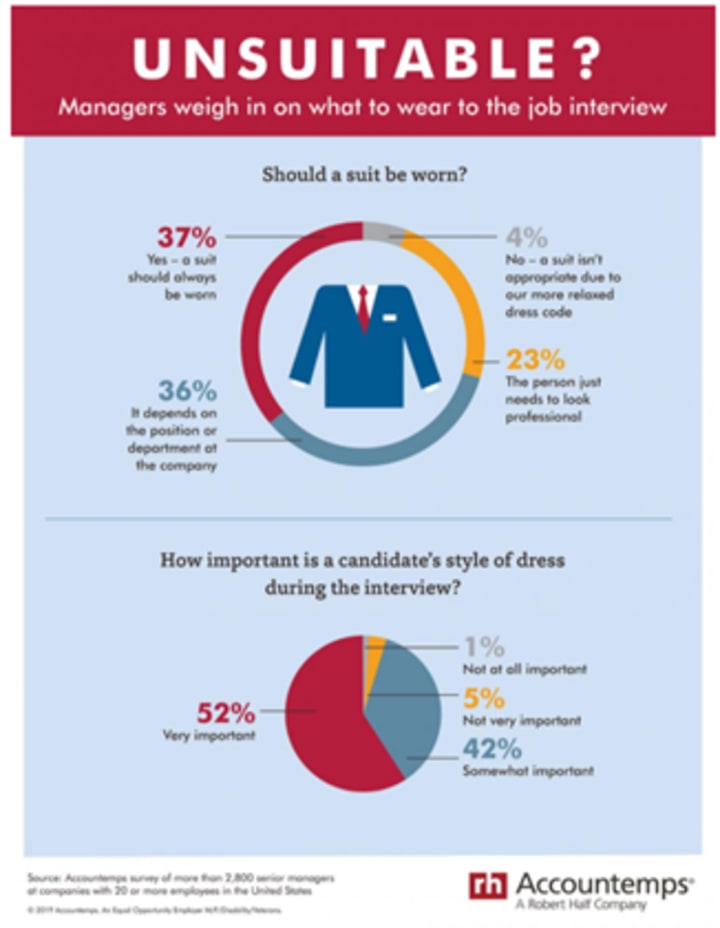
Here is an infographic developed after research by Accountemps — financial staffing company, where 2800 senior hiring managers in the US participated.
A not so surprising 94% of managers said a sense of style of candidates matter. It’s better to take note of any dress code beforehand. If it is formal wear, then neutral hues of navy, blue, gray, black, and white work well, according to a study by topinterview, a top-rated interview coaching service. A warm blue implies you’re a team player, and grey depicts logical and analytical strength. White exudes your confidence, and black screams leadership and authority.
And, of course, complement your outfit with a necktie if the role you’re interviewing for mandates it.

Even if it is an informal interview, wearing something that looks professional conveys that you are serious about the gig.
You would know you should avoid multicolor striped patterns that are distracting and loud solid bolds — Reds, Oranges, and Pinks. Avoid tight, ripped, flashy and revealing attire at any cost.
Shoes: Don’t try on new shoes as some new shoes can give you a shoe-bite making you cringe at yourself all the while. A pair of comfortable, well-polished, formal, or casual shoes as your outfit’s needs is perfect.
________________________________________
6. Wear a half-smile

Yes, the Buddha smile. It not only relaxes your mind and calms down your racing heartbeat. You won’t look like a sweating bundle of nerves. There are several benefits of wearing a half-smile even when we go about mundane chores in our life, and this becomes almost second nature. It does not take rocket science to understand that a warm, genuine smile is contagious. But google it, and you will find a bunch of them like these, and they are indeed proven facts.
A smile creates a friendly environment and eases up the buckling tension around. It also builds trust in the other person about you while boosting your confidence. This article from “Simply Hired” aptly points the importance of smiling during an interview.
A firm hand-shake is a literal sign of job-readiness. But given the current situation (you know…), a genuine smile should do.
________________________________________
7. Be prepared and knowledgeable about the company and even the interviewer(s).
Depending on the role you are pursuing, it is in your better interest you do all the homework about the company. I once had an interview for the position of content strategist. So impressed was the interviewer with my preparation, she exclaimed, “Wow!, you know almost as much as I know about our company.” I had spent only 20 minutes looking at their website and noting down their specializations, products, and services. So researching is a thoughtful strategy that can make you stand out among the rest.
You may like the company’s culture, the social causes they support, and it can be a good talking point and show you care. By researching the interviewers’ profiles, you are likely to find commonalities or their achievements that you can appreciate. You might have been in the same high school as the interviewer or from the same town. However, the icing will be if you uncover potential setbacks in their business that you can help resolve.
________________________________________
8. Take advantage of Body language and Power posing.
Have you heard about the famous “7%-38%-55% Rule” by Prof. Albert Mehrabian? He says that communication is only 7% verbal, 38% is the tone, and 55% is about body language. So to make the most of the body language during that crucial interview.
• Show enthusiasm (not over the top kinds) when facing prospective new clients, employers, or business partners.
• Sit up Straight: A straight posture shows that you are eager and dependable. And naturally, lean a bit forward when answering a question. You are not a rock.
• Maintain eye contact: Eye contact implies self-confidence and honesty in your responses.
• Make appropriate hand-gestures: A hand-gesture when explaining a point signals your involvement and clarity of thought.
• Smile: As an introductory greeting, and also reciprocate a smile from the interviewer at any time. It portrays your friendliness, approachability, and openness.
• Don’t keep shifting: Some people keep doing a small leg-dance under the table. Or keep moving back and forth in their seat without even realizing it. It exposes your nervous, anxious, and vulnerable self.
Power posing is a powerful posing mechanism aimed to trigger self-esteem. Consistent power posing practice boosts public speaking confidence and helps master any situation where you generally feel anxious. It works by changing people’s perception of you.
After just a 2 minute session of power posing, it makes one feel more confident, authentic, enthusiastic, captivating, comfortable and builds your presence in the room. Power posing is to stand with chest up, hands-on-hips, feet a bit apart, think wonder woman? Ex-president Obama and Oprah are well-known power posers. Several leaders speaking in global business summits often employ a sort of power posing before their speech.
Dr. Amy Cuddy, a social psychologist and business executive coach at Harvard Business school, champions the power posing concept. Watch her Ted talk about power posing. It’s the second most-watched Ted talks with more than 18M views.
Video:Ted.com
Many of us unconsciously do it in times of need for strength. I remember doing something like this unconsciously during my lab exams, and I can only vouch that it works.
9. Talk numbers in your resume and even in the interview.
Employers look at your potential Return on Investment(ROI). If a solution you provided helped close a $1 million deal, talk about it. If a change you suggested helped your company cut costs by 43% or a code you wrote saves 10 hours per week; mention it. So you get the idea.
Talk about how you intend to drive profits, save time or cut expenditure, and you’ll have the edge over other candidates. You also get to showcase your leadership and managerial skills for the job.
________________________________________
10. After a question, pause, think, reflect, answer, shut up.

Here is where you can go deeper into your achievements and wins and tell them how you did it. Not in the intro script. It’s better to take a second or two to think and answer strategically and to the point. Also, pause in between sentences as you answer and avoid speaking in paragraphs as it becomes exhaustive for the listener to digest.
When you don’t refrain from blabbering what comes to the tip of the tongue, you tend to get lost in the next questions that’ll throw you off track. You lose all sense of control. You risk sounding like an over-rehearsed monologue and at times jumbling up answers leading to utter confusion. Nobody expects anybody to know all the answers.
“Focus on making a human connection and have a great conversation.”
But keep your answers ready for the most asked questions like these.
• What are your three top accomplishments?
• What is your greatest strength?
• What is your weakness?
• why do you want to quit your present job?
• How do you handle failure?
It is the poise under stress that matters more.
________________________________________
11. Ask questions.
One question to ask at the start of the interview; “What made you choose my profile for this role?”. Asking such a question unconsciously affects the interviewer to immediately defend his choice by thinking about and looking at your profile and decide why you are a good fit for them. The interview result usually swings in your favor. I learned this trick from the book “Pre-suation” by Robert Cialdini, a persuasion expert. He recommends using this tactic at the start of the interview after you have just given an introduction about yourself. Just hear him in this short video.
Video: Business Insider-YouTube
At the end of the interview, you can also ask about the global team size(if relevant), their new customers, how they arrived at their strategy, what’s worked for them so far? What’s their biggest challenge, and how can you help them tackle it. The more you get at ease discussing business and can even offer a tip to prove your smarts will help. Here you can bring in relevant points you researched about them and show you’ve done your homework.
Because most interviewers insist, they prefer a candidate who asks at least a question at the end of the interview.
________________________________________
12. End the interview with a positive affirmation and greeting.

Ending an interview with a confident smile and few words like “Thanks for giving me an opportunity and considering me for this role. I look forward to hearing from you. Have a pleasant day!” has given me an edge in interviews. As an ex-corporate executive, I’ve also been on the other side of interviewing candidates. It portrays a candidate’s apathy as they whisper a namesake thank-you on their way out.
________________________________________
13. Send a polite business follow-up email up to three times.

One of the leading resume writers, Topresume, conducted a survey about sending a thank you note after the interview. According to the study, 68% of hiring managers reveal that receiving an interview thank-you note impacts the interviewee’s candidacy. But a shocking 95% of candidates do not send a thank-you note after an interview.
In my new career as a freelance business writer, I often follow up with potential clients who’ve gone silent after our meeting. And 75% of them respond positively. They might be busy or and trying to find an ideal fit may have slipped off their mind.
My small two-line, to the point email (below), does the trick most of the time.
Hello [name],
I hope you are doing well. I just wanted to ask if you received my proposal post our discussion last week.
Let me know if you have any questions.
Speak soon?
[your name]
Sending at least one thank-you courtesy note gives you a vantage if others haven’t reached out.
________________________________________
14. It is okay to FAIL.
The job may not be perfect for you. Move on…

A bend in the road is not the end of the road…- Hellen Keller
Always remember a failure is just a bend in the road. Thomas A Edison once quipped, “I didn’t fail 1,000 times. The light bulb was an invention with 1,000 steps.” It took Stephen King 30 rejections before Doubleday agreed to take a bet on him and published his first novel “Carrie” which became a bestseller. It is usually not your fault the other person cannot see the genius in you (and me). ;-)
If something doesn’t work out even after giving your best, then it is a signal, something better lies ahead. I have often landed a better offer than what I thought was my dream job. I realized it just takes a few more attempts.
“Most great people have attained their greatest success just one step beyond their greatest failure.” -Napoleon Hill
________________________________________
I hope this mini-guide helps you win your next big interview. Like how trying to learn a bike is 95% confidence and just 5% skill, learning to ace an interview is similar. The more we pitch and have a go at it, the better we get at it. Consistency is the key. Thankfully, with the world coming back to normalcy, getting a job is on the agenda for many. The job market isn’t very favorable, and businesses are trying to cherry-pick ideal candidates. You know you’ve got what it takes. Just go out and get them.
Remember: Never let success get to your head; never let failure get to your heart.
About the Creator
Keep reading
More stories from Brinda Koushik and writers in Journal and other communities.
The Hidden Psychology of Free Stuff
Remember that friendly salesperson from a nearby eatery with a tray full of bite-sized samples of a delicacy stops you on a busy street, hands you one piece (with a fresh toothpick) to try for “Free.” You visit a supermarket, and the store personnel offers you some free candy or small chocolate. Have you signed up to someone’s mailing list to get a free SEO checklist or a workout planner, or any such freebie?
By Brinda Koushik5 years ago in Journal
How Digital Marketing Services Changed the Way I Approach Business Growth
A few years ago, I believed that being active online was enough to grow a business. I created a website, opened social media accounts, and started posting regularly. Whenever engagement slowed, I experimented with paid ads. When traffic dropped, I increased content output. From the outside, it looked like effort. But internally, it felt chaotic.
By Anthony Rodgers5 days ago in Journal
Tatt~Master
— Assembly Line Tatt Machine ~ Impressions to Impress — As I begin to understand more about the Tattoo Phenomenon. I've written silly, yet verbatim, dating site anecdotes in 'Frazzled.' So let me ask you: Would you be More attracted to someone slathered with tattoos, or Less?
By Jay Kantor6 days ago in Humor




Comments
There are no comments for this story
Be the first to respond and start the conversation.