
Why I Stopped Watching Reality TV
Escaping the Scripted Illusion: What I Learned When I Turned Off the Drama


It started with a broken glass and a screaming match on screen — and a strange silence in my living room. That was the moment I realized reality TV wasn't entertainment anymore. It was noise. Addictive, exaggerated, and quietly reshaping how I saw myself and others. I reached for the remote... and never looked back.
---
The Allure of the Drama: How Reality TV Hooked Me
I still remember the first time I got hooked. It was a weekday night, and I had just discovered a new reality dating show where strangers were matched to marry — without ever meeting. The premise was outrageous. The drama was relentless. And I was obsessed. Every episode left me eager for the next emotional explosion, scandalous confession, or backstabbing betrayal.
Reality TV was a guilty pleasure I shared with friends. We'd talk about contestants like we knew them, pick sides, argue over "who deserved better," and binge-watch hours at a time. In a world that often felt heavy and unpredictable, these shows offered an escape — a world more dramatic than my own, but somehow easier to process.
But the more I watched, the more I started noticing something strange.
---
The Line Between Real and Scripted Began to Blur
Reality TV is marketed as “real people in real situations,” but it didn’t take long to realize that everything was carefully constructed — the lighting, the editing, the camera angles, even the "casual" conversations. Conflict wasn’t just encouraged, it was manufactured. Drama wasn’t a byproduct — it was the goal.
And as I kept watching, I began to feel it changing me. I found myself becoming more cynical, more judgmental. I was comparing my life — my looks, my success, my relationships — to people whose lives were edited for maximum shock value. I was analyzing every expression, every outfit, every misstep, as if I was qualified to pass judgment. And worse: I started craving conflict, not just on screen, but in subtle ways in real life too.
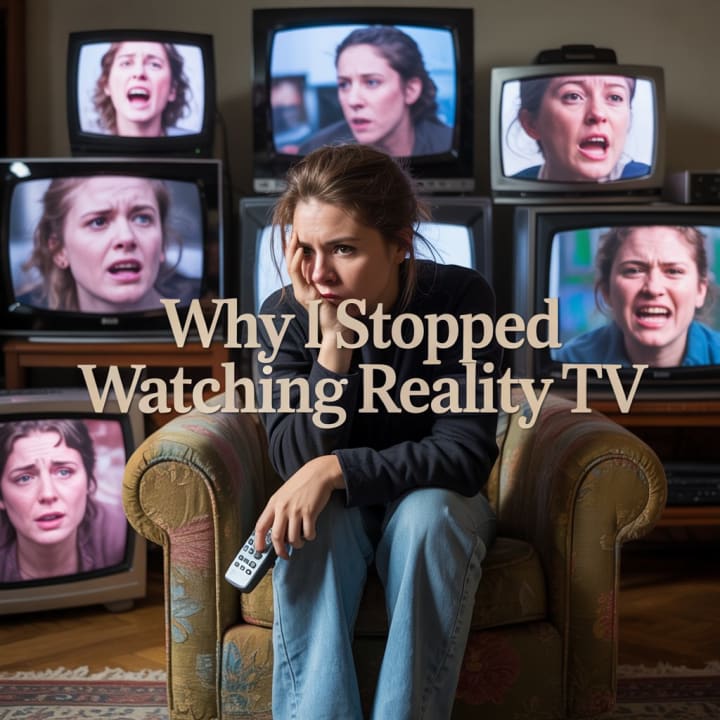
Toxic Patterns I Didn’t See at First
The deeper I got into reality TV, the more I noticed how normalized toxicity had become. Shows glamorized cheating, gaslighting, manipulation, body shaming, and public humiliation. Contestants were praised for being “villains” if they stirred the pot, and punished with silence if they showed vulnerability or growth. Redemption arcs were rare; scandal sold better.
At first, I told myself it was just entertainment. But slowly, I began to question: What is this doing to me? What is this doing to all of us?
That’s when the switch flipped.
---
The Breaking Point: When Entertainment Turned Into Discomfort
One night, while watching a heated argument between two contestants — a fight clearly encouraged by producers — something changed. It didn’t feel entertaining anymore. It felt cruel. The yelling wasn’t dramatic; it was sad. The humiliation wasn’t funny; it was exploitative. I realized I was watching people’s real pain being turned into a spectacle for ratings. And I was complicit.
That’s when I stopped.
I didn’t make a big announcement. I didn’t tweet about it. I just quietly started turning to other forms of entertainment — books, documentaries, podcasts, even silence. And the impact was bigger than I expected.
---
The Quiet Detox: What Happened When I Disconnected
At first, it was strange not having the constant background noise of other people’s drama. But within weeks, I noticed a change. I felt calmer. More present. My thoughts were clearer. I stopped comparing myself so much to people I didn’t even know. I didn’t feel the constant emotional rollercoaster of rooting for someone and then being disappointed when the editing turned them into a villain.
I rediscovered hobbies I had ignored. I became more mindful of the content I consumed. And maybe most importantly, I became more empathetic — in real life.
---
How Reality TV Warps Our View of Reality
One of the most dangerous things about reality TV is how it subtly reshapes our understanding of relationships, success, beauty, and human behavior. It teaches us that conflict is entertainment. That worth is measured by followers and screen time. That betrayal is strategic. That love is a game.
This isn’t harmless. These narratives seep into our culture, our expectations, our dating lives, our friendships. They tell us who to idolize and who to dismiss — often based on how well someone performs for the camera.
I started asking myself: If reality TV is shaping how we see the world, what kind of world are we creating?
---
Behind the Scenes: The Unseen Cost to Participants
After I stopped watching, I began reading stories from former contestants. Many spoke of anxiety, depression, even suicidal thoughts after their appearances. Some had been edited to look cruel or incompetent for the sake of storylines. Others were encouraged to drink, fight, or cheat on camera — only to be shamed for it later by the very audience that watched with popcorn in hand.
There’s a real cost to “reality.” And often, the people who pay it never signed up for the full weight of what came after.

---
Redefining Entertainment: What I Watch Now
I’m not saying all reality TV is evil. There are shows that inspire, that educate, that uplift. But now, I choose content more consciously. I ask: Is this building me up or breaking someone else down for my amusement? Is this helping me grow or keeping me numb?
Now, I watch documentaries that challenge me, shows with thoughtful storytelling, and even quiet, slow-paced series that feel more like real life. I enjoy fiction that reflects truth — not just exaggeration. And I don’t miss the chaos. Not even a little.
---
Final Thoughts: You Are What You Watch
In the end, reality TV taught me something valuable — not about love or success or style, but about myself. About how easy it is to get pulled into narratives that aren’t real. About how consumption shapes perception. And about how peace often comes when we step away from the noise.
I stopped watching reality TV not because it was too fake, but because it made me feel fake. I wanted realness — in my conversations, my relationships, my mind. And sometimes, the only way to find that is by turning the screen off.
About the Creator
Keep reading
More stories from Mr Haris Khan and writers in Interview and other communities.
I Followed a Billionaire’s Routine for a Week — Here's What Actually Happened
Introduction: The Temptation of a Billionaire’s Lifestyle We’ve all heard the mantras: “Wake up at 5 AM,” “Read a book a week,” “Never skip a cold shower.” These are the routines glamorized by ultra-successful billionaires—people like Elon Musk, Jeff Bezos, and Richard Branson. But how realistic are these habits for the average person?
By Mr Haris Khan10 months ago in Humans
Part 2 Interview With Joe Patterson, Author Of Melanin Memoirs
This is my second interview with Joe Patterson. His 4th anniversary writing on Vocal will be in March 2026. He has one achievement on Vocal, The Other Foot. He has over 17,000 reads on Vocal since he started on Vocal in 2022. Joe Patterson is very creative poet and rapper. Joe is deep thinker and I feel it is reflected in his latest published book, Melanin Memoirs.
By Mariann Carroll18 days ago in Interview
When the Shelter Closes
Across the street from my house, a man slept under a tree, his dog by his side. My first, naive thought: he must be traveling through. But he kept coming back, often sleeping there during the day. Then it hit me—that person might not have a home.
By Bride of Sound5 days ago in Humans



Comments (1)
NIce