
U.S. Air Force Sends Powerful Message with Massive “Elephant Walk” in Japan
Amid rising tensions in the Indo-Pacific, the U.S. Air Force showcases its strength and readiness with a massive multi-aircraft formation at its key forward base in Okinawa.

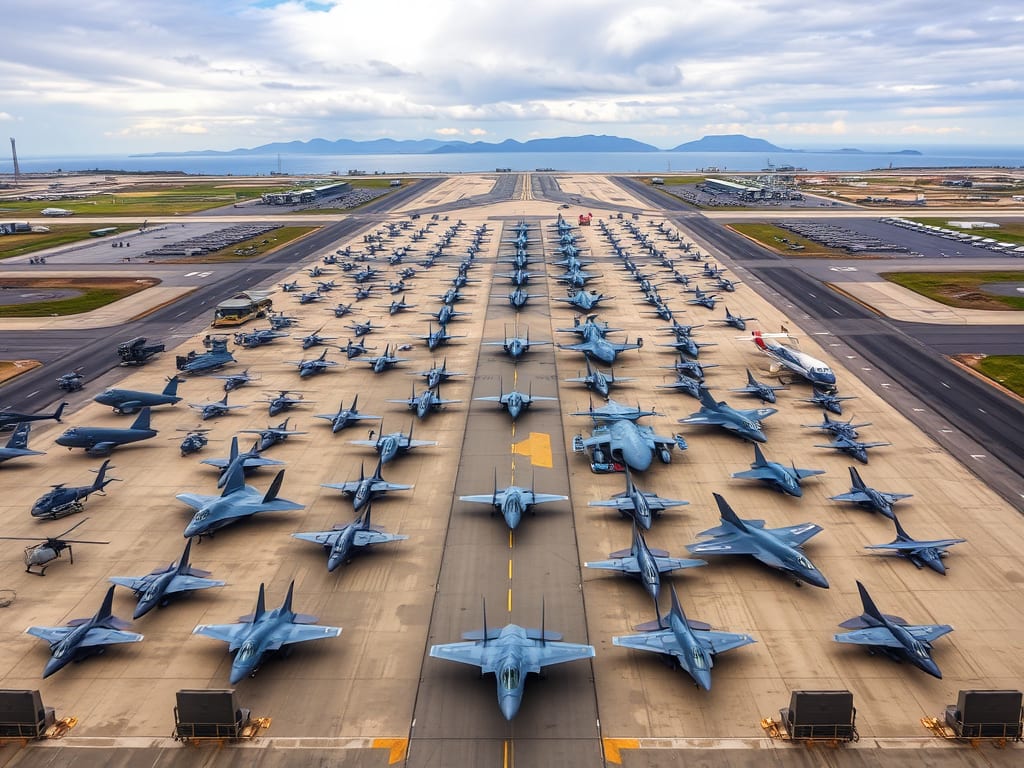
In a powerful show of force and coordination, the U.S. Air Force carried out a dramatic “elephant walk” this week at Kadena Air Base in Okinawa, Japan. The operation featured a massive lineup of 53 aircraft, ranging from stealth strike fighters to helicopters and drones, all moving in unison in a carefully choreographed display of airpower. Positioned just 400 miles from the Chinese coastline, the event served not only as a demonstration of operational readiness but also as a clear message of deterrence in a region where geopolitical tensions remain high.
” refers to the sight of multiple military aircraft taxiing closely together before takeoff—a tradition that dates back to World War II. Originally intended to prepare large numbers of bombers for mass departure, the maneuver has since evolved into a symbolic and tactical exercise to test the agility, speed, and cohesiveness of air units.
This week’s event at Kadena Air Base wasn’t just about spectacle; it was a demonstration of rapid force deployment, strategic coordination, and technological might. The participation of a wide variety of aircraft underscored the complexity of modern joint-force operations and the evolving nature of air warfare in the Indo-Pacific theater.
A Versatile and Powerful Lineup
Photographs released by the Air Force show an impressive variety of aircraft taxiing in tight formation along the flight line. Supersonic stealth fighters, likely including the F-22 Raptor and F-35A Lightning II, led the formation. Behind them were support helicopters and unmanned aerial vehicles (UAVs), demonstrating the integration of next-generation technology into U.S. air combat readiness. Toward the rear of the formation, larger aircraft such as refueling tankers and cargo planes stood ready to support extended operations.
Adding a layer of layered defense, Patriot surface-to-air missile (SAM) systems were positioned along the sides of the runway, emphasizing the Air Force’s ability to protect both air and ground forces against a wide range of aerial threats. The presence of these advanced air defense systems signaled a commitment to full-spectrum combat readiness—covering offensive strike capability as well as homeland and asset defense.
The Strategic Significance of Kadena
Kadena Air Base is a vital hub for U.S. operations in the Asia-Pacific region. With its strategic location on the island of Okinawa, Kadena allows American forces to project airpower throughout East Asia, including potential flashpoints like the Taiwan Strait, the Korean Peninsula, and the South China Sea.
At a time when tensions between the U.S. and China are elevated due to issues ranging from Taiwan to regional militarization, events like this elephant walk are seen as firm reminders of American presence and resolve in the region.
Chief Master Sergeant Brandon Wolfgang, the Command Chief of the 18th Wing at Kadena, emphasized the symbolic weight of the maneuver:
“An elephant walk like this sends a message you can’t ignore—it shows our Airmen, allies, and adversaries that we’re united, capable, and ready.”
This message resonates not only with potential adversaries but also with regional allies such as Japan, South Korea, the Philippines, and Australia. These nations increasingly coordinate with U.S. forces to ensure stability in the Indo-Pacific, forming a collective deterrent against aggression.
Readiness in a New Era of Conflict
While the visual spectacle of dozens of aircraft moving in tight formation might captivate aviation enthusiasts and defense observers, the real value of the elephant walk lies in what it reveals about operational readiness. Each aircraft must be flight-ready; each crew must be prepared for rapid deployment. Maintenance, logistics, and command control are tested under pressure, ensuring the ability to launch coordinated missions at a moment’s notice.
The integration of advanced drones and stealth platforms also highlights a shift in how the U.S. is preparing for future conflicts. Unmanned systems now play a central role in reconnaissance, electronic warfare, and even direct combat roles—functions that once required large human-crewed assets.
A Regional Message with Global Implications
Though centered in Okinawa, the implications of this elephant walk extend far beyond the Pacific. As global military dynamics shift—driven by conflicts in Eastern Europe, the Middle East, and increased Chinese military activity—such shows of strength serve as reassurance to U.S. allies and as cautionary signals to adversaries.
With 53 aircraft of various types mobilized in unison, this was more than a drill—it was a mobile declaration of intent, capability, and cohesion.
Whether on the ground, in the air, or through integrated missile defense systems, the message was clear: the U.S. Air Force is not only prepared for combat but ready to lead in any multi-domain operation.
As tensions simmer in the Indo-Pacific, the sky above Kadena echoed with the coordinated roar of engines, sending a statement loud enough to be heard across the region—and perhaps the world.
About the Creator
kb daily
Covering today’s trends, tomorrow’s conversations. I publish daily stories on the hottest topics in entertainment, culture, and the internet—one scroll-worthy headline at a time
Nightly Pulse: Knicks vs Pacers, Game 1 – Eastern Conference Finals Showdown
Nightly Pulse: Knicks vs Pacers, Game 1 – Eastern Conference Finals Showdown The 2025 NBA Playoffs have been electric, and the Eastern Conference Finals have brought a nostalgic yet thrilling matchup between two storied franchises: the New York Knicks and the Indiana Pacers. Game 1 of the series tipped off at the iconic Madison Square Garden, drawing fans into a whirlwind of excitement, tension, and high-stakes basketball. For longtime followers of the NBA, this duel echoes the fierce battles of the 1990s, now rekindled with a modern edge. The stage was set for an epic Game 1, and both teams delivered a performance that lived up to the anticipation.
By kb daily10 months ago in Unbalanced
Part 2 Interview With Joe Patterson, Author Of Melanin Memoirs
This is my second interview with Joe Patterson. His 4th anniversary writing on Vocal will be in March 2026. He has one achievement on Vocal, The Other Foot. He has over 17,000 reads on Vocal since he started on Vocal in 2022. Joe Patterson is very creative poet and rapper. Joe is deep thinker and I feel it is reflected in his latest published book, Melanin Memoirs.
By Mariann Carroll23 days ago in Interview




Comments
There are no comments for this story
Be the first to respond and start the conversation.