
Tina Adams Talks All About Filming With Animal Actors.
Getting animals to act is challenging, but Tina Adams dives in deep with the best insider tips and tricks to getting the best live action shots you can imagine.


Tina Adams is an award-winning filmmaker and producer currently living in Canada. Over the years, she has written and produced many films, including The Perfect Kiss, Hotel Limbo, My Wacko Parents, and documentaries like Harlem and Concealed Identity.
Click Here to Watch our Trailers.
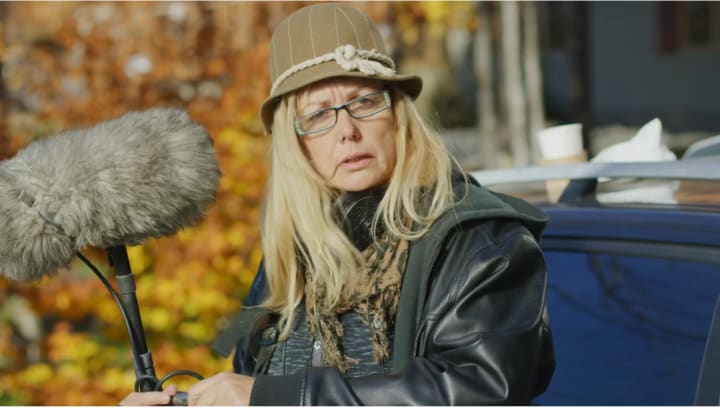
We spoke with Tina and asked her some questions about filmmaking and the life and times of being on a set. Here is part of a series of questions and answers we asked her.
***
Who's your favorite dog in a TV show or movie, and why?
It's a dog that most people do not know.
With all the war images we see everyday now from the Ukraine, I am reminded of a Polish series called "The Four in the Tank and the Dog".
This series was about a Polish tank crew that had a dog, a German Shepard, owned by a dazzling surgeon Jacek. I was crying not because of the tear jerking battle scenes, but when the dog was sometimes injured during its very dangerous missions.
It was all about this dog. This is what we enjoyed in Europe, this dog was a hero for us.
Another very famous feature I really liked was about saving lions in Africa. Elsa the lion and Joy Adams were the stars of the movie: Born Free (1966).
That same lady with her blonde hair and whom we share last names wrote the original book that was brought to fame by the movie. We actually share the same origins and come from the same area back in the Czech Republic.
The energy this film created had empowered an entire new generation of environmentalists.
I was very inspired that Ms. Adams was from the same region as myself and has a similar last name to me as well. So she was just as powerful an influence on me to get into filmmaking, as she was on the environmentalist movement, so I chose to take a similar English version of our last name as well.
Do acting dogs get paid?
Of Course! Yes they do and on the spot, they are usually treated very well ;)
It's actually the owner of the animal that is paid monetarily of course for the pets services.
But the animals are rewarded with toys and treats right then and there.
In the production structure, the vet bills and food are also included in the budget. But, the animals also have some challenges, like not interacting with the crew while on scene, or not running off at the wrong time.
So on set, members of the film crew are not allowed to pet or touch the dogs to avoid the dog interacting with the wrong people while shooting.
Dogs are loving animals and are always looking to please, so they try their best based on their simple personalities and abilities.
But since we cannot show an animal how to act in a certain way or do something specific, it's hard and frustrating sometimes to develop the right communication and triggers to get exactly what you want in mind.
Do dog appearances in films influence the popularity of certain breeds?
Think about 101 Dalmatians, when the film came out everyone instantly wanted one.
But… then everyone discovered that this breed was extremely difficult to have in an apartment and they were not so kid friendly.
Of course like everything else we are influenced by what we see on a screen. Whether it was fashion, hair or even the cute little dog in a purse, an influential image popularized by Paris Hilton.
This remarkable impact is something that still amazes me until today; how and why do simple and sometimes foolish ideas of filmmakers become commonplace.
At the end of the day, a movie is just an illusion and real life is totally different, so when it comes to pet ownership you really need to know enough about the breed before you decide to own one.
During the early days of film, the idea was just about capturing the moment and sequencing the individual pictures into a movement. The first actual close up in a film portrayed a kitten and so the cat became very symbolic to film. Later this happened again with YouTube, where the first viral video was that of a kitten playing.
Movie Directors: How do you direct 'animal' actors?
Not every director can direct animals, it takes deep knowledge of animal psychology. Even if you are a lifetime dog owner it takes special knowledge to get them to do certain tricks and behaviors.
Animals are not the same as humans, we know that. The psychology behind animals is different, but it's there and it exists. Many people think that all animals need special training just to be on screen. I don't think that this is necessary.
With dogs, they usually have a favorite toy or favorite treat. In my experience their toys work better than their favorite treat.
For example, you want the dog to be observant on screen, looking from left to right, for example, you take its favorite toy, i.e. a tennis ball, ask the dog to sit and then move the ball from left to right while allowing the dog to follow with their face. It's simple but very efficient.
The same goes for when you want the dog to run from one end of the shot to the next.
For example, if you want the dog to be excited towards one of the characters, then place the dog somewhere close to the actor and place the ball somewhere on the actor’s body, the dog will react with love and excitement for the ball on the actor, but on screen it will look like its excited to see the actor.
In my film Hotel Limbo we have two dogs that have major roles in the film.
The larger dog was a half Pitbull, and the smaller dog was actually 4 different small dogs from the same breed.
We used the personality of each of those small dogs to show either excitement, calmness and high energy running.
One of the small dogs was blind, so he was the actor during the scenes where they are sitting still. The other one loved to run so he would do all the running scenes, and the last one was very nervous so he would do the nervous facial reaction scenes.
The larger Pitbull, Layla, is actually a female dog and she had the role of a male dog in the movie. Because she has a very unique aesthetic to her, we were afraid that if something happened to her during the shoot, it would be complicated trying to complete the movie.
Another popular animal actor is cats.
In My Wacko parents, the best friend of the main character, Tanya, owns a black cat. We were lucky that the black cat actually came with the location of filming.
The cat was present when Brittany was in her bath, then again when children were playing and then again when they were preparing breakfast. In this case, the cat is more of an accessory than a character.
My experience with cats is they need to be filmed within their own habitats or home, if not they get afraid and hide.
So to deal with cats you need one that lives at the filming location. If not, you will need the cat to become very comfortable with that location. Filming cats is more like filming a documentary.
Dogs on the other hand are much more cooperative.
Another interesting aspect of directing animals is having other species of animals on set.
We had many other animals on the set of Hotel Limbo.
It takes a lot of patience and adds a whole new dimension to our work, because the entire crew has to be aware of the animals.
We had a moment when our gaffer, a large and masculine guy, was holding a white rabbit for a scene. He built a relationship with the rabbit and was very sad when we had to return the rabbit.
He thanked me for that experience.
We also had some hens. Two of these hens had some experience on camera, and they somehow knew when being filmed, it was as if they gave us an extra show for the camera.
We also had another two hens which did not have any experience, and we could see how differently they behaved compared to the hens with experience. We had to constantly feed them because hens pretty much always need to eat.
These techniques are just a few of the many techniques out there for directing and filming animals. It takes a lot of patience and perseverance and creativity to build that psychological understanding of the animal, to use its personality and to capture all the right moments.
So it's not really the animal that needs to be trained, it's you.
***
We hope you enjoyed our latest interview with Tina Adams and are thrilled to bring more knowledge, stories and wisdom from the filmmaking world. Join us as we explore more questions and tell more stories about film, script, editing and everything related.
Check out Hotel Limbo, On iTunes May 12th, 2022.
About the Creator
7 Art Distribution
Over 20 years, Seven Art Distribution has supported Independent Filmmakers by providing them a channel to bring their art to screens all around the World.
Keep reading
More stories from 7 Art Distribution and writers in Interview and other communities.
An Interview with Tina Adams.
Tina Adams is an award-winning filmmaker and producer currently living in Canada. Over the years, she has written and produced many films, including The Perfect Kiss, Hotel Limbo, My Wacko Parents, and documentaries like Harlem and Concealed Identity.
By 7 Art Distribution 4 years ago in Interview
Part 2 Interview With Joe Patterson, Author Of Melanin Memoirs
This is my second interview with Joe Patterson. His 4th anniversary writing on Vocal will be in March 2026. He has one achievement on Vocal, The Other Foot. He has over 17,000 reads on Vocal since he started on Vocal in 2022. Joe Patterson is very creative poet and rapper. Joe is deep thinker and I feel it is reflected in his latest published book, Melanin Memoirs.
By Mariann Carroll27 days ago in Interview
Enzo Zelocchi: Exploring the Journey of an Actor, Producer, and Visionary Shaping Modern Independent Cinema
Independent cinema has long been a space where creativity thrives and unique voices emerge. Unlike large studio productions that often follow established formulas, independent films allow creators to experiment with ideas, explore deeper themes, and tell stories that might otherwise remain untold. Within this dynamic environment, artists who combine passion with vision can create meaningful contributions to the film industry. One such figure is Enzo Zelocchi, whose growing career reflects dedication to storytelling and modern filmmaking.
By Brian Smith7 days ago in Interview




Comments
There are no comments for this story
Be the first to respond and start the conversation.