
The Russian army is learning Hamas tactics.
The Russian army is learning Hamas tactics.
The fundamental reason why the powerful Israeli army has been unable to eliminate Hamas, a mob of militants, for nearly three years is that Hamas disregards all contemporary rules of engagement.
In peacetime, Hamas flaunts its military might in uniform; in wartime, they change into civilian clothes, hunker down and fire from corners. Once in danger, they immediately abandon their weapons and claim to be civilians. Therefore, the severely inflated casualty figures Hamas reports never distinguish between military personnel and civilians.
They prohibit civilians from fleeing the firefight zone, hiding among them and using them as human shields.
This isn't surprising, as they are, after all, a recognized terrorist organization in the civilized world.
However, the world's second-largest army is acting in this manner on Ukrainian territory.
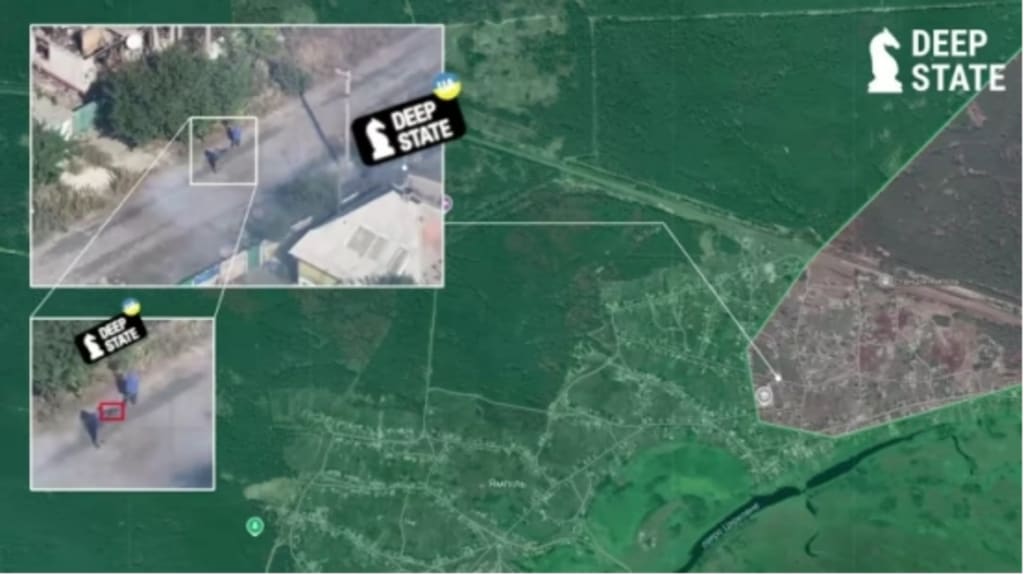
Ukrainian civilian war monitoring organization Deep State reported yesterday that Russian military personnel disguised as civilians had infiltrated the village of Yampil in the Donetsk region. According to the agency, Russian soldiers, having changed into civilian clothes and discarded their uniforms, entered the village in groups of two or three via side roads. After breaking into villagers' homes, they coerced the villagers into serving as human shields. Hiding in basements and behind curtains, they fired at Ukrainian troops.
Under international law, it is illegal for Russian soldiers to wear civilian clothes during combat. Captured individuals are not protected by the Geneva Conventions and can be executed without trial by Ukraine. Kidnapping civilians as human shields is a war crime. Of course, discussing international law with these Russian soldiers from remote and impoverished regions of Russia is completely futile.
By the way, even in 2025, over 40% of Russians still lack access to flush toilets. This also serves as a reminder for Russian strategists: International oil prices have been high for 25 years. Where has all the money Russia has made from oil sales gone?
The tactics the Russian army adopted from Hamas did indeed create considerable challenges for the Ukrainian army: they had to eliminate infiltrating enemy soldiers while avoiding harming civilians.
The Ukrainian army faced a more difficult situation than the Israeli army, as the Israelis were facing fellow Hamas fighters, while the Ukrainian army was facing its own people.
Furthermore, in exchange for captured Ukrainian soldiers, the Ukrainian army typically spared executing Russian prisoners posing as civilians, but this did not improve the fate of these Russian prisoners.
According to the Russian independent media outlet Novaya Gazeta, after being exchanged, Russian prisoners first underwent lengthy interrogations by the FSB. Those who voluntarily surrendered faced criminal prosecution. Others who presented "no problems" were immediately transferred to combat units and returned to the battlefield, not even allowed to see their families.
Once returned to the battlefield, they were assigned to "death charges," designed to deplete Ukrainian ammunition and drones and expose Ukrainian firepower points.
This is why some wounded Russian soldiers chose suicide rather than be captured—they feared not Ukrainians, but their own people.
Other Russian soldiers made different choices.
The Daily Telegraph reported that a large number of captured Russian soldiers refused prisoner exchange and returned home, instead joining the Ukrainian army to fight against Russia.
The newspaper interviewed several Russians who fought for Ukraine and shared their stories.
26-year-old "White," a former Wagner soldier, spent nine months in a Ukrainian prisoner-of-war camp. He refused prisoner exchange and joined the Ukrainian army's spontaneously formed "Anti-Kremlin Unit" assault team. The unit's members are all former Wagner soldiers, former FSB members, and Russian civilians.
"White" told reporters: "I will only return to Russia in a tank."
21-year-old "Ney," a Moscow native who majored in philosophy, told reporters that he would not return to Putin's rule.
The unit's chief of staff, "Fortula," was a businessman who moved to Ukraine in 2017. After witnessing the Irpin massacre in 2022, he volunteered to join the Ukrainian army to fight against Russians.
"John," a 40-year-old Russian soldier, fought with the Azov Battalion after the 2014 invasion of Dons. After the full-scale war broke out in 2022, he joined the Ukrainian army.
"John" told a Daily Telegraph reporter: "The Kremlin's 'peace terms' are laughable." According to Ukrainian data, the total number of Russians fighting for Ukraine has now exceeded 15,000.
These people have seen through the Kremlin's true nature and understand, better than ordinary Ukrainians, the extent of its harm to all ordinary people. Therefore, they would rather take up arms and fire on their own compatriots than stand aside.
A reader who does business with many Russians here told me that those Russian businessmen follow the war developments daily, but their faces are gloomy and depressed. They never discuss the fighting, nor do they defend the invasion of Ukraine.
It's not hard to guess what they're thinking.
Many years ago, I read a quote: "One indicator of whether a country is civilized or barbaric is its treatment of prisoners of war—both foreign and domestic."
As for Russia and Ukraine's treatment of each other's prisoners of war, I believe everyone is familiar with the story of the world-famous "Smoking Uncle" Macievsky. There are also numerous images of Ukrainian prisoners of war being tortured to death or even beheaded.
The two countries also differ greatly in their treatment of their own prisoners of war.
Ukrainian prisoners of war returning home are treated like heroes returning home. Ukrainian law stipulates that returning prisoners have the right to decide for themselves whether to return to the battlefield.
There is no harm without comparison; civilization and barbarism are clearly distinguishable.
If a barbaric country defeats a civilized country, it will be a disgrace to the entire human world.
And US President Trump is doing everything he can to help the aggressor win.
Trump's pro-Russia strategy can be divided into three phases:
The first phase: Upon taking office, he accused Zelenskyy of inciting the war—and on September 13th, he again claimed in a lengthy post that Zelenskyy and Biden had started the war—in an attempt to preemptively morally undermine Zelenskyy and force Ukraine's surrender.
When Zelenskyy refused, he cut off arms and intelligence support, inflicting the worst defeat of the Ukrainian army in Kursk since the start of the war.
The second phase: After resuming arms deliveries to Ukraine under domestic and international pressure, Trump shifted tactics, forcing Ukraine to cede territory under the guise of peace.
While Europe and Ukraine cooperated with his "peace talks," they increased military support and military production. Now, despite the near-cessation of US aid, the Ukrainian army's combat effectiveness has not significantly declined. Zelenskyy claimed that the proportion of weapons and ammunition used by the Ukrainian army has reached 60% domestic production!
Coupled with the ongoing attacks on Russian refineries, energy depots, ammunition depots, transportation hubs, and oil terminals, the invading forces are in a very awkward position.
The third stage: Trump, realizing that no matter what he did, he couldn't weaken Ukraine's fighting capacity, turned to a perverse strategy: helping Russia improve its wartime capabilities.
He had tried to ease or lift some sanctions on Russia, but found this a futile approach. All he could do was refuse to add or participate in new sanctions.
With the cunning of a real estate businessman, he shifted the blame for not imposing sanctions on Russia onto Europe—he would impose sanctions on Russia as long as Europe cut off Russian energy and imposed secondary sanctions of 100% tariffs on three major buyers of Rosneft. Even a fool knows that even a sow can climb a tree, Europe can't. Therefore, the United States would not impose any sanctions.
This proved to have no significant effect on improving Russia's wartime capabilities.
Reuters reported yesterday that Russia was using a crude "barter" trade method, exchanging agricultural products like wheat from supporters for cars and appliances, then stripping the chips from them for use in its weapons.
How could a modern war be won under such circumstances?
Trump came up with a clever trick: using Belarus as a roundabout way to help Russia.
A few days ago, he lifted aviation sanctions on Belarus, allowing Russia to immediately obtain high-tech weapons parts and chips urgently needed for various weaponry.
Not enough, Trump even initiated military cooperation with Belarus, arranging for American military officers to observe the joint Russian and Belarusian military exercises, "West-2025," currently taking place in Belarus.
The hypothetical adversaries of these exercises are Europe and the United States. Eastern European countries are conducting similar military exercises as if facing a formidable enemy, yet Trump is now sending military personnel to support them—an unprecedented move!
This is undoubtedly a move to warm the thaw in relations between the United States and Belarus.
Kerr, Trump's appointed special envoy to Belarus, stated that the United States plans to reopen its embassy in Minsk in the "near future" and resume trade relations with Belarus, although no one knows what kind of trade relations the two countries will actually have. It is well known that Russia and Belarus have already intensified their integration efforts. From this perspective, any relationship the United States establishes with Belarus can be viewed as a relationship with Russia.
Repairing the plank road in the open, but secretly crossing Chencang!
Once the door to military cooperation is opened, all doors open.
Yesterday, Trump said in a public speech: "This week, a total of 8,000 soldiers from both countries died. Russia lost slightly more, but when you're the aggressor, your losses are greater."
Many Trump supporters were moved to tears—look! Trump finally called Russia an aggressor.
Come on, that's just because he's old and accidentally told the truth.
No matter what he says about the Russo-Ukrainian war, his goal is only one: to help Russia win.
I'm not sure he'll stick to it, but at least nothing has changed for now.
About the Creator
Part 2 Interview With Joe Patterson, Author Of Melanin Memoirs
This is my second interview with Joe Patterson. His 4th anniversary writing on Vocal will be in March 2026. He has one achievement on Vocal, The Other Foot. He has over 17,000 reads on Vocal since he started on Vocal in 2022. Joe Patterson is very creative poet and rapper. Joe is deep thinker and I feel it is reflected in his latest published book, Melanin Memoirs.
By Mariann Carroll16 days ago in Interview
Sports podcast What's The Call Premieres
Tennis is one of my favorite sports. And, I enjoy the women’s game much more than men’s tennis. Why? Who wants to see 40 aces in a game? It’s like watching teams strike out in baseball. I like the ball in play in any sport. Sports mean action. Even Curling has action. In golf, there should be a shot clock. Stop throwing grass in the air and just hit the ball!
By Frank Racioppiabout 8 hours ago in Interview
Flower Bloom 369
FLOWER Bloom 2/25/26 Wednesday By Mariann Carroll Karen had been with Tony for 7 years. Tony started acting strangely after her surgery. He would mow the lawn in the rain and be on his cellphone. He started pushing Karen away. Tony came clean about seeing someone. Karen moved out two months later. Karen moved in with a friend. She felt betrayed.
By Mariann Carroll4 days ago in Fiction




Comments
There are no comments for this story
Be the first to respond and start the conversation.