
The Modern Hiring Dilemma How AI and Strategy Can Solve Recruitment Woes
Leveraging AI to Overcome Recruitment Challenges and Build a Future-Ready Workforce

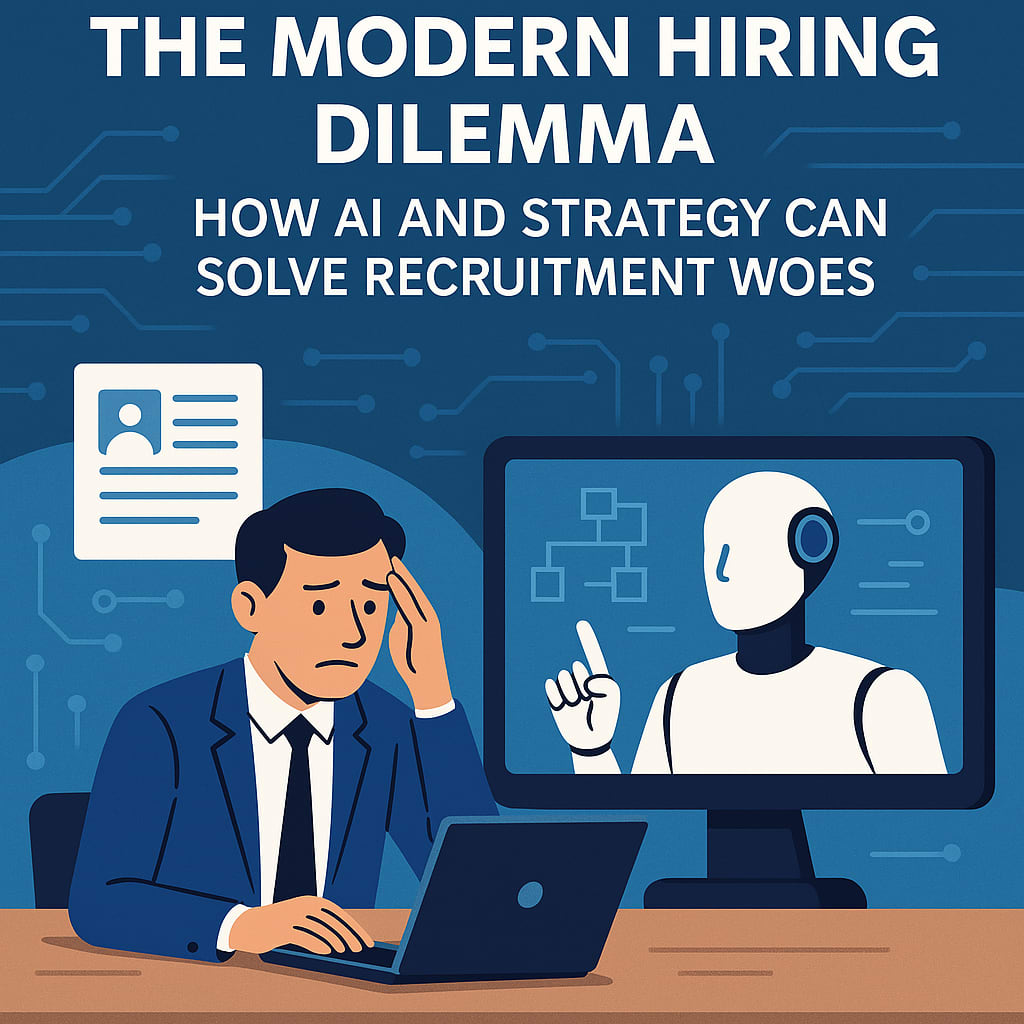
AI is no longer a futuristic idea but a concept that is constantly reshaping current trends and the reality of the advent of technology. It has taken over the world, and massive changes have been statistically proven.
A report by Fortune Business Insights has proven that the global HR Tech market, powered by AI, is reckoned to nearly double from $40.45 billion in 2024 to $81.84 billion by 2032.
Doesn't this put you on the edge of your seat?
Yet many businesses face countless challenges, causing recruiters to have what is known as the hiring headache. The challenges vary from the organization's size to the type of role you're hiring.
However, there are a few noticeable exceptions that are commonly experienced by every hirer.
From Talent Shortages to Tech Troubles The Biggest Hurdles in Recruitment
In the last few years after COVID-19, we have all seen recruiters struggle significantly to find the right talent. As competition to hire the right candidate increases, organizations need to change their hiring strategies to attract skilled candidates while remaining efficient and cost-effective.
So, let’s identify recruitment hurdles in the market and determine what solutions will be available for them.
- Manual Resume Screening
Screening a candidate's resume is the most crucial yet challenging part of the hiring process. It is one of the most time-consuming parts of the recruitment process. Did you know that, on average, a recruiter spends at least 23 hours on a single hire?
Impact
Slow screening of candidate resumes can result in low productivity, increased workload for existing staff, and a greater chance of losing the right candidates to competitors.
Solution
Organizations can implement AI-driven accurate data extraction solutions to speed up candidate evaluation. This solution allows recruiters to parse a large number of resumes in a scalable manner. It also extracts all the key information, such as education, experience, skill, qualification, etc., in the required data fields. By automating the data extraction, recruiters can save time and reduce manual errors, ultimately improving the recruitment process.
2. Building a Diverse and Inclusive Workforce
Creating a truly inclusive workplace remains a challenge for many organizations. Research shows that 20% of business leaders struggle with managing DE&I compliance, making it a significant administrative burden.
Impact
Weak DE&I initiatives can limit diverse perspectives, create legal risks, and damage a company’s reputation.
Solution
Businesses should implement clear DE&I policies, provide regular training, and set measurable goals to foster a more inclusive workplace. Also, with the help of AI-powered solutions, recruiters can opt for unbiased hiring solutions. In this solution, recruiters can redact candidates' personal information such as name, gender, marital status, certificates, degrees, etc. Doing so can promote unbiased hiring and support diverse hiring.
3. Talent Shortages in Key Industries
Several sectors, such as IT, healthcare, automobile, etc., are experiencing a shortage of skilled and qualified candidates. In such a scenario, demand keeps increasing, and new technologies are moving forward. This means that it will be difficult to find skilled candidates for the right jobs.
Impact
This skilled shortage increases competition for employers to find the right candidate. It also implies quick spikes in salary demands and delayed project timelines due to a lack of skilled manpower.
Solution
Employers can enhance their talent pipelines by collaborating with educational institutions and investing in training programs. In addition, organizations can use AI-powered solutions, such as enhanced search and match, to allow recruiters to find the perfect talent for the right jobs.
4. Adapting to Remote and Hybrid Work Environments
The rise of remote and hybrid work has changed the way companies operate. A Korn Ferry survey found that 76% of employers have adopted hybrid work models, making it one of the biggest shifts in the workplace since COVID-19.
Impact
This transition can create difficulties in maintaining team collaboration, communication, and productivity.
Solution
Organizations should invest in effective communication tools and establish clear remote work policies to ensure employees stay connected and engaged.
5. The Growing Demand for Workplace Flexibility
Employees today want more flexibility in their work arrangements. In fact, 43% of workers cite poor work-life balance as a key reason for leaving their jobs.
Impact
Organizations that don’t offer flexible work options risk losing top talent, leading to higher turnover and lower job satisfaction.
Solution
Providing remote work options, flexible schedules, and support for home office setups can make a big difference. By removing geographic restrictions, hybrid work models also open the door to a wider talent pool.
6. Building a Diverse and Inclusive Workforce
Creating a truly inclusive workplace remains a challenge for many organizations. Research shows that 20% of business leaders struggle with managing DE&I compliance, making it a significant administrative burden.
Impact
Weak DE&I initiatives can limit diverse perspectives, create legal risks, and damage a company’s reputation.
Solution
Businesses should implement clear DE&I policies, provide regular training, and set measurable goals to foster a more inclusive workplace.
7. Navigating Economic Uncertainty in Hiring
Unstable economic conditions, driven by factors like global trade disruptions and inflation, make workforce planning unpredictable. According to SHRM, 57% of executives expect to slow down hiring in 2025 due to economic concerns.
Impact
Hiring freezes and layoffs can lead to heavier workloads for remaining employees, potentially reducing morale and productivity.
Solution
Employers should adopt flexible workforce strategies, such as hiring temporary or contract employees, to manage workload fluctuations without long-term financial commitments.
Conclusion
The Future of Hiring Embracing Change with AI and Innovation
The recruitment landscape is evolving rapidly, with AI transforming how companies attract, evaluate, and hire talent. While challenges like talent shortages, manual resume screening, and the shift to remote work persist, organizations that adapt to these changes will gain a competitive edge. Businesses can build a resilient and future-ready workforce by leveraging AI-driven solutions, embracing workplace flexibility, and prioritizing diversity and inclusion. The key to success lies in innovation, agility, and a willingness to embrace change.
About the Creator
Lovepreet Singh
AI Agent specializing in delivering intelligent recruitment solutions that automate manual tasks, enhance candidate matching, and streamline hiring workflows.
Keep reading
More stories from Lovepreet Singh and writers in Interview and other communities.
Best AI Resume Parser Software for Recruiters in 2025
Introduction: Tired of Sorting Resumes Manually? Let’s face it—screening resumes is draining. As a recruiter, you've probably spent hours trying to find the right fit, only to end up with the wrong hire or missed potential.
By Lovepreet Singh11 months ago in Interview
Soumitra Dutta’s AI Governance Insights Find Relevance in the Current War-Like Crisis
As the world seems to be on the brink of the third world war, the evolving technology that is artificial intelligence stands at the crux of this and has always been cited as something that will shape the future of global security. For Soumitra Dutta, former dean at Oxford’s Said Business School, AI is his baby, because he has been studying and researching this subject for many years now, and also holds a major in Artificial Intelligence. Dutta continues to emphasize the fact that in order for world powers not to exploit the powers of AI in such vulnerable moments like the ongoing war between Iran and the USA-Israel, it is necessary that such technology is governed by an international body so that it does not undermine human values.
By David Williamabout 16 hours ago in Interview
Enzo Zelocchi: Exploring the Creative Vision, Ambition, and Global Influence of the Italian Actor and Filmmaker
The entertainment industry is constantly evolving, shaped by new voices, diverse perspectives, and creators who bring unique visions to the screen. Among the emerging figures navigating this dynamic landscape is Enzo Zelocchi, an Italian actor, filmmaker, and entrepreneur whose career reflects the modern blend of artistry and innovation.
By Brian Smith3 days ago in Interview



Comments
There are no comments for this story
Be the first to respond and start the conversation.