
The Hidden Empire: Central Banking, Intelligence Networks & the Architecture of Global Power
An Investigative Commentary

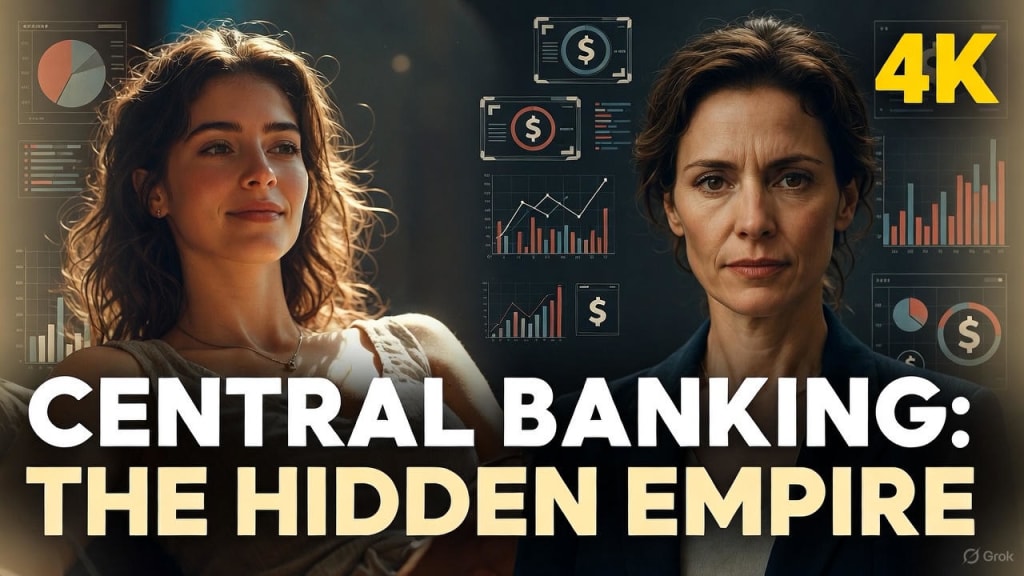
History is often told through the stories of empires, wars, treaties, and revolutions. But some analysts argue that beneath these dramatic events lies another story — a slower, quieter, and far more complex evolution of power. A story not written by nations, but by financial systems, intelligence networks, and supranational institutions that operate above the boundaries of individual states.
To these observers, this formation is not merely a system — it is what they call “The Hidden Empire.”
This perspective does not present absolute truth, but it reveals an alternative lens through which many researchers today interpret modern global structures.
- The Breakdown of Trust: Media, Narratives & Manufactured Perception
- News is less about investigation and more about narrative construction.
- Outrage and fear are amplified because they generate profit.
- Social media algorithms promote division because conflict increases engagement.
- Former intelligence officials regularly appear as “expert analysts,” using their credibility to shape public opinion.
- Global finance operates as an interconnected power web, not merely as isolated national banks.
- The Bank for International Settlements (BIS) is seen as the “central bank of central banks,” a hub that transcends national authority.
- BIS and related institutions possess unique protections:
- legal immunities
- exemption from national audits
- international privileges
- diplomatic-style protections
For most people, reality is shaped by what they see on television, in newspapers, and online.
Yet many critics believe that modern media has shifted from neutral information to a powerful form of psychological influence.
From their viewpoint:
This raises a troubling possibility:
that the line between information and manipulation is becoming dangerously thin.
2 The Financial Superstructure: Central Banks & Supranational Control
Central banking sits at the heart of modern societies. But some analysts argue that these institutions have grown into something much larger than national economic tools.
According to this perspective:
To critics, these privileges make central banking not just a financial system but a globalized architecture of influence with remarkable autonomy.
3. After the War: Operation Paperclip & the Deep Integration
- When World War II ended, the world believed Nazism had been defeated.
- But researchers studying declassified files argue that the story is far more complicated.
Under Operation Paperclip, thousands of former Nazi scientists, strategists, engineers, and intelligence officers were brought into Western institutions.
Their influence spread into:
- defense laboratories
- psychological warfare divisions
- aerospace programs
- psychiatric research
- advertising and propaganda
- national intelligence agencies
Their methods — including psychological conditioning, interrogation techniques, and propaganda models — quietly blended into Western intelligence structures. Some scholars describe this as:
“The ideology was defeated, but the systems survived — rebranded and redistributed.”
4. War as Industry: From Cold War to the War on Terror
In this alternative analysis, war is viewed not only as geopolitics but as economic infrastructure.
- The Cold War justified massive expansion of defense budgets.
- Proxy conflicts in Asia, Latin America, and the Middle East fueled weapons industries.
- Reconstruction programs and foreign aid created profit loops for contractors and banks.
- Currency stabilization programs increased global dependency on Western institutions.
- “Permanent war” became a predictable economic cycle.
- Under this lens, war is not a sudden tragedy —
- it is a sustained business model that shapes global institutions.
5. The Modern Phase: Technocracy, Digital Currency & Behavioral Governance
Critics argue we are now entering a new stage of global power —
one defined not by empires or armies, but by technology and centralized data control. This model has three central pillars:
1. Digital Finance
Central Bank Digital Currencies (CBDCs) could allow unprecedented fine-grained control over money — programmable, trackable, and potentially restricted.
2. Mass Surveillance
Cameras, biometrics, data brokers, and AI monitoring systems merge into a global observation grid.
3. Narrative Management
Digital platforms regulate speech, limit dissent, and shape public perception through algorithms, AI moderation, and controlled information flows.
Together, these systems form what some analysts call the “21st-century technocratic order” — an infrastructure of governance built through code, finance, and data rather than traditional political structures.
About the Creator
Voice of Reality
Exposing hidden agendas in global politics and media. Voice of Reality empowers independent thinking the truth has a sound, and we are its voice."
Keep reading
More stories from Voice of Reality and writers in Interview and other communities.
The Battle for Election Integrity: A Deep Dive into Rigged Systems and Paths to Restoratio
In a powerful discussion on election fraud and government overreach, a former law professor and filmmaker behind the censored documentary Let My People Go shared frontline insights into America's broken voting systems. With years of experience battling election irregularities, health mandates, and institutional corruption, he dissected the 2025 midterm losses, the perils of electronic voting, and urgent solutions under a potential Trump administration. The core message: Elections remain rigged, and establishment narratives—left or right—are deliberate distractions.
By Voice of Reality2 months ago in Education
Center Stage with Paul Stewart
*** I'm keen to republish the interviews I did for my series with Vocal creators. It's been a few years and I thought it might be nice to revisit these wonderful conversations. I'll be releasing them one at a time for a few weeks/months.
By Heather Hubler4 days ago in Interview
A Story of Taylor Swift
On a quiet Christmas morning in Reading, Pennsylvania, a young girl sat on the edge of her bed holding a guitar that was nearly as big as she was. Her fingers pressed carefully against the strings as she tried to match the melodies she heard in her head. Her name was Taylor Swift, and even at that young age, she understood something important: music was not just sound—it was a way to tell the truth. Long before stadium lights and chart-topping records, Taylor was learning how to turn feelings into stories.
By Organic Products 2 days ago in Interview



Comments
There are no comments for this story
Be the first to respond and start the conversation.