
Raised by Nomads
No house, no hometown—just a childhood lived across continents, cultures, and campfires

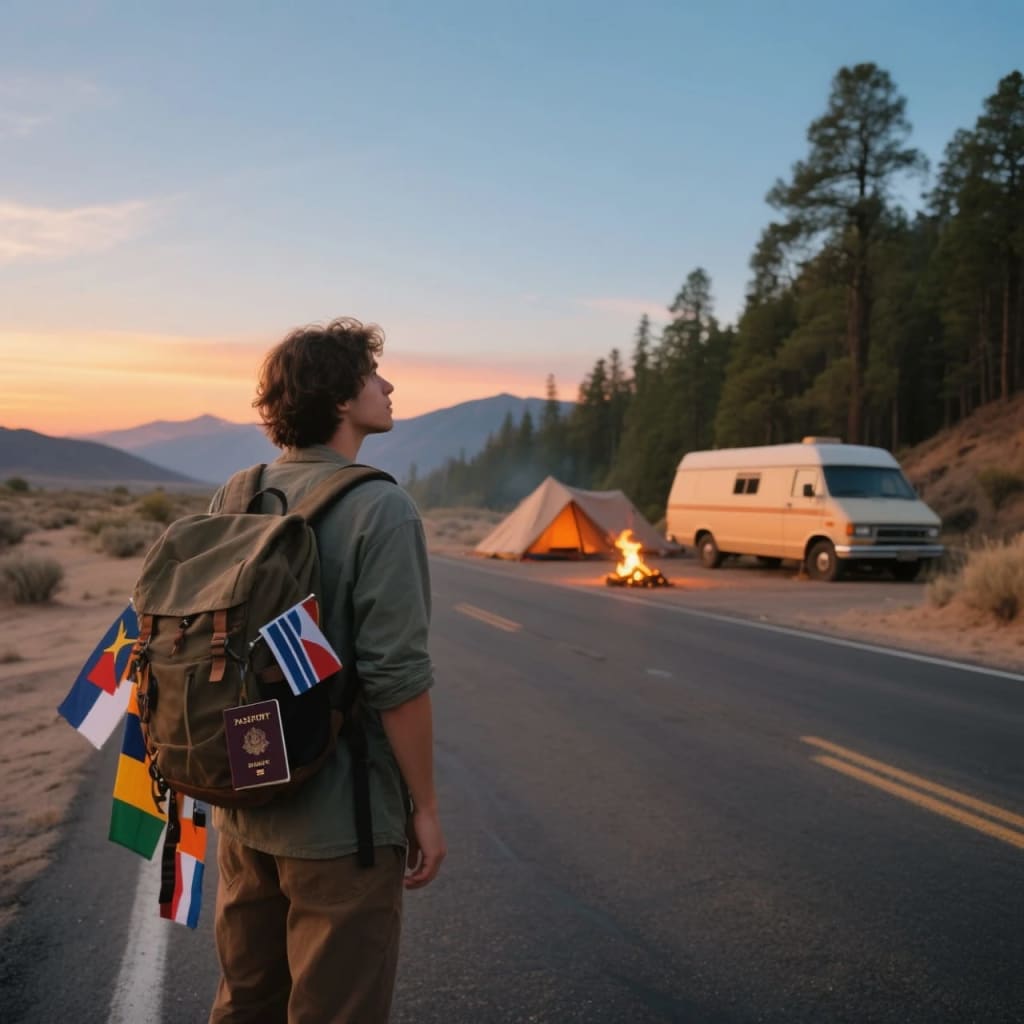
When I was a child, I didn’t have a home—at least, not the way most people think of it. I didn’t have a bedroom with walls or a backyard with a swing set. I didn’t have a school that I returned to every year, or neighbors who recognized my face as a familiar one. My life was different from the others. My life was transient, wandering, and rooted in something far more complex than just a physical place.
I was raised by nomads.
My parents weren’t wanderers in the traditional sense of the word—they weren’t escaping from society or running away from something they feared. They simply believed that home wasn’t defined by a building or an address, but by the people you loved and the experiences you gained. They believed in freedom, in constant discovery, and in the richness of culture beyond borders. And so, every few months, we would pack up our things, fold our tents, and move on to the next destination.
It wasn’t always easy. There were challenges I couldn’t fully understand as a child—like the constant upheaval of friendships, the difficulty of language barriers, and the awkwardness of never being quite like anyone else. But those moments of discomfort were overshadowed by the profound lessons I learned, and the experiences that would come to shape my entire life.
I can still remember the first place I called "home"—but it wasn’t a home in the traditional sense. It was a sprawling desert in Morocco, where the winds howled and the air shimmered with heat. We lived in a small, dusty tent, just outside a vibrant Berber village. I was five years old when my parents decided to stay there for a few months. The people of the village didn’t have much, but they were incredibly generous. The nomads who lived there would greet us with smiles and share their meals with us. There was a warmth in their hospitality that transcended language, and a sense of community that I couldn’t quite understand but felt deeply.
I learned the value of kindness there. It wasn’t the material wealth that mattered—it was the connections, the shared stories by the campfire, and the wisdom passed down through generations. I learned to be patient with differences, to listen more than I spoke, and to find beauty in simplicity. I also learned how to dance to the beat of drums, how to play the oud, and how to appreciate the taste of fresh bread, hot from the oven, in the company of strangers who quickly became family.
From Morocco, we traveled south to the jungles of central Africa. The landscape was lush and green, teeming with wildlife that I had only ever seen in books. The people there lived in small, circular huts made from mud and straw, surrounded by dense vegetation and towering trees. They didn’t have electricity or running water, but they had something even more valuable: an intimate connection with nature. The villagers lived in harmony with their surroundings, and I learned to respect the land and its creatures in ways I had never imagined.
In that village, I spent my days playing with the children of the tribe, learning to weave baskets and plant crops. I learned the names of every tree, every plant, and every bird. But it wasn’t just the physical world that fascinated me—it was the spirituality of the place. I became enthralled by the villagers’ rituals, by their belief in the spirits of the earth and the ancestors. It was there, sitting by the fire at night, that I began to understand the power of stories and traditions. The elders would tell tales of the past, of how the land had been shaped by gods and ancestors, and how the cycle of life was intertwined with the earth’s own rhythms. It was in those stories that I realized how powerful cultural legacies could be, and how my own identity was tied to a long lineage of people who traveled and survived across the globe.
As we moved on, from Asia to Europe, my world grew broader. I spent summers in the bustling streets of Istanbul, surrounded by a kaleidoscope of cultures, languages, and flavors. I learned to haggle at markets, bargaining for spices, fabrics, and trinkets with the vendors, my rudimentary Turkish evolving with each interaction. I ate fresh baklava, sweet and sticky, and shared cups of tea with strangers who treated me like an old friend.
And then, there was the journey through the heart of Europe—through the Alps, through the tiny villages tucked in valleys, where houses were built into the mountainsides and roads wound like ribbons. I hiked with my parents for days, through snow and sunshine, learning to appreciate the quiet solitude of nature. We learned to live off the land, foraging for mushrooms, fishing in mountain streams, and lighting fires to warm ourselves on cold nights. The sound of the crackling fire and the distant echoes of animals became my lullaby.
But the most striking thing I learned during all of this was how interconnected the world truly is. Even though I had no hometown to call my own, I understood that I belonged to something far larger than the borders on a map. I belonged to the rhythm of the earth, the movement of people, and the shared human experience.
As I grew older, the world seemed to get smaller. I settled in cities, found work, built relationships—but the restlessness of my youth never fully left me. I still feel the pull of distant places, the curiosity about the cultures I haven’t yet experienced. I still carry with me the lessons learned from countless campfires, from the people whose faces I will never see again but whose stories I will carry forever.
Today, I am a wanderer by choice. I have no permanent address, no fixed home, but I find comfort in knowing that the world is vast and full of wonder. I no longer fear the unknown. Instead, I seek it out, following the same winding paths my parents once led me down.
Some may call me rootless, but I prefer to think of myself as someone who has learned to grow wherever I am planted. And, wherever I go, I will always be a nomad at heart, following the rhythm of the world, one journey at a time.
About the Creator
Muhammad Sabeel
I write not for silence, but for the echo—where mystery lingers, hearts awaken, and every story dares to leave a mark
Keep reading
More stories from Muhammad Sabeel and writers in Interview and other communities.
Still Dancing at Ninety
On the quiet edge of a bustling town in upstate New York, tucked behind a café and a laundromat, is a small, ivy-covered building with foggy windows and faded lettering that reads: Greene School of Dance. To most passersby, it looks like a relic from a forgotten past. But inside, it’s alive with the rhythm of stories—of resilience, memory, and love. And at the center of it all is Eleanor Greene.
By Muhammad Sabeel10 months ago in Interview
Part 2 Interview With Joe Patterson, Author Of Melanin Memoirs
This is my second interview with Joe Patterson. His 4th anniversary writing on Vocal will be in March 2026. He has one achievement on Vocal, The Other Foot. He has over 17,000 reads on Vocal since he started on Vocal in 2022. Joe Patterson is very creative poet and rapper. Joe is deep thinker and I feel it is reflected in his latest published book, Melanin Memoirs.
By Mariann Carroll18 days ago in Interview
Nashville Actor Michael Ocean Steps Into the National Spotlight in 2026 with Four Network Credits and Major Documentary Revival
In 2026, Nashville actor Michael Ocean steps firmly into national visibility, appearing in four network television productions — a defining surge for the dedicated family man whose steady, disciplined work has steadily built toward this moment.
By Kathryn Monroe6 days ago in Interview
me, me, me
when i read back my poetry it screams “me, me, me” on my screen in bold letters and i can’t shut it up — most days, i cannot make any other words out; i want to throttle a thousand versions of the me gone by, i want to throw myself from a figurative balcony, i want to sink a sword into every pen i’ve held
By angela hepworth5 days ago in Poets


Comments
There are no comments for this story
Be the first to respond and start the conversation.