
Keep The Flame Alive Podcast
A Gold Medal for Excellence

In the last several Olympics (Winter and Summer), corporate media have added podcasting to their toolbox for broadcasting about the Olympics. Peacock has an Olympics podcast, but the platform hosted Olympic-themed content and podcasts during the 2024 Paris Games, like In the Village with Elizabeth Beisel and Watch with Alex Cooper, while NBC also had shows like The Podium, featuring athlete interviews and behind-the-scenes looks, all tied to the Olympic experience on Peacock, which served as the exclusive streaming home for live coverage.
NBC spent billions on its Olympics coverage and millions on its Olympic podcasts. Is it possible that an independent podcast could offer better coverage of the Olympics than NBC?
The answer is a definite and enthusiastic YES. The evidence is Keep the Flame Alive. Hosted by Alison Brown and Jill Jaracz (Their listeners affectionately call them the “Olympic Aunties”), Keep the Flame Alive isn’t just a recap show. It’s a deep dive into the athletes, sports, and spectacle of the movement. While others focus solely on medal counts, Jill and Alison explore the cultural mechanics of the Games, from the physics of the luge track to the complexities of host city infrastructure.
Founded in 2017, Keep the Flame Alive® is one of the first continually-running podcasts about the Olympics and Paralympics. When the Games are on, they have daily recap episodes with results from all events of the day. When the cauldron is out, they talk about everything that makes the Games what they are.
Keep the Flame Alive has been featured on the BBC and BBC South, as well as in numerous articles, including the Associated Press. This independent show has been nominated for multiple Sports Podcast Awards and a Women in Podcasting Award.
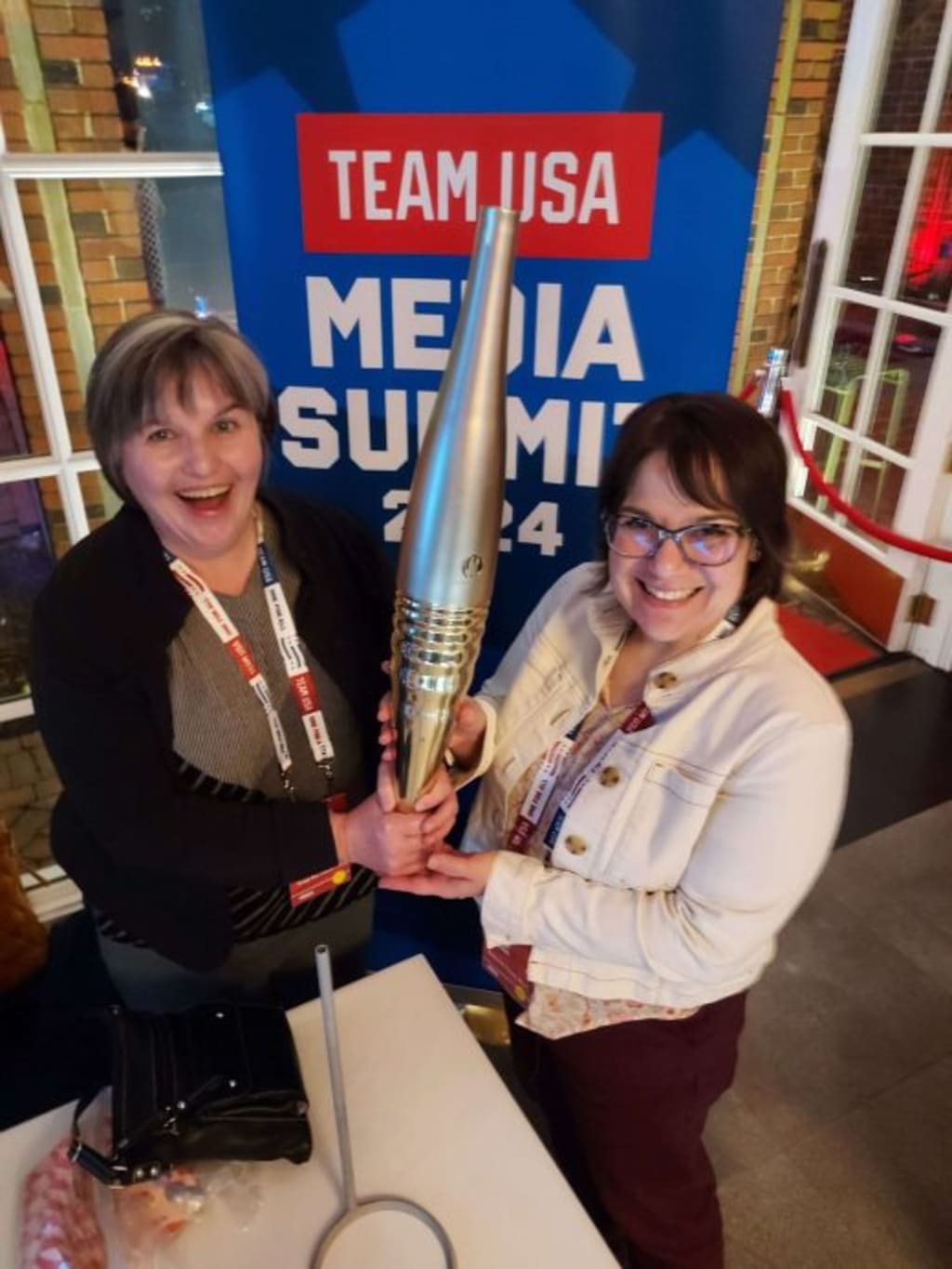
The co-hosts say: “We’re honored to have been accredited for three Olympics and Paralympics–Beijing 2022, Paris 2024, and Milan-Cortina 2026–and multiple events, including Team USA Media Summits, the 2024 US Swimming Olympic Trials, and 2025 World Figure Skating Championships.”
Alison Brown fell in love with the Olympics while watching Dorothy Hamill and Nadia Comăneci. Alison is also a former research librarian and has spent several years in the nonprofit sector. Jill Jaracz got hooked on the Olympics during the 1984 Summer Olympics in Los Angeles. A former research librarian, she’s also a freelance writer.
Alison Brown defines the distinction between their podcast and the shows of Corporate media. “This is where we truly differ from the pack. Unlike the vast majority of Olympic and Paralympic podcasts, which are produced by major broadcast companies, such as NBC, BBC, or Eurosport, we are a fully independent production. We are not part of a larger broadcast network; we are bootstrapping our way to Italy to provide on-the-ground coverage that rivals the corporate giants.”
Jill Jaracz adds: “We treat the Olympics not just as a sports event, but as a massive cultural phenomenon, often exploring the stories that fall off the radar of mainstream broadcasts.”
What I love about this show is that it is not just about the 16 days of the actual competition every two years. No, these wonderful women cover the Olympics throughout the year, and cover the Paralympics. The show has released well over 500 episodes since 2017. Talk about an Olympic record!
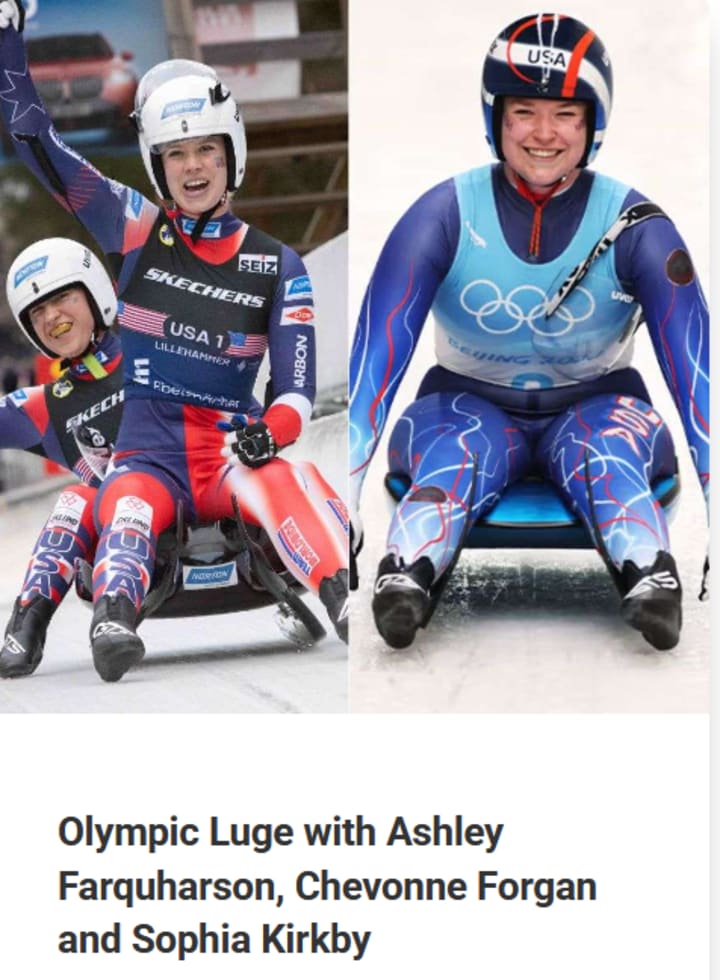
The November 6th episode is indicative of their brilliant coverage. The co-hosts explain: “We are sliding down the luge track in this episode, interviewing three women from Team USA’s luge team, who are vying to compete at the Milano Cortina 2026 Olympics. First up, singles luger and 2022 Olympian Ashley Farquharson returns to the podcast to explain some of the technical details — and physics — of the sport.
“Then, we talk with women’s doubles lugers Sophia Kirkby and Chevonne Forgan. Women’s doubles is a new Olympic event, so the pair discusses how this event works. They were also part of the athlete testing group for the new sliding track in Cortina, so they share some insight on how it rides and what we can look for when we watch it.”
In October, the co-hosts welcomed author Doug Levy to talk about his book about “Unknown Olympic Heroes.” Swiss runner Gabrielle Andersen ran in the first women’s marathon in 1984. That day, she ran into unbelievable heat smog and then atypical humidity in Los Angeles on that August day of 1984.
Levy tells the rest of the story on the podcast: “At the time, the rules stipulated that there could only be five water stations and the contestants could not be given water anywhere else. Gabriela Andersen missed the fifth and last station and became dehydrated as a result. The crowd gasped as she staggered onto the track, her torso twisted, her left arm limp, her right leg mostly seized. She waved away medical personnel who rushed to help her, knowing that if they touched her, she would be disqualified. While the effects of her heat exhaustion were evident, trackside medics saw that she was perspiring, indicating that her body still had some fluid reserves, and let her continue. The L.A. Coliseum crowd applauded as she limped around the track in the race’s final 400 meters, occasionally stopping and holding her head. It took five minutes and forty-four seconds to complete the last 400 meters. She finished 37th out of 44.”
In a June episode, Alison and Jill explained: “LA 2028 announced that it would be the first Olympics to have more quota spots for women than men. That’s a win for women’s sports, right? Not so fast. Our gender in sports expert, Dr. Michele K. Donnelly — an associate professor in Sport Management at Brock University in Ontario, Canada — returns to peel back the layers of LA 28’s press release and tell us how fair these gender numbers really are.”
In addition, the show’s episodes provide valuable Olympic updates, such as: “In Milano-Cortina 2026 news, the Armani-designed Italian kit has been unveiled. We have some milky white thoughts about it. In LA 2028 news, Honda has signed a big sponsorship deal, the Paralympic venue plan and sport program have been announced, and we have a new event in para athletics! Also, USA Track & Field has announced the qualifying times for the 2028 US Olympic Marathon Trials.”
Alison and Jill urge: “With a few days to go, this is the perfect moment for new listeners to jump in before the torch is lit.”
Check out Keep the Flame Alive. The co-hosts — Alison and Jill — embody the best of the indie spirit: passion, deep specialized knowledge, and a unique cultural perspective that stands apart from the big broadcasters. It’s a superb independent podcast that has kept the Olympic spirit alive every single week since 2017. They deserve a Gold Medal.
About the Creator
Frank Racioppi
I am a South Jersey-based author who is a writer for the Ear Worthy publication, which appears on Vocal, Substack, Medium, Blogger, Tumblr, and social media. Ear Worthy offers daily podcast reviews, recommendations, and articles.
Keep reading
More stories from Frank Racioppi and writers in Interview and other communities.
Five Of The Best Podcasts About Podcasting
As podcasting has grown in popularity, so has an industry dedicated to helping podcasters set an infrastructure for growth, develop a sustainable model, and, of course, make money. Since podcasts on Amazon, iHeart, and Spotify already have their sugar daddies, they’re generally not the target audience. Of course, it’s independent podcasters.
By Frank Racioppi2 months ago in Interview
Part 2 Interview With Joe Patterson, Author Of Melanin Memoirs
This is my second interview with Joe Patterson. His 4th anniversary writing on Vocal will be in March 2026. He has one achievement on Vocal, The Other Foot. He has over 17,000 reads on Vocal since he started on Vocal in 2022. Joe Patterson is very creative poet and rapper. Joe is deep thinker and I feel it is reflected in his latest published book, Melanin Memoirs.
By Mariann Carroll23 days ago in Interview
Tatt~Master
— Assembly Line Tatt Machine ~ Impressions to Impress — As I begin to understand more about the Tattoo Phenomenon. I've written silly, yet verbatim, dating site anecdotes in 'Frazzled.' So let me ask you: Would you be More attracted to someone slathered with tattoos, or Less?
By Jay Kantor7 days ago in Humor

Comments
There are no comments for this story
Be the first to respond and start the conversation.