
Inside Sundar Pichai’s AI Playbook: Google’s Bold Move into the Future
AI is redefining Google under Sundar Pichai’s leadership. Discover how machine learning, search evolution, and AI-powered tools are shaping the future of technology.
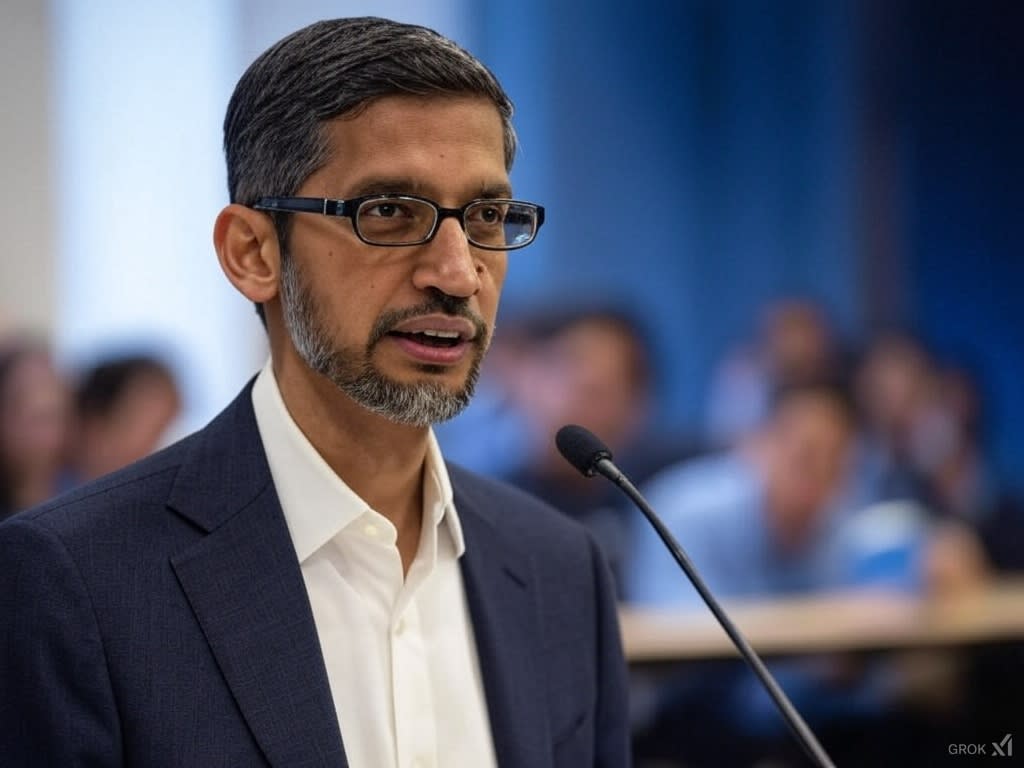
We are in the Plex. This is the center of Google. Gosh, it's hard to remember life before Google. It changed literally everything - how we live, how we work, how we communicate, how we get literally anywhere on a Googly colored bike. Google has been the front door of the internet for over two decades, and now there are so many doors. Google may not be the first place you go for answers anymore, so what are they gonna do about it?
Meeting Sundar Pichai
Hello.
Hi, Emily. So good to meet you again.
Good to see you again. Thanks so much for having us here.
Oh, likewise. I'm glad you chose a sunny day to come on campus. It's beautiful.
Sundar Pichai is at a pivotal moment. He's the CEO of Google and its parent company, Alphabet, rising to the top after proving his mettle as a talented product leader and peacemaker. He runs a tech giant that functions more like a micro country, overseeing businesses as consequential as YouTube, DeepMind, Cloud, and, of course, Search.
Pichai has been carefully crafting a strategy that infuses AI into every corner of the business. That deliberate planning was met with a surprise from longtime rival Microsoft and OpenAI, whose chatbot seemingly knocked Google off its perch and challenged its cultural relevance. ChatGPT set off a code red at Google and an industry-wide fever pitch over AI not seen since the dot-com boom. But for Pichai, the frenzy is just part of the long game.
Google's Evolution
I saw it's your 20th anniversary.
That's right. It was last week. It crept up on me.
Are you coffee or tea?
I'll go for coffee. How about you?
I'm gonna have a green tea.
Does it feel like you've been here for 20 years?
Not quite. You know, time flies by. I had my kids right when I started at Google, too, so the whole thing just flew by.
Google is famous for those out-of-the-box job interview questions. Do you remember any of yours?
Thank God, no. But I remember very, very clearly that I interviewed on April 1st, April Fool's Day 2004. There was a rumor. I didn't know whether it had actually happened, but Gmail apparently had launched. So all my interviews were about Gmail. People wanted to know what I thought of the product.
And it definitely wasn't a joke?
They launched it. They actually launched it, yeah. But I never allow products to launch on April Fool's Day. I think it's too confusing.
---
AI and Google's Strategy
You just had a blowout quarter. The stock jumped more than it has in a long time. Did that feel like a little bit of vindication, or, as they say in cricket, was that the bat talking?
In many ways, we worked very hard to set up the company for that. In 2016, one of the first things I did as CEO was to say the company should be AI-first. To me, we are just getting started in the beginning of what I think will be an extraordinary decade of innovation, and so I'm incredibly excited about it.
AI has been around for decades, but it seems like everything is happening everywhere, all at once.
How do you make sense of the frenzy and the scale?
All tech cycles are this way, right?
But this one feels different. It feels bigger. Is it?
It is bigger. We still have long ways to go, but we are in the early stages of that. You're gonna feel that excitement, that frenzy, but I think we are prepared for it. So you kind of roll with the flow. You embrace it.
---
Personal Life and AI at Home
How are you and your kids experimenting with AI at home?
We use Google Lens for homework. I don't want to get 'em in trouble, but the class allows you to do that. But sometimes he asks me for help on math. Sometimes I'm lazy and I pretend as if I'm thinking, but I'm also using Google Lens to figure out the answer.
---
Pichai's Early Life and Tech Fascination
You grew up in Chennai, India. What was it like at the kitchen table? What got you here?
My parents always emphasized learning and knowledge, and in some ways, Google, with its mission, always resonated very deeply with me. I felt this quest for learning and knowledge. It's what the company is about, too.
I grew up in a middle-class family. I perceived our life through the arrival of gadgets. We waited five years for a telephone. It was a rotary phone, but when it came to our home, it changed everyone's lives. I remember getting our first television and suddenly being able to watch sports. I used to bike a long way to school, but there was no gear on the bike, and I had to go uphill. Then, after many years, I got a bike with gears, and I thought, "Wow, this thing makes such a dramatic difference." I never took technology for granted. That optimism about technology has always stayed with me.
---
Leadership and Competition
You've been CEO now for a decade. How have you changed in that time?
When you've done it for a while, you understand patterns. So when you're running into something, there's a sense of déjà vu - you've seen it before. That helps you pattern match and deal with it more effectively. At this scale, you have so much coming at you, there's a lot of noise, and most of it doesn't matter. The ability to separate the signals from the noise, pay attention to the few things that need attention - I think I've gotten better at that over the years.
I heard Sergey is back and working a bit on AI. What is the involvement of Larry and Sergey these days?
I talk to them regularly. Sergey is actually spending more time in the office. He's literally coding. Some of my fondest memories over the last year are sitting with Sergey on a large screen looking at loss curves as we train these models. One of the advantages they have is they're not caught up in the day-to-day. So sometimes, when I have conversations with them, it allows all of us to step back and look at the bigger picture, which I think is incredibly important when you run something at this scale.
Final Thoughts
Can you walk through campus without getting stopped?
It's definitely been nice to walk and see people, so I enjoy it a lot.
I see a dinosaur statue in the distance, which I think is a good reminder. How much do you worry about becoming a dinosaur in a world where technology is moving so quickly?
In technology, if you don't innovate to stay ahead, that's the inevitable fate of any company.
No dinosaurs?
Not yet. They were great, but you don't want to have the same fate.
How much has this AI moment forced you to move and think differently? Because it does seem like you're playing defense sometimes.
We've been preparing for this for a while. A lot of the foundational breakthroughs in AI came from Google. Over the past year, we've been channeling the company to meet the moment.
About the Creator
Keep reading
More stories from Tata Sai tharun and writers in Interview and other communities.
Part 2 Interview With Joe Patterson, Author Of Melanin Memoirs
This is my second interview with Joe Patterson. His 4th anniversary writing on Vocal will be in March 2026. He has one achievement on Vocal, The Other Foot. He has over 17,000 reads on Vocal since he started on Vocal in 2022. Joe Patterson is very creative poet and rapper. Joe is deep thinker and I feel it is reflected in his latest published book, Melanin Memoirs.
By Mariann Carroll22 days ago in Interview
The Mediterranean Visionary Redefining Global Pop Standards Through The Lens Of Lyndsay Pace
In an era where the music industry’s global frontiers are increasingly fluid, Maltese singer-songwriter Lyndsay Pace has executed a career maneuver that transcends traditional geographic limitations. By securing the Best Pop Song title for her hit single "Trippin’" at the prestigious World Entertainment Awards, Pace has not only claimed a trophy but has effectively remapped the trajectory for independent artists emerging from small-island nations. This victory serves as a definitive case study in how vocal discipline, when paired with a sophisticated understanding of brand architecture, can disrupt the traditional power centers of the music world.
By Yadav shivamabout 3 hours ago in Interview




Comments
There are no comments for this story
Be the first to respond and start the conversation.