
Humanity at 85 Seconds to Midnight: What the 2026 Doomsday Clock Really Means
Why a symbolic clock getting closer to “midnight” should make all of us think — and act

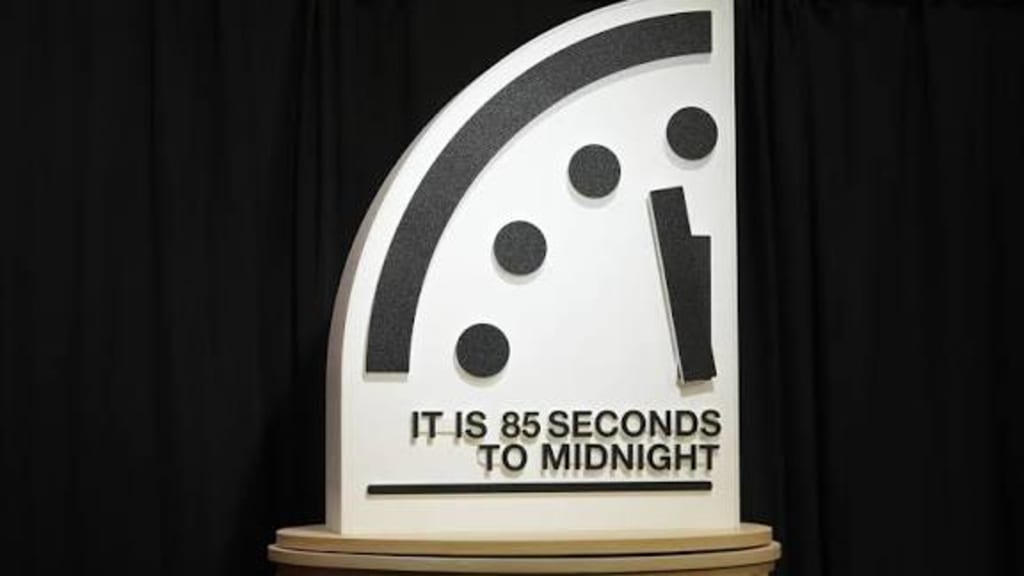
When scientists warn that humanity is closer than ever to catastrophic destruction, it’s easy to brush it off as abstract or alarmist. But on January 27, 2026, something unusual happened: the world’s most famous symbolic measure of global risk — the Doomsday Clock — was moved to 85 seconds to midnight, marking the *closest it has ever been to a theoretical “end of civilization.”
It might sound dramatic, but this isn’t a movie plot. It’s an annual update from the Bulletin of the Atomic Scientists, a group of scientists, policy experts, and Nobel laureates who assess existential threats to humanity. Their announcement isn’t just about numbers on a clock — it’s about real-world trends that affect all of us.
A Clock That Tells a Story
The Doomsday Clock was created in 1947, shortly after the atomic bombings of World War II. The idea was simple: use a clock face to show how close humanity is to self-destruction. Midnight doesn’t represent a literal moment, but a powerful metaphor for global catastrophe.
In its earliest years, the clock reflected Cold War tensions. In 1991 — after the collapse of the Soviet Union and the end of the Cold War — the clock was set to 17 minutes to midnight, the farthest from danger it has ever been.
But over the decades, the clock has shifted forward and backward depending on global events. And the steady trend in recent years has been toward greater danger, not less.
What 85 Seconds to Midnight Actually Signals
At first glance, 85 seconds might seem like a tiny “tick” on a symbolic clock. But the experts behind the Doomsday Clock don’t move that minute hand lightly. The decision reflects a complex mix of global challenges that are both immediate and long-term.
Here’s what’s driving the latest shift:
Nuclear Risk Is Rising Again
The risk of nuclear conflict has returned to the forefront of global concern. A key arms control treaty — one that limited nuclear weapons between the U.S. and Russia — is expiring, and there’s no agreed replacement ready to take its place. That raises the possibility of an unchecked nuclear arms race.
Leaders in major nuclear powers are increasingly assertive, nationalistic, and adversarial, according to the Bulletin’s analysis — and that combination makes diplomatic de-escalation harder.
Climate Change Isn’t Waiting
Nuclear weapons aren’t the only worry. Climate change — from record global temperatures to flooding, fires, droughts, and rising sea levels — continues to worsen. Despite widespread awareness, meaningful international cooperation to reduce emissions and limit warming has stalled, the scientists warn.
The result? A hotter, more unpredictable planet with costly consequences for ecosystems, economies, and human lives.
New Tech, New Threats
In prior years, nuclear weapons and climate change lived at the top of the Doomsday Clock’s radar. Now a new category has joined the mix: emerging technologies like artificial intelligence and biotechnology.
While these innovations have extraordinary potential to improve lives, they also pose risks when widely deployed without proper safeguards — especially if they increase misinformation, weaken democratic processes, or magnify missteps on the global stage.
Why This Matters to You
You might be wondering: “If this clock is just symbolic, why should I care?”
The power of the Doomsday Clock isn’t that it predicts the future. It’s that it reflects the current state of humanity’s most dangerous challenges, assessed by experts who have spent decades studying these risks.
In simpler terms, the clock is a wake-up call. When the minute hand moves closer to midnight, it means the world is moving in a direction that could lead to catastrophe unless action is taken. That doesn’t mean disaster is inevitable — but it does mean that without cooperation and wise policy choices, our future becomes more precarious.
How We Got Here — and Where We Might Go
Looking at the Doomsday Clock over time is like looking at a timeline of world events:
During the Cold War, fear of nuclear war dominated.
Environmental risks and global warming became central in the late 20th and early 21st centuries.
Today, a combination of nuclear tension, climate inaction, and technological dangers keeps the clock near its closest point yet.
Yet, the story doesn’t have to end at midnight. The clock has moved backward before — when nations collaborated and global treaties limited dangerous weapons. That possibility still exists.
Final Thoughts: The Clock Isn’t Running Out — We Are
The Doomsday Clock’s move to 85 seconds to midnight is a stark reminder that humanity faces serious risks — but it’s also a reminder that time matters. Every second represents opportunities to act, to rethink policies, to build bridges between nations, and to advance solutions rather than escalate crises.
At the end of the day, the clock isn’t meant to scare us into fatalism. It’s meant to inspire urgency, cooperation, and the kind of leadership that understands our shared future depends on choices made today.
Whether humans can turn back the minute hand — or let it creep closer to midnight — remains a question not just for governments and scientists, but for all of us.
About the Creator
Sylvester
✨ Hey, I’m the founder of NovaSoft Labs. I started coding young because I wanted to make real tools that help people. Right now, I’m working hard on Minitok and NexaCore Agent with zero budget.
Living in a hemp house
Hemp, a multi-purpose crop that delivers fibres, shivs, seeds, and pharmaceuticals is currently used in insulation materials and bio-composites for a more sustainable construction industry. Russ Martin and his wife Karon Korp tell their story as owners of the first hemp house in the U.S.
By Susan Fourtané a day ago in Interview
Fumfer Physics 39: Anthropic Principle, Cosmic Scale, and Why We Live in the Middle
Scott Douglas Jacobsen and Rick Rosner explore whether the ratio between the observable universe and the smallest physical scales carries deeper significance. Rosner situates the question within the anthropic principle: observers necessarily arise in regions and eras compatible with simple life. Humans exist near an active star, within the universe’s luminous core, because complex or long-lived civilizations would occupy very different energetic regimes. Rosner extends this reasoning to human history itself, noting that the present era contains the largest concentration of humans who have ever lived, making it statistically unsurprising that we find ourselves “now.” The result is not cosmic centrality, but observational inevitability.
By Scott Douglas Jacobsen2 days ago in Interview


Comments
There are no comments for this story
Be the first to respond and start the conversation.