
France Thinking to recognize Palestine as a free state.
France president macron thinking about Palestine as a free sovereign state.


The recent statements made by French President Emmanuel Macron, which gave the impression that a Palestinian state might be recognized in June, sparked new discussions about the ongoing conflict between Israel and Palestine. This move, if realized, would mark a significant shift in France's traditional approach and hold profound implications for the region's geopolitical landscape.
Macron's statements, though not definitive, suggest a growing frustration with the stalled peace process and a renewed commitment to finding a viable solution. The context of this potential recognition is crucial. The ongoing conflict in Gaza has increased international pressure on world leaders to address the fundamental issues of the Israeli-Palestinian conflict, such as the issue of Palestinian statehood. France has traditionally advocated for a negotiated settlement between Israel and the Palestinians in favor of a two-state solution. However, it has emphasized the necessity of a comprehensive agreement, like many European nations, and has avoided unilateral recognition. The current shift in rhetoric signals a potential departure from this cautious stance.
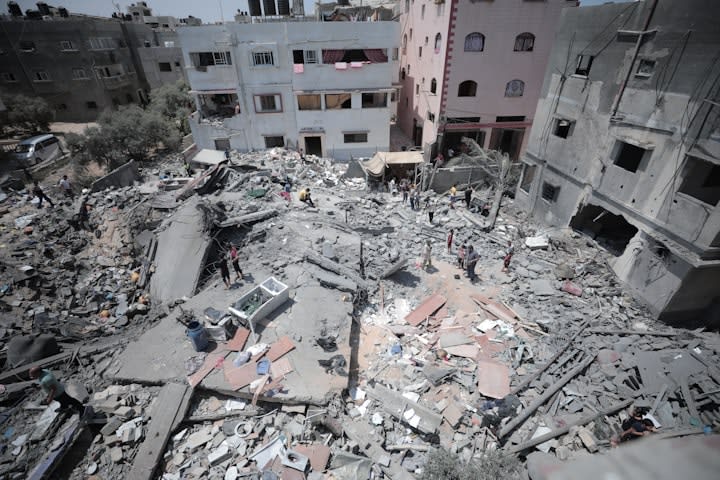
This change may be caused by a number of things. First, European leaders have felt a sense of urgency due to the expansion of Israeli settlements in the occupied territories and the perceived lack of progress in the peace process. They perceive a growing risk of the two-state solution becoming unattainable. Second, public pressure has increased on governments to play a more active role in resolving the conflict due to the humanitarian crisis in Gaza and the rising death toll. Additionally, numerous UN member states and a significant portion of the international community already recognize Palestinian statehood. This existing recognition, while largely symbolic, creates a precedent that France might be considering following. The move could also be seen as an attempt to exert greater influence in the region, positioning France as a key mediator in the conflict.
However, there are many obstacles in the way of the potential recognition. Israel is likely to strongly condemn any unilateral move, arguing that it undermines direct negotiations and violates existing agreements. The United States, a staunch ally of Israel, may also express reservations, potentially creating diplomatic tensions with France.
Moreover, the timing of this potential recognition is critical. June is a relatively brief period, and the region's complex political landscape necessitates careful maneuvering. The internal divisions within the Palestinian Authority, as well as the ongoing conflict in Gaza, pose significant obstacles to any meaningful progress.
The implications of French recognition are multifaceted. Firstly, it would provide a significant boost to the Palestinian cause, lending legitimacy to their aspirations for statehood. It would also increase international pressure on Israel to engage in serious negotiations. Second, it might inspire other European nations to do the same, setting off a chain reaction that could alter the way the world views the conflict. Nevertheless, it is essential to acknowledge that symbolic recognition alone will not resolve the underlying issues. A viable two-state solution requires addressing critical issues such as borders, Jerusalem's status, the right of return for Palestinian refugees, and security arrangements. Recognition may continue to be a symbolic gesture with limited practical impact if these issues are not addressed in a concrete way. Additionally, a unified Palestinian leadership is essential. The internal divisions between Hamas and the Palestinian Authority must be resolved to ensure effective representation and negotiation.
Ultimately, Macron's potential decision highlights the growing urgency to address the Israeli-Palestinian conflict. Whether it translates into tangible progress remains to be seen. However, it indicates a renewed commitment to finding a just and long-lasting solution for the region and a potential turning point in France's foreign policy. The international community will be watching closely to see if this potential recognition will lead to a meaningful shift in the dynamics of the conflict, or if it will simply add another layer of complexity to an already intractable problem.
About the Creator
PUBLISHER OF BANGLADESH.
Published with every truth news.
Keep reading
More stories from writers in Interview and other communities.
Part 2 Interview With Joe Patterson, Author Of Melanin Memoirs
This is my second interview with Joe Patterson. His 4th anniversary writing on Vocal will be in March 2026. He has one achievement on Vocal, The Other Foot. He has over 17,000 reads on Vocal since he started on Vocal in 2022. Joe Patterson is very creative poet and rapper. Joe is deep thinker and I feel it is reflected in his latest published book, Melanin Memoirs.
By Mariann Carroll22 days ago in Interview
Finding His Voice: Steven McCoy on Storytelling, Silence, and the Power of Media
For Steven McCoy, journalism isn’t just a career, it’s a lifeline. As a child, bullying left him silenced, struggling with selective mutism, unable to fully share his thoughts with the world. But where words failed, pencils, pens, and paper spoke. He built entire worlds on paper, channeling his imagination and voice through stories, drawings, and poems. That early refuge became the foundation of his calling: telling stories that matter and giving voice to those who feel unheard.
By Tales From The Media3 days ago in Interview
Unofficial Challenge: Black History Celebration
Forward: February 28th, 10:53 PM, EST... The final hour of Black History Month, 2026. Hello fellow writers. I've had this challenge waiting in my drafts for most of the month. But I held off on publishing it, until now.
By Sam Spinelli6 days ago in Writers


Comments
There are no comments for this story
Be the first to respond and start the conversation.