
David Mulero – Clair-obscur, the art of letting shadow and light breathe
From Electronic Roots to Neoclassical Intimacy


With Clair-obscur, David Mulero delivers an album of rare delicacy, in which the piano becomes at once material, breath, and inner narrative. A self-taught composer with a singular path, Mulero continues here a trajectory patiently built over nearly thirty years, between electronic music, jazz, cinematic writing and, today, a fully embraced neoclassical aesthetic.
A contemplative record, deeply human, recently praised by the webzine ConcertoNet, which highlights both the sophistication of his writing and his expressive freedom.
Born in 1979 in Toulon, France, David Mulero grew up immersed in pioneering electronic sounds — Vangelis, Kraftwerk, Jean-Michel Jarre — before plunging into the techno and house scenes of the 1990s. An early DJ and instinctive composer, he very quickly invented his own tools for musical notation, outside academic frameworks. This freedom, far from fading with time, now seems to have been refined and distilled, focused around the piano.
With Clair-obscur, Mulero offers a work in which each note seems carefully weighed, yet never frozen. The piano sometimes dialogues with the violin (Clair-obscur), sometimes with silence (Fugit irreparabile tempus), and often with the listener’s imagination. A music that evokes both intimate pages of the classical repertoire and the suspended atmospheres of European auteur cinema.
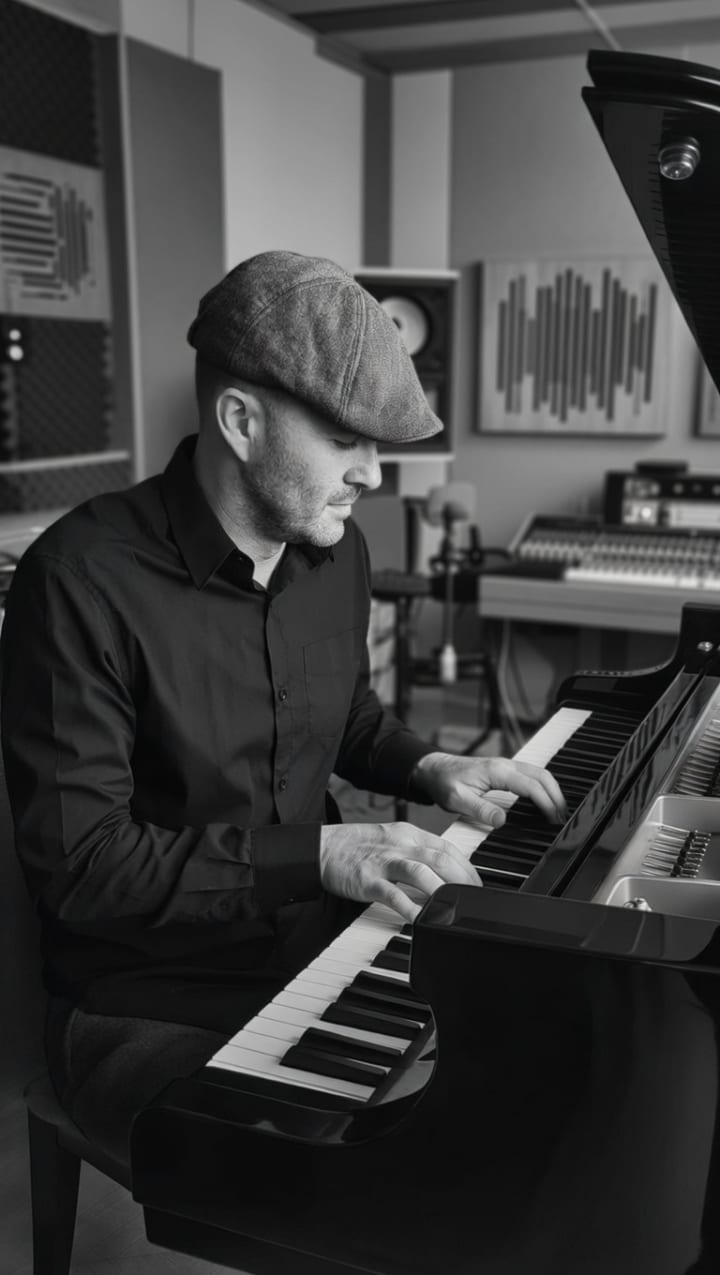
Interview
Your album is titled Clair-obscur, a term directly borrowed from the visual arts. What place does imagery hold in your compositional process?
David Mulero: It is central. I have always felt music as a form of inner landscape.
Chiaroscu, for me, is not merely a pictorial technique; it is a metaphor for the human soul. I enjoy working with these zones of tension between what is said and what remains suggested, between fragility and resilience. Music then becomes a space onto which one can project one’s own images.
The piano is omnipresent on this album, almost like a main character. Is this a natural evolution in your journey?
Yes, clearly. After exploring many territories — electronic, rhythmic, textural — I felt the need to return to something more stripped-down, more direct. The piano allows for this immediate sincerity. It is an instrument that does not lie. Every nuance, every breath matters.
When listening to tracks such as Amour et Psyché or Brume, one perceives a very structured writing, yet never rigid. How do you find this balance?
I believe it comes from my self-taught background. Having not learned music theory in a classical way, I developed a very intuitive relationship to form. I like repetitions, motifs that evolve slowly, but I always leave room for accident, for the emotion of the moment. That may be where the balance lies.
Certain passages subtly recall the economy of means of a Bach, or the repetitive cycles dear to contemporary minimalist composers, without ever falling into quotation. Is this conscious?
These are influences I fully acknowledge, but they are digested, integrated. Bach, Mozart, but also Philip Glass or certain non-Western traditions… all of this belongs to a global musical landscape. I am not seeking to pay direct homage, but rather to extend a way of thinking about music as a flow, a breath.
The album exudes a very cinematic atmosphere. Is cinema an important reference for you?
Absolutely. I have always been inspired by cinema. Certain film scores have an incredible ability to suggest without underlining. I like the idea that music haccompanies or enhances emotion without constraining it.
What would you like the listener to take with them after hearing Clair-obscur?
If the album can offer a pause, a moment of calm amid the turmoil, then it has fulfilled its mission. I would like everyone to be able to find within it a space to slow down, to feel, perhaps to reconnect with something more intimate.
With Clair-obscur, David Mulero firmly situates himself within the contemporary French neoclassical scene, while preserving a singular voice, nourished by multiple experiences and an intact curiosity. A work to be listened to as one contemplates a painting: by taking the time to let shadow and light engage in dialogue.
About the Creator
Dena Falken Esq
Dena Falken Esq is renowned in the legal community as the Founder and CEO of Legal-Ease International, where she has made significant contributions to enhancing legal communication and proficiency worldwide.
Keep reading
More stories from Dena Falken Esq and writers in Interview and other communities.
Interview: CEO of Schenex Machinery
The heavy equipment industry rarely makes headlines, yet it quietly drives infrastructure, construction, and agricultural projects nationwide. Behind the machines and logistics are companies making careful decisions about reliability, sourcing, and operational efficiency. Schenex Machinery is one such company, steadily gaining attention for its practical approach to pre-owned heavy equipment.
By Dena Falken Esq4 days ago in Interview
Living in a hemp house
Hemp, a multi-purpose crop that delivers fibres, shivs, seeds, and pharmaceuticals is currently used in insulation materials and bio-composites for a more sustainable construction industry. Russ Martin and his wife Karon Korp tell their story as owners of the first hemp house in the U.S.
By Susan Fourtané a day ago in Interview
Nice Genes Podcast On Genomics
Some independent podcasts are sponsored by organizations that strive to make the world a better place. Genome British Columbia (BC) is one of them. Genome BC applies the power of genomics to solve pressing societal, environmental, and economic challenges in the areas of human health, agriculture, forestry, mining, environment, energy, and fisheries. They do this by: Investing in world-class research and managing complex translation and innovation projects.
By Frank Racioppi5 days ago in Interview
Seattle Nightlife Report: Pony
Mid-winter Friday night. Early but already so dark. The days are getting longer but 6 PM is still pitch black. “Firepit!” You declare things after just a few seconds of solemn thought – not a request or suggestion, not a demand. Last week you walked around saying, “Hot tub?” to anyone who would listen. Or one afternoon you pointed at two men holding hands as they crossed 12th Avenue, looked me in the eyes and said, “Boyfriends.”
By Joe Nasta | Seattle foodie poet5 days ago in Wander




Comments
There are no comments for this story
Be the first to respond and start the conversation.