
“Carrying the Harmonium Across Continents” — An Interview with Sadakat Aman Khan
A conversation with the Malda-born harmonium player on tradition, transition and finding space for Indian music overseas.

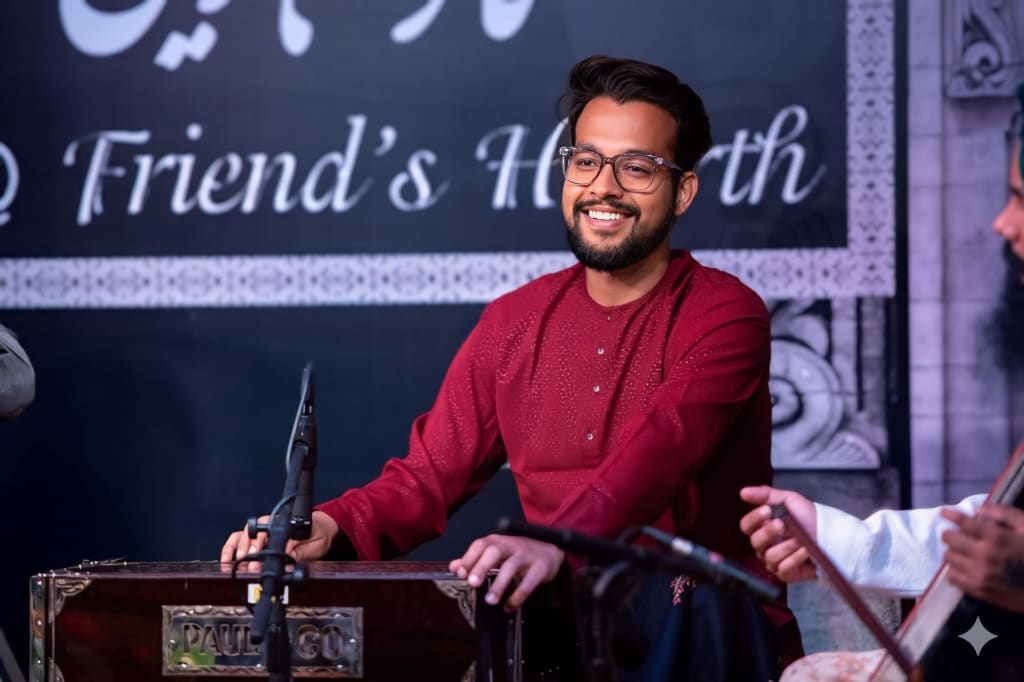
Indian classical musician Sadakat Aman Khan, born on 11 August 1997 in the Malda district of West Bengal, has been steadily establishing himself in the United Kingdom’s music circles. He performs Hindustani classical and fusion music and is known for promoting the harmonium as a solo concert instrument.
Khan comes from a family deeply rooted in classical tradition. His grandfather, Sangeetacharya Ustad Mohammad Yunus Khan, and his father, Ustad Sahadat Rana Khan, were both respected vocalists, and he received his early musical training from them before developing his own independent style.
Now based in London, he represents a younger generation of artists who are expanding their traditional training into new cultural environments. In this interview, he speaks about practice, migration and the challenges of building an audience away from home. Excerpts from the interview:
Q1. You relocated to London fairly early in your musical journey. What influenced that decision?
Khan: I reached a point where I wanted to understand how my music would function outside the system I grew up in. In India, classical music is familiar to most people, even if they are not trained in it. Listeners recognise the sound and the format. Here, the situation is different. Every performance needs context, and that forces you to think carefully about what you are presenting and how you are presenting it. I felt that this shift would help me grow. I also wanted to see if the harmonium could find a space in a place where it is not commonly heard. The move was not easy, but it made me look at my own work with more clarity.
Q2. Settling into a new country can be challenging. How did you begin building a base in the UK?
Khan: The early phase was slow. I attended concerts, observed how audiences responded to different styles and tried to understand where classical Indian music fits in the larger cultural scene. Over time, I met musicians from various backgrounds, and those conversations helped me find the right direction. Work began with small performances, workshops and collaborations. Once organisers and listeners saw consistency, the opportunities grew. London has a wide range of communities, and many of them are open to listening if you approach the work with seriousness.
Q3. How has your practice routine changed since moving away from your structured training environment?
Khan: My routine has become more deliberate. Earlier, practice was shaped by the presence of teachers and senior musicians around me. Here, I rely more on self-monitoring. I start with slow practice, focusing on tone and clarity. Later, I work on compositions or material for upcoming concerts. I also record my practice often. Without a teacher physically present, it becomes important to listen back and identify mistakes. This approach has made my practice quieter but more focused.
Q4. Many of your listeners abroad encounter the harmonium for the first time. How do you usually introduce it?
Khan: I begin by explaining the basics. I talk about how the instrument works, where it sits in Indian classical music and what its range is. After that, I play a simple phrase so listeners can hear the tone. I have learned that people connect faster through sound than through long explanations. Once they understand the basic character, it becomes easier to discuss the instrument’s history or technique.
Q5. What assumptions have you noticed about Indian classical music in international settings?
Khan: A common assumption is that the music is very difficult to follow. In reality, the form is structured, but listeners do not need technical knowledge to appreciate it. When people hear it live, they often respond to the emotional aspect first. Another assumption is that classical musicians do not explore new ideas. Many do. The exploration happens within a framework, but it is still exploration. Once audiences understand this balance, their perception becomes more accurate.
Q6. You collaborate with artists from different genres. How do you choose which projects to take up?
Khan: I look for clarity of intent. If the aim is simply to add a “traditional sound”, the collaboration does not feel meaningful. But if the project has a strong concept and space for actual musical exchange, I feel more comfortable participating. I also check whether the arrangement allows the harmonium to be heard properly. Some formats are too dense. Others allow detail. The instrument needs a certain kind of space to be effective.
Q7. Do you notice a difference between younger and older audiences during your performances?
Khan: Younger audiences tend to ask more questions. They want to know how the music works and why certain choices are made. Older listeners relate more through familiarity. For them, the sound often carries memories. Both types of responses are useful. They help me understand how the music is functioning across generations.

Q8. What personal lessons has the harmonium given you outside the musical field?
Khan: It has made me more patient and more aware of my own state of mind. The harmonium responds immediately to how you play it. If you rush or lose focus, it shows in the tone. If you are steady, the sound settles. This has influenced how I approach daily work as well. It has made me more attentive and more disciplined.
Q9. As a classical musician living abroad, what does success mean to you?
Khan: Success, for me, is consistency. If I can continue performing regularly, continue learning and continue engaging new listeners, that is a form of success. Not everything has to be large or public. Building an audience here is a slow process. I have accepted that, and I value steady growth more than sudden recognition. That approach keeps the work sustainable.
Q10. What projects are you currently developing?
Khan: I am preparing a series of intimate concerts in which I will perform and speak briefly about the ideas behind each piece. Many listeners abroad want context, but they do not want long lectures. This format might help bridge that gap. I am also working with a few Western classical musicians to explore shared spaces between our styles. We are still experimenting, and nothing is final yet, but the process has been interesting.
Q11. The harmonium is often seen as an accompanying instrument. How do you address that perception?
Khan: The perception is understandable because that was its primary role for many years. But the instrument has a range of possibilities beyond accompaniment. The more musicians explore those possibilities, the more the perception will change. My focus is on presenting it responsibly and letting listeners see what it can do on its own.
Q12. What would you tell young Indian classical musicians who want to build a career outside India?
Khan: Be prepared for slow progress. Abroad, you have to rebuild your space from the beginning. Patience and consistency matter a lot. At the same time, stay close to your training. A strong foundation helps you adapt to new environments without losing your direction. If you balance both, you will find your place gradually.
About the Creator
Aarohi Mehta
Aarohi is an independent journalist and art enthusiast who covers culture, creativity, and modern digital trends. She brings a fresh, expressive voice to her stories, blending clear reporting with a strong artistic perspective.
Keep reading
More stories from Aarohi Mehta and writers in Interview and other communities.
Ustad Faizan Ali Khan: Upholding a 500-Year Legacy of the Shamchaurasi Gharana
The Shamchaurasi Gharana—one of the subcontinent’s oldest schools of classical music—has carried its tradition across five centuries, passing from ustad to disciple, from father to son. Today, its legacy finds a powerful, youthful voice in Ustad Faizan Ali Khan, grandson of the legendary Ustad Salamat Ali Khan and son of celebrated classical vocalist Ustad Shafqat Ali Khan.
By Aarohi Mehta4 months ago in Interview
An Interview with Dr. Douglas Sung Won
In modern healthcare, progress often emerges at the intersection of clinical innovation and structural leadership. Few professionals embody that intersection as clearly as Dr. Douglas Sung Won, MD. Over the past two decades, Dr. Won has built a reputation not only as a pioneer in minimally invasive spine surgery but also as a healthcare systems architect responsible for developing vertically integrated clinical infrastructures.
By Robin Milton7 days ago in Interview
My Interview With Marilyn Glover, A Master Poet On Vocal
https://shopping-feedback.today/authors/marilyn-glover-wp6q409z0 Marilyn Glover is a single mom of 3 daughters and one son. She also has two grandsons. She practices Reiki and loves nature. Her current project is her poetry book. She has been a creator on Vocal for five years. She has written over 300 stories on Vocal with 9753 reads so far.
By Mariann Carroll2 days ago in Interview



Comments