
An In-Depth Exploration of Skeleton Detection
Skeleton detection is a crucial technique in the field of human motion analysis, which focuses on recognizing and tracking human body movements.

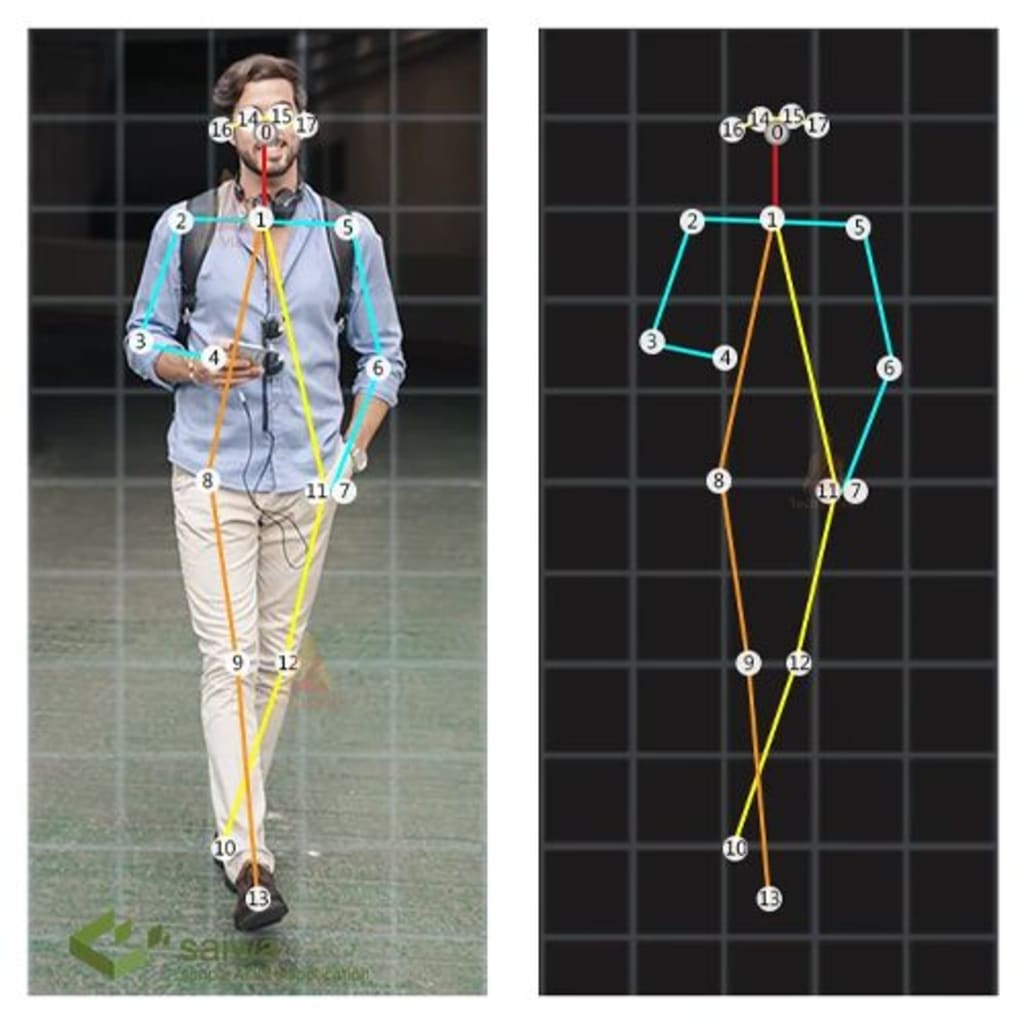
Skeleton detection is a crucial technique in the field of human motion analysis, which focuses on recognizing and tracking human body movements. Given the complexity and detailed nature of the human body, coupled with the variety of clothing and textures individuals wear, identifying postures can be challenging. Skeleton detection simplifies this process by recognizing essential points on the human body, such as the head, neck, shoulders, elbows, wrists, hips, knees, and ankles. This technique impacts system performance and algorithm complexity significantly, aiding in the representation of the overall shape and movement of the human body.
The application of simplified patterns for skeleton-joint models is widespread due to the necessity of analyzing small data quantities. Effective skeletonization algorithms must be accurate, resilient to noise, and capable of generating a connected skeleton to maintain topological and hierarchical features. Despite the computational demands and sophisticated data structures required by most techniques, skeleton detection remains a vital aspect of human motion analysis. In this article, we will delve into the principles of skeleton detection and explore a specialized technique developed at Saiwa.
How Does Skeleton Detection Work?

Skeleton detection systems utilize sensors, primarily webcams or depth cameras, to detect human movements. This technology is akin to motion capture used in movie special effects but does not require special costumes or markers on the individual. Depth cameras are preferred for reliable real-time results, though 2D cameras combined with open-source software like OpenPose can achieve satisfactory outcomes at lower frame rates.
The process begins by distinguishing a human from the background, followed by the identification of key joints such as shoulders, knees, elbows, and hands. Some advanced systems can also monitor hand movements or specific gestures. Once these joints are identified, the system connects them to form a humanoid skeleton, determining their positions in real-time. This real-time data can be used to power interactive displays, games, virtual reality (VR), augmented reality (AR) experiences, and unique integrations like projecting a "shadow" onto the side of a vehicle.
Using depth cameras enhances the system's ability to distinguish between overlapped or obscured objects or limbs, making it more robust against changing lighting conditions compared to 2D camera-based methods.
Applications of Skeleton Detection
Skeleton detection has a multitude of real-world applications. Here are some prominent use cases:
Human Movement and Activity
Skeleton detection models track and measure human movement, empowering various applications such as AI-based personal trainers. In this scenario, a camera captures a person's workout, and the skeleton detection model evaluates the correctness of the exercise performed.
Analysis of Infant Motion
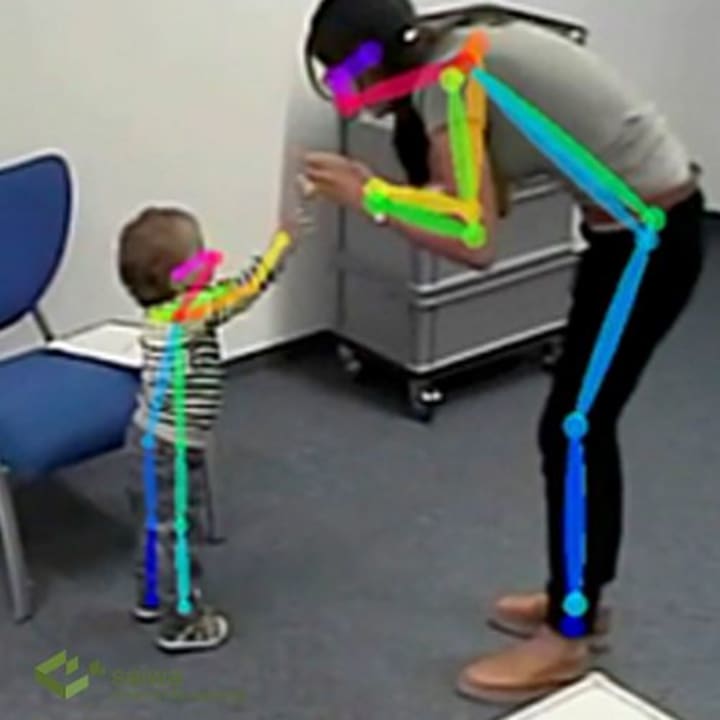
This technology is also beneficial for analyzing infant movement, aiding in monitoring a baby's behavior and physical development over time.
Augmented Reality Experiences
Skeleton detection plays a crucial role in developing realistic and responsive AR applications, enhancing user interaction and immersion.
Skeleton Detection Models
Several model architectures are pivotal in skeleton AI detection:
• Two-Stage Detectors: Models like Mask R-CNN generate region proposals likely containing people, refine them, and predict keypoints for each refined instance.
• Top-Down Transformers: These models effectively encode global context and long-range joint dependencies using self-attention, capturing whole body patterns.
• Graph Neural Networks: These networks model the inherent connectivity structure between joints using graph convolutions to incorporate relational cues and constraints.
• Multistage Convolutional Pose Machines: These models incrementally refine keypoint heatmaps and assemble them into full poses across a network hierarchy.
• Encoder-Decoder Networks: These networks directly regress poses from image features in an end-to-end differentiable framework, removing dependencies on external detectors.
Ongoing research aims to balance efficiency, accuracy, and generalization capabilities in skeleton detection models.
Skeleton Detection in Pre-Processing
Pre-processing is one of the most challenging aspects of skeleton detection and pose estimation. Critical tasks in this phase include body part localization, background removal, data calibration, and image editing. These steps are essential for posture detection and various skeleton identification applications. Here are some notable applications:
Human Activity Estimation
Tracking and quantifying human activity and movement is a primary use of skeleton detection. Popular architectures like DensePose, PoseNet, and OpenPose are frequently employed for activity, gesture, and gait identification. Examples include:
• Identifying sitting movements.
• Communication using body language (e.g., traffic police signals).
• Applications that detect if a person has fallen or is unwell.
• Sports analysis applications.
• Dance technique analysis.
• Posture learning for bodywork and finesse.
• Security and surveillance enhancement.
Robot Training
In robotics, training a robot to follow a method can be time-consuming. However, deep learning technologies, particularly reinforcement learning, can significantly expedite this process by using simulated environments to achieve the necessary accuracy for specific tasks.
Motion Tracking for Gaming and Entertainment
Skeleton detection is also used in gaming, where players' movements can be captured and injected into the gaming environment, creating an interactive experience.
Athlete Skeleton Detection
In sports, data analysis is crucial. Skeleton detection helps athletes improve their technique and performance. It also aids in studying opponents' strengths and weaknesses, providing valuable insights for professional athletes and their trainers.
AI Skeleton Detection
AI skeleton detection leverages artificial intelligence algorithms to identify and track the human skeleton in images or videos. The objective is to extract joint positions and create a digital representation of the skeleton. This technology finds applications in motion tracking, action recognition, and human pose estimation.
The process involves deep learning algorithms, such as convolutional neural networks (CNNs), which analyze image or video frames to identify joint locations. The resulting 2D or 3D coordinates are used to create a digital skeleton representation, applicable in various domains like sports training, medical diagnosis, surveillance, and gaming.
Skeleton Representation
Skeletons inferred from images or videos need to be represented in formats suitable for downstream analysis. Common representations include:
- Graph Models: Joints are represented as nodes and their connectivity as edges with spatial and semantic attributes, allowing analysis using graph algorithms.
- Vectors and Matrices: Joint coordinates, confidence scores, and pairwise displacements enable compact representation and ease of integration into machine learning pipelines.
- Multivariate Time Series: Capturing pose dynamics in videos, useful for applications like action recognition and motion synthesis.
- Hierarchical Tree Structures: Reflecting anatomical structures, these provide an efficient representation for sampling plausible poses and modeling joint dependencies.
The choice of pose representation depends on balancing accuracy, dimensionality, and application constraints.
The Importance of Skeleton Detection
High-performance real-time skeleton detection and tracking drive significant advancements in computer vision. Real-time detection of human skeletal poses enables computers to understand human behavior accurately. Skeleton detection has practical applications across video analysis, monitoring, robotic systems, human-machine interaction, augmented and VR technology, assistive living, intelligent buildings, education, and more. It is a fundamental component of reasoning systems for constructing human representations.
AI Skeleton Detection Algorithms
AI skeleton detection algorithms are computer vision techniques that locate a human body's joints or key points in images or videos using deep learning. Some widely used algorithms include:
- OpenPose: An open-source library that detects key points using a multi-stage CNN approach, capable of identifying up to 135 points on the human body.
-Mask R-CNN: An object detection and segmentation algorithm that detects human bodies and identifies key points using a two-stage CNN approach.
- DeepLabCut: A tool for tracking body parts' movement in animals and humans, employing supervised machine learning to learn key point locations.
- AlphaPose: A deep learning-based pose estimation algorithm using a multi-stage CNN approach to detect up to 17 key points in the human body, used in behavior analysis and medical research.
These algorithms are employed in various applications, including human pose estimation, action recognition, and human-computer interaction.
Robustness and Generalization
Two critical challenges in skeleton detection are robustness to occlusions and generalization to new data. Techniques to address these challenges include:
• Occlusion Handling: Using historical pose context, plausible bone length constraints, and pose grammar trees to improve robustness when joints are obscured.
• Unsupervised Domain Adaptation: Adapting models trained on one dataset to new domains with minimal labeling through self-training, image translation, and landmark alignment.
• Multi-Task Learning and Distillation: Leveraging supplementary signals like depth maps, optical flow, and inertial data to enrich features and improve generalization.
• Data Augmentation: Incorporating occlusions and diverse viewpoints during training to enhance model robustness.
Achieving robustness and generalization remains an ongoing research challenge, requiring diverse training data and advanced adaptive learning algorithms.
Conclusion
skeleton detection is a critical technique in human motion analysis, with a wide range of applications and significant advancements driven by AI and deep learning algorithms. The continuous evolution of this field promises to enhance various domains, from sports and entertainment to healthcare and robotics, by providing accurate and efficient methods for tracking and understanding human movement.
About the Creator
saiwa etudeweb
saiwa is an online platform which provides privacy preserving artificial intelligence (AI) and machine learning (ML) services.
Keep reading
More stories from saiwa etudeweb and writers in Interview and other communities.
Demystifying Computer Vision Models
Computer vision, a branch of artificial intelligence (AI), empowers computers to comprehend and interpret the visual world. By deploying sophisticated algorithms and machine learning models, computer vision can analyze and interpret visual data from various sources, including cameras, images, and videos. Several models, including feature-based models, deep learning networks, and convolutional neural networks (CNNs), are designed to learn and recognize patterns in the visual environment. This comprehensive guide delves into the intricacies of computer vision models, providing a thorough understanding of their functioning and applications.
By saiwa etudeweb2 years ago in Interview
Part 2 Interview With Joe Patterson, Author Of Melanin Memoirs
This is my second interview with Joe Patterson. His 4th anniversary writing on Vocal will be in March 2026. He has one achievement on Vocal, The Other Foot. He has over 17,000 reads on Vocal since he started on Vocal in 2022. Joe Patterson is very creative poet and rapper. Joe is deep thinker and I feel it is reflected in his latest published book, Melanin Memoirs.
By Mariann Carroll25 days ago in Interview



Comments
There are no comments for this story
Be the first to respond and start the conversation.