
AI in Talent Acquisition: A Balanced, Strategic Approach for Modern Hiring
Harnessing AI to Streamline Hiring, Enhance Candidate Matching, and Empower Recruiters with Data-Driven Insights.

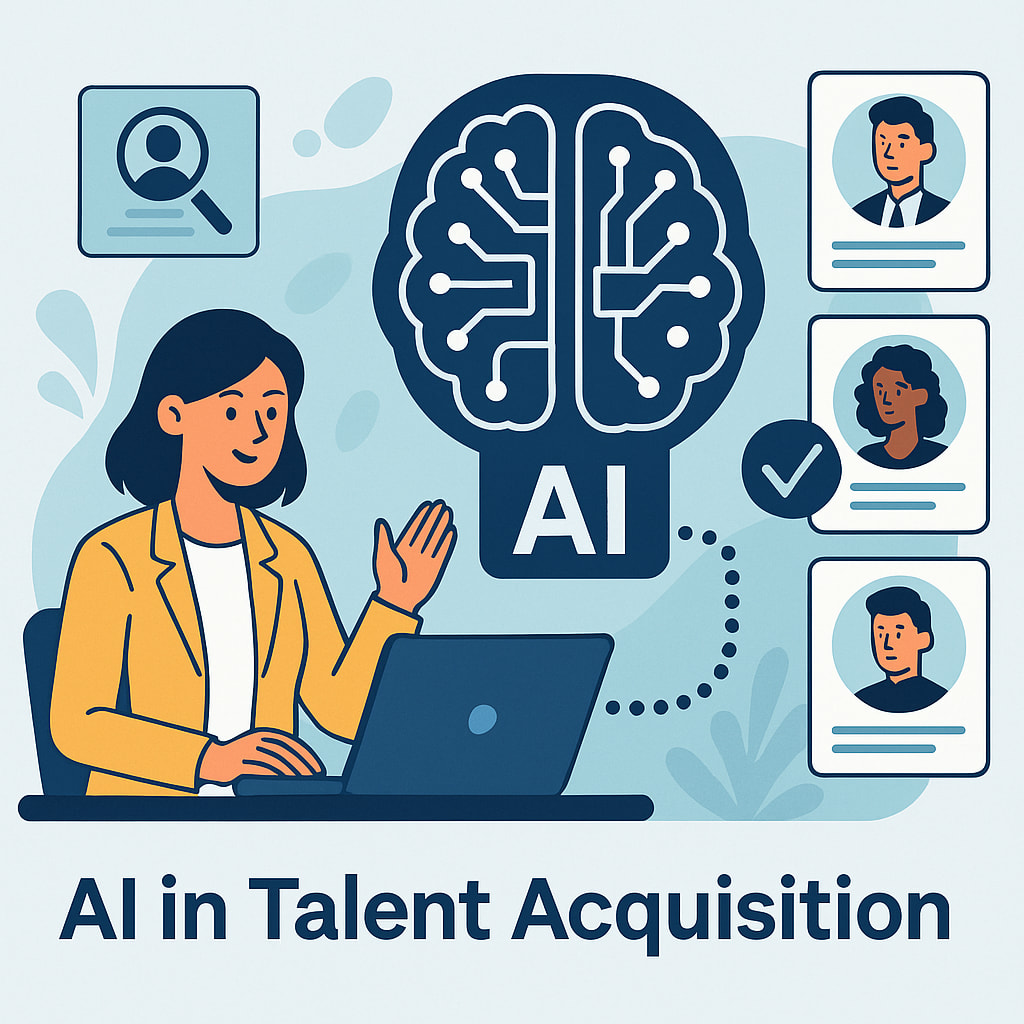
Welcome to the new era of talent acquisition, where recruitment is no longer just about filling vacancies—it's about aligning talent strategy with business goals. Today, AI in talent acquisition is revolutionizing how companies identify, engage, and hire top talent.
Organizations that adopt AI-driven hiring tools are seeing reduced time-to-hire, increased recruiter productivity, and improved quality of candidates. But what does AI really mean in the context of hiring? And how can companies use it effectively?
What Is AI in Talent Acquisition and Why Does It Matter?
Artificial Intelligence in recruitment refers to using intelligent technologies to automate, optimize, and improve various stages of the hiring process. This includes:
- Resume parsing and candidate screening
- Intelligent candidate sourcing
- Bias reduction through data anonymization
- Predictive analytics for candidate success
- Automated interview scheduling and communication
Using AI, recruiters and HR professionals can access enriched and up-to-date candidate data, allowing for smarter, faster, and more informed hiring decisions.
Key Benefits of AI in Recruitment
1. Faster Screening and Hiring
AI-enabled tools quickly extract and analyze resume data, drastically reducing the time spent sorting through applications. This improves the speed of recruitment and allows HR professionals to focus on strategy and engagement.
2. Improved Candidate Matching
AI compares candidate resumes with job descriptions to find the best-fit applicants based on skills, experience, and qualifications. This enhances candidate-job fit and minimizes bad hires.
3. Data-Driven Hiring Decisions
With the help of AI, recruiters gain insights into hiring trends, successful candidate profiles, and pipeline metrics—driving more accurate and data-driven hiring strategies.
7 Best Practices to Maximize AI in Talent Acquisition
To get the most from AI-powered recruitment tools, it’s essential to use them wisely. Here are seven best practices:
1. Automate Repetitive Tasks, But Keep Judgment Human
Let AI handle screening and shortlisting, but keep the final call human. Emotional intelligence and cultural fit assessment still require a human touch.
2. Maintain Clean, Updated, and Centralized Candidate Data
Regularly reprocess your candidate database using AI-driven data hygiene tools. This ensures accurate information for better candidate engagement and matching.
3. Promote Diversity Through Bias-Free Hiring
Use AI solutions with resume redaction features to remove identifiers like names, age, and gender. This supports inclusive and diverse hiring practices.
4. Use Predictive Analytics for Better Hiring Outcomes
With AI, spot hiring patterns and predict candidate success based on historical data. This helps optimize job descriptions, sourcing strategies, and interview criteria.
5. Integrate AI Seamlessly with Your ATS
Choose solutions that integrate directly with your Applicant Tracking System (ATS). A unified platform streamlines your workflow and improves recruiter productivity.
6. Personalize the Candidate Experience
Leverage AI chatbots and recommendation engines to engage candidates with timely updates, tailored job suggestions, and automated interview scheduling—enhancing the candidate experience.
7. Continuously Audit and Improve Your AI Tools
AI models need periodic review. Assess them for bias, accuracy, and ROI. Align AI outcomes with evolving business needs and compliance standards.
Common Challenges of Using AI in Recruitment
Despite the advantages, there are real-world challenges businesses face when implementing AI in hiring. Here’s a simple breakdown:
1. Incomplete or Messy Data Affects AI Performance
Outdated resumes or inconsistent data formats can confuse AI systems, leading to mismatches and poor candidate recommendations.
2. AI Can Replicate Historical Bias
AI learns from your data. If historical hiring trends were biased, the AI may perpetuate them. Regular monitoring and diverse data inputs are essential.
3. Lack of Transparency in AI Decisions
Many AI tools function as "black boxes" and don't explain their decision-making. Recruiters need explainable AI to build trust and ensure accountability.
4. One-Size-Fits-All AI Doesn’t Work
AI tools trained on general data may not understand niche roles or industry-specific keywords. Fine-tune the tool with job-specific criteria for accurate results.
5. Integration Issues with Legacy Systems
Many companies face integration challenges when connecting AI tools with existing ATS, CRM, or HRIS platforms, requiring extra technical support.
6. Dehumanized Candidate Experience
If AI tools replace too much human interaction, candidates may feel ignored or undervalued—hurting your employer brand.
7. Ethical and Legal Concerns
AI tools must comply with data privacy laws (like GDPR) and anti-discrimination regulations. Failing to do so can lead to legal consequences and reputational harm.
How to Use AI Effectively: Human-AI Collaboration Is Key
AI should serve as a smart assistant, not a replacement for human recruiters. While it streamlines processes and provides valuable insights, the final hiring decisions should still be made by people.
How to Use AI Effectively: Human-AI Collaboration Is Key
AI should serve as a smart assistant, not a replacement for human recruiters. While it streamlines processes and provides valuable insights, the final hiring decisions should still be made by people.
When used correctly, AI in talent acquisition leads to:
- Increased recruitment efficiency
- Reduced costs and time-to-hire
- Higher quality of hires
- Fairer and more inclusive hiring processes
However, successful adoption depends on clean data, ethical implementation, integration with existing workflows, and ongoing performance monitoring.
Final Thoughts: Balance Tech with Human Insight
Artificial Intelligence is transforming how companies recruit talent, offering speed, accuracy, and strategic insights. But it’s not a silver bullet. Companies that thrive with AI in hiring are those that balance its potential with human expertise, empathy, and adaptability.
So, don’t just implement AI—implement it wisely. Build strong data foundations, embrace ethical practices, and keep the human touch alive in your hiring process.
About the Creator
Rchilli Inc
RChilli is the trusted partner for HR technology companies and recruitment agencies, offering cutting-edge resume parsing solutions that simplify and accelerate the hiring process.
Keep reading
More stories from Rchilli Inc and writers in Interview and other communities.
How to Use AI Resume Parser Effectively: A Game-Changer for Recruitment
In today’s fast-paced world, hiring the right person quickly is more important than ever. But let’s face it—sifting through hundreds of resumes can feel like looking for a needle in a haystack. What if you could instantly sort through all those resumes and spot the best candidates without losing hours of your day? Enter the AI resume parser—your new secret weapon that’s about to revolutionize your hiring process!
By Rchilli Inc12 months ago in Interview
The Mediterranean Visionary Redefining Global Pop Standards Through The Lens Of Lyndsay Pace
In an era where the music industry’s global frontiers are increasingly fluid, Maltese singer-songwriter Lyndsay Pace has executed a career maneuver that transcends traditional geographic limitations. By securing the Best Pop Song title for her hit single "Trippin’" at the prestigious World Entertainment Awards, Pace has not only claimed a trophy but has effectively remapped the trajectory for independent artists emerging from small-island nations. This victory serves as a definitive case study in how vocal discipline, when paired with a sophisticated understanding of brand architecture, can disrupt the traditional power centers of the music world.
By Yadav shivam7 days ago in Interview
Rickard Sagirbay on Philosophy, Science, and Human Potential: or, Intelligence, Stoicism, and Spiritual Inquiry
Rickard Sagirbay is a Swedish author and online writer of Turkish family origin, born in 1984, who blends philosophy, metaphysics, science, and self-development. Active in niche high-IQ communities including OLYMPIQ, ISPE, and Mensa, he is a multilingual thinker interested in truth, logic, reincarnation, and human potential. His bibliography includes numerous self-published titles, among them "The AI-integrated Human Evolution" and "2150 The World Upside Down." Sagirbay emphasizes endurance, personal transformation, and intellectual growth, often framing life as a struggle through darkness toward greater insight, resilience, and evolving self-understanding in both mind and spirit over time.
By Scott Douglas Jacobsena day ago in Interview



Comments
There are no comments for this story
Be the first to respond and start the conversation.