
9/11 Remembered: Sarah Bishop
A 9/11 interview with my friend Sarah Bishop
Joe: When were you born?
Sarah: I was born after the September 11th, 2001 attacks, so I didn’t experience the events firsthand. My entire understanding of 9/11 has come from what I have been taught, the stories of my parents, and through documentaries and commemorations.
Joe: As a young woman born after 9/11, at what age did you learn the history of the attacks?
Sarah: I first learned about 9/11 in school, probably around third or fourth grade. At that age, it was explained very simply, planes were hijacked, the towers fell, and many lives were lost. As I grew older, I learned more layers of the story, including the personal tragedies, the courage of first responders, and the broader impact on security and foreign policy. In middle school and high school, teachers gave us more historical context about terrorism, the wars in Afghanistan and Iraq, and how 9/11 changed global relations. I took a trip to New York City with a club during middle school, where my mom and I visited the 9/11 Memorial, seeing the reflecting pools and museum in person made what I had learned much more real and emotional.
Joe: What was your reaction to the attacks when you first learned about them?
Sarah: At first, I was honestly confused. I couldn’t picture planes being used as weapons or why someone would want to cause that much harm. As I got older and understood more, my reaction became sadness and shock. The images of people running through the streets of New York or firefighters climbing into the towers stuck with me. It made me realize how fragile safety can feel when something so unexpected and devastating happens.
Joe: Did your parents tell you what impact the attacks had on them?
Sarah: Yes, they often share where they were and what they felt that day. My mom was seven months pregnant with my older brother, working at a tanning salon. She remembers hearing on the radio that the first tower had been hit, and then a woman ran into the salon saying her son worked at the World Trade Center and asked if there was a TV. They turned one on just in time to see the second tower get hit live. My mom said the business stayed open, but the atmosphere changed instantly. She said everyone was quiet, stunned, and deeply unsettled. She also shared how strange the following days felt with quiet skies, constant news coverage, and a lingering sense of fear.
Joe: Do you think 9/11 has shaped the world you’ve grown up in? If so, how?
Sarah: Absolutely. I grew up in a world where terms like “Homeland Security,” TSA screenings, and “terror threat levels” were just part of life. Airport security lines, taking off shoes, and heightened security everywhere felt normal to me. Beyond travel, 9/11 shaped politics, foreign policy, and the way Americans think about national security. It also impacted how people view other cultures and religions, sometimes leading to misunderstanding or prejudice. Even though I wasn’t alive, it has shaped my generation’s worldview.
Joe: Do you think the world has been made safer since 9/11?
Sarah: Yes and no. I think security measures, especially around aviation, are much stronger, and intelligence sharing has probably prevented more attacks. But the world also feels less safe in other ways. There are new threats like cyberattacks, lone-wolf terrorism, and mass shootings. 9/11 taught us that safety is never guaranteed and that balancing security and freedom is an ongoing challenge.
Joe: How have the attacks impacted you personally?
Sarah: Even though I wasn’t alive during the attacks, they shaped the world I grew up in and influenced my career path. 9/11 gave me a deep respect for first responders and inspired me to start as a junior firefighter at 16 alongside my older brother. I then worked 911 EMS for four years and now work in critical care transport while pursuing my physician assistant degree. That day reinforced my desire to be part of a system that helps others in moments of crisis.
Joe: Do you think the world has done enough to honor those lost in the attacks?
Sarah: The U.S. has done a lot through the 9/11 Memorial & Museum, annual moments of silence, and educational programs. But as time passes, I think people sometimes forget the magnitude of what happened. It’s important, especially as my generation, who were not born at the time of the attacks, begins entering the first responder and military workforce, that those who lived through 9/11 continue to share their experiences so its lessons aren’t lost.
Joe: Do you commemorate the attacks? If so, how?
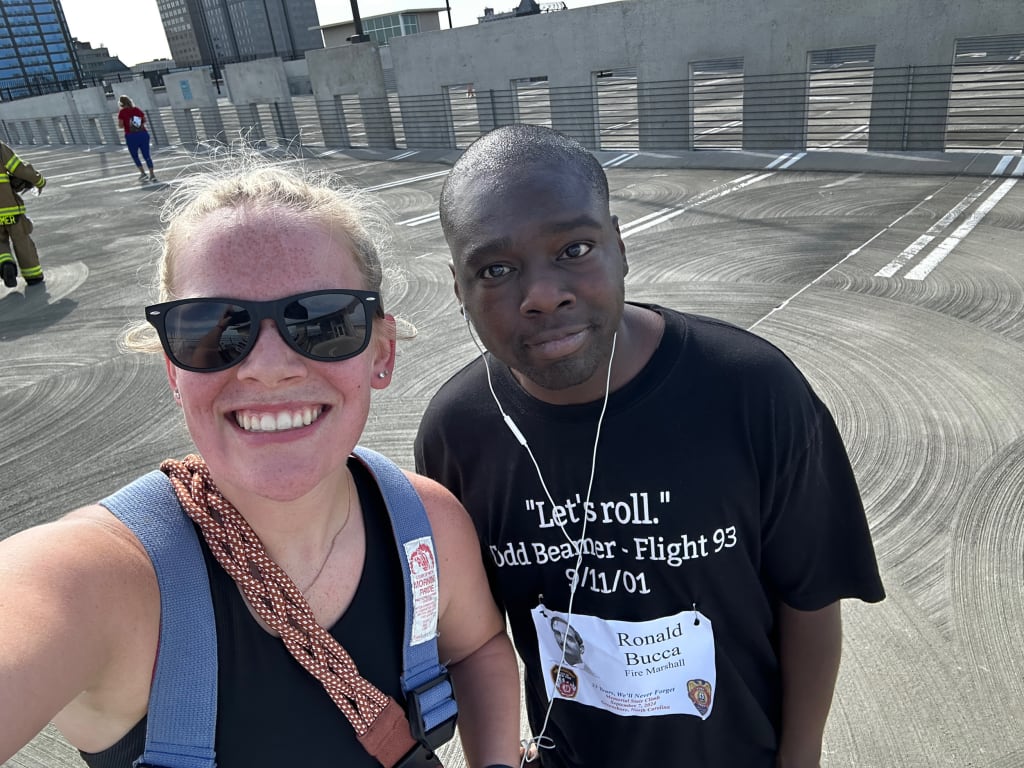
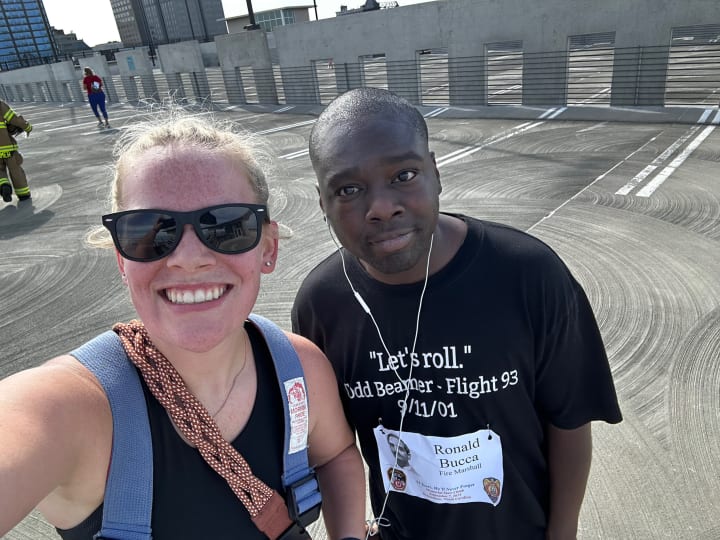
Sarah: Yes. For the past four years, I have participated in the Greensboro 9/11 Memorial Stair Climb. This year, I also participated in the UNC Chapel Hill ROTC stair climb at Kenan Stadium. During those climbs, I reflect on the firefighters and first responders who gave their lives and think about the families who lost loved ones. It is a very physical and emotional way to connect with the weight of that day and pay my respects.
Joe: What is the biggest lesson you’ve learned from September 11th, 2001?
Sarah: The biggest lesson is that tragedy can either divide people or bring them together and 9/11 showed the incredible power of unity. Americans came together across differences to support one another. It also taught me about resilience and the ability to keep moving forward after tragedy. For me, 9/11 is both a cautionary tale about how fragile peace can be and an example of how communities can rise from darkness with courage and compassion.
Dedicated to the memory of everyone who perished on September 11th 2001.
About the Creator
Joe Patterson
Hi I'm Joe Patterson. I am a writer at heart who is a big geek for film, music, and literature, which have all inspired me to be a writer. I rap, write stories both short and long, and I'm also aspiring to be an author and a filmmaker.
Keep reading
More stories from Joe Patterson and writers in Interview and other communities.
9/11 Remembered: Tara Pidgeon
Joe: So I know you’re a native New Yorker, where in New York do you come from? Tara: I’m from Rensselaer, NY which is right across the Hudson River from Albany. It’s about 3 hours driving from New York City or 90 minutes by train.
By Joe Patterson6 months ago in Interview
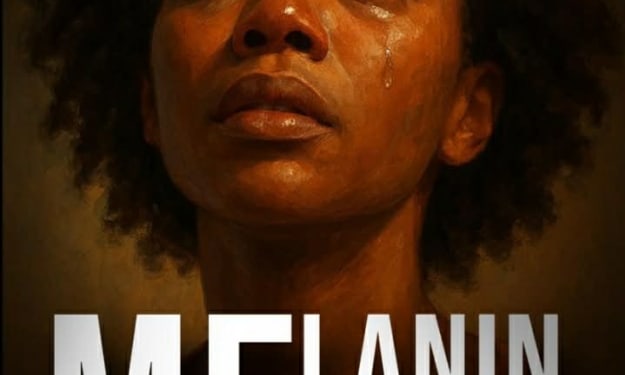
Part 2 Interview With Joe Patterson, Author Of Melanin Memoirs
This is my second interview with Joe Patterson. His 4th anniversary writing on Vocal will be in March 2026. He has one achievement on Vocal, The Other Foot. He has over 17,000 reads on Vocal since he started on Vocal in 2022. Joe Patterson is very creative poet and rapper. Joe is deep thinker and I feel it is reflected in his latest published book, Melanin Memoirs.
By Mariann Carroll16 days ago in Interview
The Quiet Discipline That Builds a Better You
Self-development is often portrayed as a dramatic transformation—a sudden breakthrough, a burst of motivation, or a life-changing decision made in a single moment. In reality, it rarely works that way. Real growth is quiet, often invisible, and built on small actions repeated over time.
By Lukáš Hrdlička3 days ago in Interview


Comments
There are no comments for this story
Be the first to respond and start the conversation.