
The Ultimate List of Weird American Town Names: Part 1
The first installment of some of the most laughable and awkward sites in the U.S.

Living the South, I’m no stranger to unusual and hard to pronounce town names. I have been to Burnt Corn, Slapout, and Smut Eye — and still giggle every time I see them. Here are some of the weirdest town names from around the United States!
The Gang’s All Here!
Ding Dong, Texas
Ding Dong was founded in the 1930s by settlers Bert and Zulis Bell. A handy man was painting the sign for the Bells’ country store, depicting two bells labeled Bert and Zulis. As a joke, a neighbor told the painter to include the words “Ding Dong” on the sign. Eventually, the name stuck.
Nimrod, Minnesota
Incorporated as a city in 1946, Nimrod’s population was a whopping 69 in 2010, making it one of the smallest incorporated towns in Minnesota. It was named after the Biblical Nimrod, who was the leader of the builders of the Tower of Babel.
Tightwad, Missouri
Formerly named Edgewood, the story is told that one day, the postmaster asked a farmer to set aside a watermelon that he would pick up after his route. On his return, the watermelon was gone. The farmer explained that he sold it to another man who offered 50 cents more for the fruit. “Tightwad!”, exclaimed to the postmaster. As postmasters could suggest name-place suggestions to the government, this particular one suggested Tightwad.
Boring, Oregon
This town became Boring, not because there wasn’t anything fun to do here, but after W.H. Boring, an older farmer who lived in the neighborhood.
All of the Traditional Names Were Taken
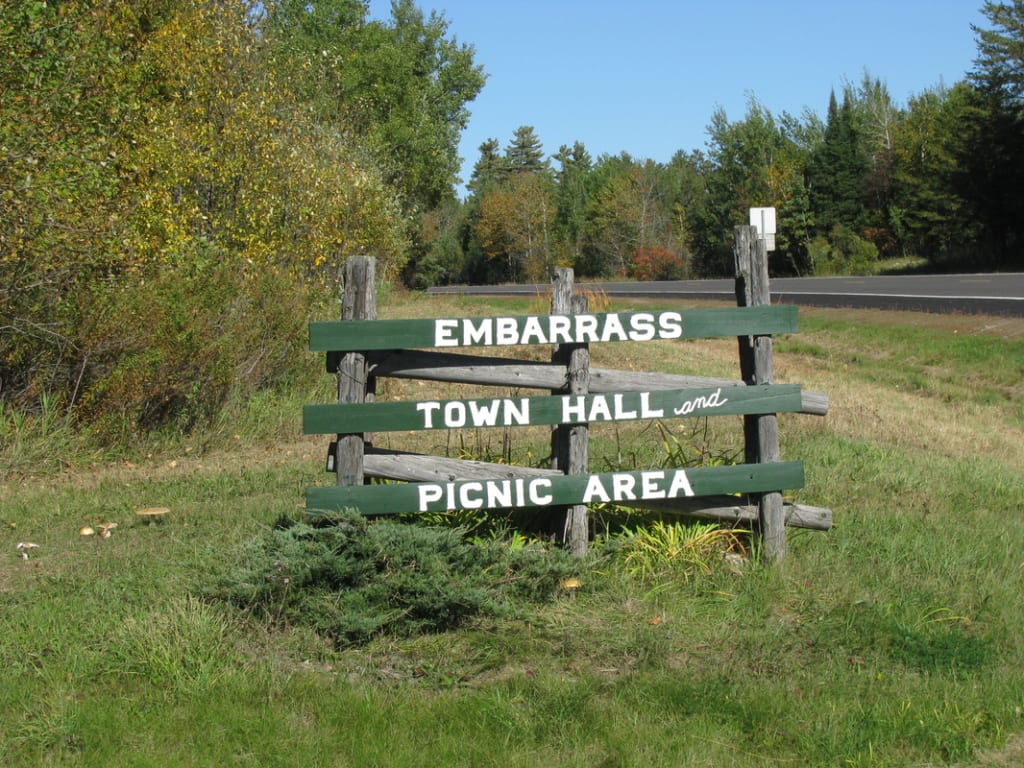
Embarrass, Minnesota
Known for its frigid temperatures, the unincorporated community’s name stems for the French word embarras, meaning “to hinder with obstacles or difficulties”. It was referred to by French fur traders who found the narrow, shallow river that flows through the valley difficult to navigate.
Accident, Maryland
While not confirmed, one popular story of the town’s name origin says that friends Brooke Beall and William Deakins, Jr, were conducting separate surveys of the land in the area. Deakins claimed land that had already been surveyed by Beall “by accident.” Residents today are referred to as “Accidentals.”
Sugar Tit, South Carolina
Really hard workers and farmers, the Scots-Irish were the first settlers in the area. They needed everyone, included the women to work the fields. The women who had infants would lie the child in the field on a blanket. They would dip sugar cane in water and place it in the blanket. Acting as the first pacifier, and referred to as a sugar tit, it would calm the baby while the mom worked.
Scratch Ankle, Alabama
While the rumors are numerous, the most widespread explanation for Scratch Ankle is that residents were frequently seen scratching their ankles due to the large population of mosquitos in the rural area.
Gas, Kansas
An abundance of natural gas was discovered in the area where Gas now sits. In 1898, a farmer sold 60 acres of his farm to companies and sub-divided the rest into lots. The area grew rapidly into “Gas City” .
Humptulips, Washington
Humptulips derives from a band of the Chehali tribe that lived in the area. In the local Native American language humptulips means “hard to pole” and referred to the difficulty that the tribe had poling their canoes along the river.
Slickpoo, Idaho
I know what you’re thinking, but Slickpoo, Idaho was actually named after Josiah Slickpoo. He assisted Idaho’s famous Father Cathaldo by providing a building site for his church. The allowed Cataldo to expand his Jesuit mission across southern Idaho.
Zizag, Oregon
In 1845, Joel Palmer crossed deep ravine near Mt. Hood National Forest. In his journal, he described the directions to the location as:
“the manner of descending is to turn directly to the right, go zigzag for about one hundred yards, then turn short round, and go zigzag until you come under the place where you started from; then to the right, and so on, until you reach the base.”
The band of travelers he guided began referring the ravine, the canyon, and the mountain as Zigzag, the name that was formerly given to the community in 1918.
Satan’s Kingdom, Vermont
This community was named by a settler who expected fertile fields, but was met with only rocky soil, unsuitable for farming.
Woonsocket, Rhode Island
In 1661, English theologian Roger Williams bought the area that is now Woonsocket from the Cowesett and Nipmuc Native American tribes. Originally named Niswosakit, it’s speculated that Woonsocket comes from the Nipmuc name Woonksechocksett, meaning “fox country” or Wannashowatuckqut, meaning “at the fork of the river.”
Santa Claus, Indiana
Originally named Santa Fe, when the town worked to establish a post office in 1954, their application was denied. This is because there was already a Santa Fe, Indiana with an established post office. A town meeting was held and the name Santa Claus was suggested. It won and now the town is famous for its year -round holiday spirit.
What Cheer, Iowa
The origin of What Cheer has been disputed over the years. One theory suggested that Civil War Veteran Joseph Andrews chose the name as a nod to his native town of Providence, Rhode Island. It is said that when Roger Williams arrived at the site that would become Providence in 1636, he was greeted by the Narragansett Native Americans with “What Cheer, Netop (friend)”.
Why, Arizona
Rather than asking a question, the name Why actually comes from the town’s location. Here, two major state highways, State Routes 85 and 86, originally met at a Y-intersection. During the time of its naming, all city and town names had to be at least three letters, so the town founders went with Why instead of just “Y”.
Why Not, Mississippi
This unincorporated community was originally called Whitesville and the name was changed to Why Not in 1852. I couldn’t find out why they changed the name. I guess they thought why not?
Wild!
Bugtussle, Kentucky
Believe it or not, an actual bug was the inspiration behind this eloquent town name. Wheat thrashers would travel through this area and often slept in the haylofts of barns during their shifts. Apparently, the native doodlebugs were so large that they would “tussle” with the workers in the hay.
Toad Suck, Arkansas
The origin of this lively community name is disputed. Some believe that rivermen would congregate at the local tavern and would “suck on the bottle” until they swelled up like toads.
Possumneck, Mississippi
Possumneck was originally known as just “The Neck” due to the shape of it’s land. W. M. Herod lived in this area and during a court case involving several men from The Neck, someone referred to him as “King Herod”. The judge asked what he was the king of. The man replied, Oh, judge, you know The Neck where we catch all dem possums.” The Judge laughed and said, “Oh yes, the King of Possumneck.” Thus, in 1847, the name stuck.
Rough and Ready, California
The first established settlement of this area was in 1849 during the California Gold Rush by a mining company from Wisconsin, known as the Rough and Ready Company. The company leader named the company after General (and later president) Zachary Taylor, who was nicknamed “Old Rough and Ready”.
Knockemstiff, Ohio
This community has various tales that explain the name’s origin. Most describe some type of brawl in the community, but one of the most humorous is that of a woman who sought her preacher’s advice during a Sunday morning worship service. She explained to him that her husband was cheating on her and asked what she should do. His response? “Knockemstiff!”
Slick Lizard, Alabama
This community received its name due to a mine that was nearby in the 1920s. Apparently, miners had to crawl on their bellies through clay portals about two feet high and emerged “slick as a lizard.”
***Story previously published on Medium.com by the author***
About the Creator
Kassondra O'Hara
Working mom who uses her curiosity to fuel the curiosities of others ~ Writes mostly history and true crime
Keep reading
More stories from Kassondra O'Hara and writers in Humor and other communities.


Comments
There are no comments for this story
Be the first to respond and start the conversation.