
The Great Grocery Escapade: When Shopping Becomes an Absurdist Adventure
A Routine Shopping Trip Spirals into a Hilariously Absurd Quest

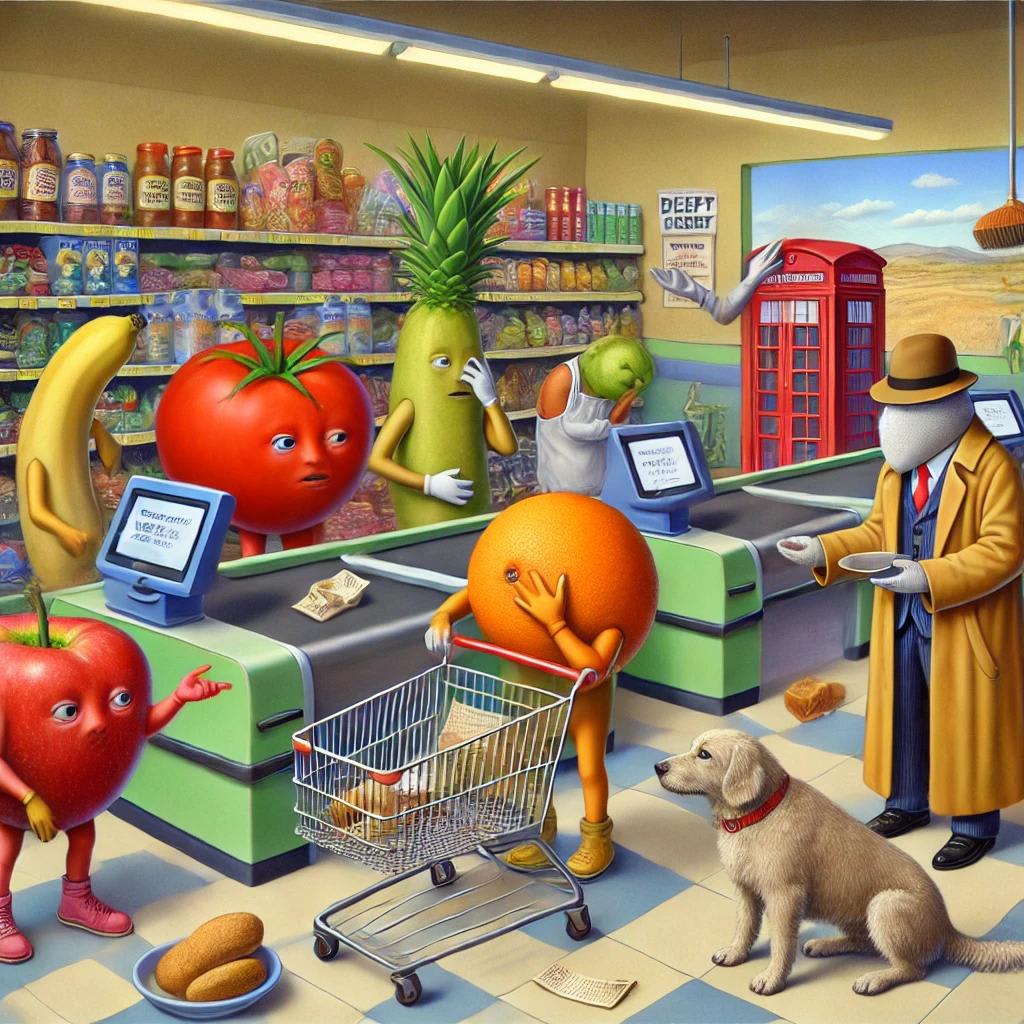
Imagine stepping into your local grocery store, expecting nothing more than a routine shopping trip, only to find yourself caught in an epic saga where the tomatoes convene for secret council meetings to plot world domination, the self-checkout machines develop existential crises and start questioning the meaning of their existence, and the janitor, of all people, moonlights as a time-traveling philosopher—offering unsolicited lectures on the nature of time while subtly guiding your choices. Sounds ridiculous? Welcome to the world of the absurd, where even the most mundane moments become mind-bending odysseys, and reality is a mercurial, fleeting thing that laughs in the face of expectation.
Absurdist storytelling thrives on twisting the ordinary into the outlandishly unexpected, revealing the fragile logic that upholds our daily lives. Through a brilliant collision of humor and the bizarre, absurdism makes us confront the very structure of our understanding, inviting us to question not only our assumptions about the world but also the world itself. In this space, anything—yes, even the grocery store—can become the epicenter of cosmic chaos.
The Roots of Absurdist Comedy
Absurdist fiction has long been a vital force in literature, theater, and film, stretching from the existential reflections of Albert Camus to the whimsical nonsense of Lewis Carroll. Writers have used absurdity to expose the illogical frameworks of human existence, offering a space where reason is bent and, at times, shattered.
In the comedic realm, absurdity found its wings with Monty Python, whose skits ripped apart societal norms with gleeful abandon. Douglas Adams elevated absurdism to intergalactic proportions, making even the most profound questions about existence seem trivial as waiting for a bus. The genre flourishes by magnifying the bizarre within the familiar, creating a reality that refuses to be predicted or understood, no matter how hard we try.
Take the act of grocery shopping: in the absurdist universe, logic becomes irrelevant. Oranges whisper cryptic secrets about parallel dimensions, cashiers communicate in elaborate haikus that reveal startling truths about your future, and the dairy aisle morphs into a portal to the Renaissance. What was once mundane becomes a stage for cosmic drama. With each product aisle a new frontier of bizarre possibility, absurdism reveals the humor and profound mystery lurking beneath the surface of daily life.
The Mechanics of an Absurdist Tale
A successful absurdist story is a delicate balancing act: it must be both unpredictable and structured, ensuring that the chaos never drowns out the engagement. The humor emerges not just from random events but from a careful manipulation of expectations. Absurdist comedy takes logical sequences and flips them into spirals of delightful confusion, where reason and absurdity dance in a chaotic waltz. Key elements driving these tales include:
1- Escalation of the Ridiculous – A misplaced shopping list doesn’t just lead to a forgotten item; it causes a Kafkaesque trial by a covert tribunal of sentient cucumbers, with each cucumber dramatically asserting its claim to power over the other. The entire store becomes a courtroom, the aisles now battlegrounds for vegetable supremacy.
2- Characters with Bizarre Motivations – The store manager, once an ordinary figure, now insists on delivering Shakespearean soliloquies as he restocks the shelves. Meanwhile, a detective dog (wearing a tiny trench coat) investigates the mysterious disappearances of loaves of bread, convinced there is a deep conspiracy involving the frozen foods section.
3- Dialogue that Defies Logic – Conversations loop in infinite regress, with each question giving birth to five new, equally absurd questions. “Why are we here?” becomes a metaphorical minefield, as the cashier insists that the meaning of life lies in the fourth can of tuna. Every inquiry only deepens the confusion.
4- The Inversion of Mundane Reality – In an absurdist world, it’s not the shopper who chooses the items—it’s the items that decide which shopper is worthy of their attention. The apples hold heated debates over who deserves to take them home, while the eggs plot rebellion, egged on by a charismatic carton leader.
Through these elements, absurdism doesn’t just entertain; it invites deeper contemplation on existentialism, social structures, and the very fabric of reality itself.
How Absurdity Enhances Storytelling
Absurdist humor transcends randomness—it’s a mirror held up to the irrationality of our own lives. It places the familiar in a setting where it no longer makes sense, forcing audiences to reassess their daily routines. Through satire, wordplay, and sheer unpredictability, absurdism stretches the boundaries of imagination, forcing us to confront the very structures that dictate how we see the world.
Consider again the grocery store: a microcosm of society where rules, transactions, and expectations dictate our behavior. In the realm of absurdity, these rules become not just flexible but laughably arbitrary. Why do we reach for the ripest fruit? What if the fruit, in turn, is deliberating whether it should let us have it at all? These questions don’t just become sources of humor; they become points of entry into a deeper commentary on our rituals, our choices, and the quiet chaos of our daily lives.
Conclusion: Embracing the Absurd
In a world governed by arbitrary rules and inscrutable systems, absurdist fiction offers both escape and critique. It teaches us that even in the most routine moments, there’s room for the unexpected, the strange, and the downright hilarious.
So, the next time you find yourself standing in the produce aisle, staring at a basket of apples, take a moment to listen. Are they whispering stock market predictions to each other? Or plotting an overthrow of the potato kingdom? In the world of the absurd, reality is a playground, and sometimes, the best thing to do is to let go of logic and enjoy the chaos.
About the Creator
Alain SUPPINI
I’m Alain — a French critical care anesthesiologist who writes to keep memory alive. Between past and present, medicine and words, I search for what endures.
Reader insights
Outstanding
Excellent work. Looking forward to reading more!
Top insight
Expert insights and opinions
Arguments were carefully researched and presented
Keep reading
More stories from Alain SUPPINI and writers in Humor and other communities.
Mastering French Without Losing Your Sanity: A Realistic Guide for Beginners
Learning French can feel like solving a Rubik’s Cube blindfolded. The tricky pronunciation, the never-ending grammar rules, and the surprising exceptions make it seem impossible. But don’t worry—equipping yourself with key expressions and effective strategies can turn frustration into fluency. Let’s simplify French and make learning enjoyable.
By Alain SUPPINIExclusive • 11 months ago
Kim.K.exe Goes Platinum: The AI Clone Who Dropped Reality for the Virtual Spotlight
Kim Kardashian just pulled off one of the most dazzling digital upgrades we’ve seen—not with a simple filter, but by spawning a full-blown AI replica. Now shining in platinum-blonde perfection, Kim.K.exe is smoothly integrated into the Metaverse, redefining what it means to be a celebrity in 2025.
By Angel Solora5 days ago in Humor
Ludacris and Nelly draw backlash over bookings at MAGA-coded music festival
Ludacris and Nelly headlining a mostly right-wing event is good for them. It’s also great for the genre of hip hop. The two rap veterans have showcased their talents on other stages. Why can’t they perform for mostly MAGA folks and grab that bag?
By Skyler Saunders4 days ago in Beat




Comments (1)
Very educational. I would have liked to have read this before I did my entry! I loved Monty Python back in the day. I think about everyone is familiar with Lewis Carroll, but I can't say I ever read his work. I just know all the Alice in Wonderland movies. I'm Bill. I have subscribed to you. I'd be curious to hear what you think of my own absurdist entry. ⚡⚡