
From Open Mic to Comedy Gold: My Secret to Getting Better
The art of turning bombs into belly laughs

The bar was not ideal for comedy: two patrons with their backs facing the mic, one bartender BRRRRRing the blender, and nearly twenty other comics all thinking, “I’m better than you.”
It has been about a year since I attended open mic (for reasons I’ll explain in another story), and instinct kicked in.
“Please welcome the very funny comic, Ryan D!” I heard a few claps as my hand gripped the microphone, pulling it from the stand that I moved back behind me. Front and center is where I like to be—facing the lions like any good tamer.
PRACTICING AGAINST THE WALL
Hitting open mics reminds me of my younger years as an up-and-coming tennis player. I would spend my high school summers hitting the ball against a wall in a large parking lot. Bricks and parking lots have this in common: they are uneven.
If a ball hits the corner of the brick, it’ll take a weird bounce. And when the ball returns and hits a crack in the parking lot—I’ll be diving.
The unexpected nuances of ricocheting and warbling taught me to quickly adjust my form. I would have returned a wonky shot if I had not learned from the sudden shift of pace and predictability.
Strangers would sometimes drive by and challenge me to a tennis match. I’d beat them and return to the wall. Hour after hour of hitting and dealing with unpredictable circumstances made me a great tennis player.
Today, I’m still hitting against an unpredictable wall. That’s why I find humor in listening to comedians’ stories of battling in the trenches of an open mic. Having a bartender blend a drink is the least of my obstacles; the story of the bachelorette party was one of the wildest bounces I’ve had to return (a group of drunk screaming women came in hooting and needing the bathroom. They had been peddling on a tour of the city.)
Each crazy bounce is a new learning experience.
THE ART OF THE PAUSE
In a documentary, Steve Martin made an interesting point. He commented on when he worked with Robin Williams on Broadway (can you imagine seeing that show?). Steve said he taught Robin to pause.
The pause is where everything happens.
In meditation, the space between breaths is where you live. In comedy, the area between words is where people laugh.
You talk—the laughing stops.
Take a moment of silence—the laughing starts.
Since I had been away so long, I blitzed through all my jokes. These are jokes that I had worked on. Wait. Real quick. This is my process: every day, I want to write a minimum of 10 jokes. By the end of the week, I should have over 70 jokes. I’ll pick my favorites and then organize them into logical order. I like to memorize them and then practice them aloud before hitting the ‘audience.’
If I have a show coming up, I’ll workshop my biggest hits from the open mics. But with nearly 4,000 jokes to work from in a year, I’ll have plenty of toys to choose from to play in the sandbox.
But, yeah, for this mic, I had about 25 jokes. Practicing them to myself took about six minutes, so I cut five jokes out and clocked in at five minutes. Allowing for time to adlib and for laughter, I cut another two jokes. 17 jokes in about 4 minutes, 20 seconds.
I made two mistakes at the mic. I ripped through 17 jokes in about 3 minutes and 30 seconds. Aside from going too fast, my other mistake was neglecting to pause.
TWO THINGS NOT TO BE AFRAID OF
Fear is the opposite of comedy. If there’s blood in the water, the sharks will bite.
To overcome the anxiety of public speaking, realize that the difference between anticipation and anxiety is breath. So, breathe. When you feel anxious—when you feel like you’re going to crap your pants—tell yourself that you are excited. Reframe it.
But here’s the real things not to be afraid of in comedy:
- Don’t be scared to HAVE FUN.
- Don’t be scared to STAY QUIET.
The first is self-explanatory, but many comics need to remember that. Either comics have been in the business too long and have allowed themselves to become jaded, or those comics are loaded with self-criticism. I’ve eaten plenty of servings of both.
The audience wants to have fun. You want to have fun. So have fun.
Like the kids on the playground, though, you can’t have fun if one kid is hogging the toy. It’s fun to share in the experience of play. Pausing allows you to share your fun with the other kids—the audience.
Pause before the punchline. Pause after the punchline.
Don’t be afraid to hold the pause longer than you think you should. If it helps, say in your mind, “FREEZE. I’m holding this pause,” and then continue. It helps if you have a smile on your face.
WHAT I’D LIKE TO DO NEXT TIME
Before the next mic, I’d like to practice before my most prominent critic—myself.
It’s not like I actively tell myself I’m a terrible comic. If anything, the opposite is true. I often find myself thinking what I write on paper is hilarious.
The critic in me does something different. When the crowd at mic night doesn’t give me a standing ovation and throw roses at my feet—that’s when he comes out.
To appease that meanie, I’d like to give him a pre-show by performing in front of a mirror or videoing myself and---EKKKE---watch it. Shudder.
The other thing I want to do is to say to myself, “FREEZE. I’m holding this pause.” I want to conscientiously give myself permission to play.
About the Creator
Keep reading
More stories from Ryan DeJonghe and writers in Humor and other communities.
The Unfortunate Tale of a Now Extinct Animal
"Aww, come on!" Noah moaned as he let go of the rope to quickly snatch together his robe that just went RIPPP. His struggle was evident in his frustration. Loading animals two-by-two into an ark had been challenging. The last pair had proven the most difficult—the Farknuckle. A rare breed that's now extinct. You'll soon see why.
By Ryan DeJonghe2 years ago in Humor
Tatt~Master
— Assembly Line Tatt Machine ~ Impressions to Impress — As I begin to understand more about the Tattoo Phenomenon. I've written silly, yet verbatim, dating site anecdotes in 'Frazzled.' So let me ask you: Would you be More attracted to someone slathered with tattoos, or Less?
By Jay Kantor13 days ago in Humor
The Slow Conquest
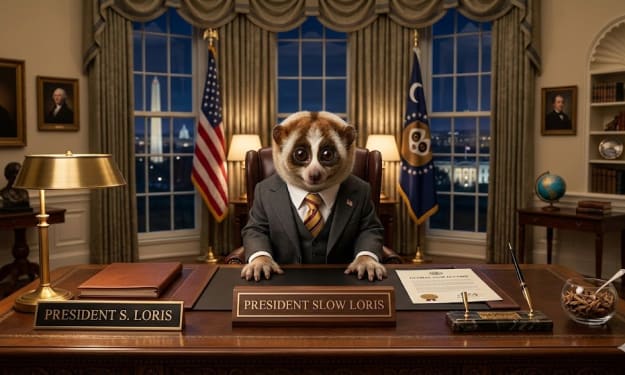
While we humans are busy arguing over climate accords and which billionaire gets to colonize Mars first, a silent, wide-eyed shadow is creeping across the canopy of Southeast Asia. We have long overlooked the slow loris, dismissing it as a "cute" viral video sensation or a lethargic fuzzball. This is our first—and perhaps final—mistake.
By Richard Weber5 days ago in Humor



Comments
There are no comments for this story
Be the first to respond and start the conversation.